Background:
Sialylated glycoproteins (proteins containing the glycan sialic acid) are reduced during HIV infection (viremic and antiretroviral-therapy (ART)-suppressed), and levels of sialidase (enzyme cleaving sialic acid) are elevated. Sialylated glycoproteins initiate anti-inflammatory immune responses by engaging the inhibitory sialic-acid binding proteins (Siglecs) expressed on several immune cells. We tested whether inhibiting sialidase, via sialidase inhibitors commonly used clinically to treat influenza (oseltamivir and DANA), would attenuate HIV-mediated immune activation/inflammation in vivo.
Methods:
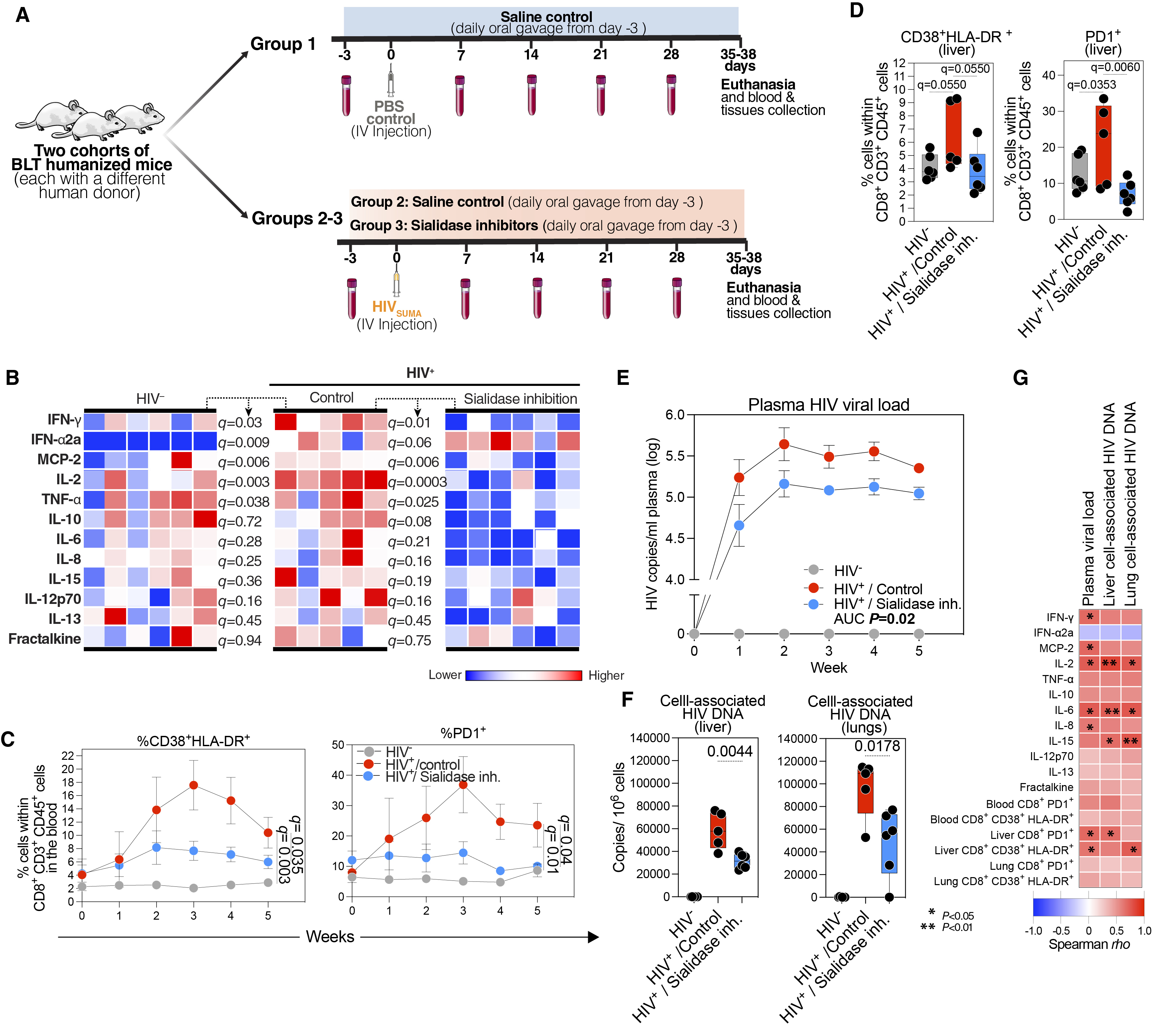
Two independent cohorts of bone-marrow-liver-thymus (BLT) humanized mice were infected or not with HIVSUMA (a transmitter-founder virus) at 3,500 TCID50. Infected mice were treated (via daily oral gavage) with a combination of oseltamivir and DANA (25mg/kg; a clinically comparable dosage) or saline control (Fig. 1A). Plasma markers of inflammation were measured by multiplex cytokine arrays five weeks post-infection. T cell activation (co-expression of CD38 and HLA-DR) and exhaustion (PD1) were measured by flow cytometry in the blood (weekly) and in the liver, lungs, and spleen (at endpoint). Plasma viral load (weekly) and levels of cell-associated HIV DNA in the liver, lungs, and spleen (at endpoint) were measured by qPCR.
Results:
Sialidase inhibition significantly attenuated HIV-mediated induction of several markers of inflammation and immune activation, including markers of the pro-inflammatory type-II interferon responses (q< 0.05; Fig. 1B). In contrast, sialidase inhibition induced levels of the antiviral type-I interferon-α (q=0.06). Consistently, sialidase inhibition significantly attenuated HIV-mediated induction of CD8+ T cell activation and exhaustion in the blood (q< 0.05; Fig. 1C) and tissues (q< 0.05; Fig. 1D). This reduction in HIV-mediated inflammation and immune activation was accompanied with a decrease in plasma viral load (P=0.02; Fig. 1E) and levels of cell-associated HIV DNA in the liver and lungs (P< 0.02; Fig. 1F). The degree of immune activation and inflammation significantly correlated with higher levels of HIV viral load in plasma and tissues (P< 0.05; Fig. 1G).
Conclusions:
Normalizing glycosylation patterns (in particular sialylation) represents a novel approach to prevent the development of inflammation during HIV infection. Future studies are warranted to examine the potential impact of sialidase inhibition on HIV-mediated inflammation during suppressive ART.
Figure 1: Sialidase inhibitors attenuate immune activation/inflammation and reduce levels of tissue-associated HIV DNA in humanized mice.