Background:
Integrase strand-transfer inhibitors (INSTIs) are associated with weight gain among persons with HIV (PWH), which may be more severe in women. We assessed differences in weight change by sex up to 6 years following switch to INSTIs.
Methods:
We used data collected between 2007-2020 in virally-suppressed (<200 c/mL) INSTI-naïve PWH on antiretroviral therapy (ART) for ≥2 years and persons without HIV (HIV-) enrolled in the MACS/WIHS Combined Cohort Study. We compared PWH who switched/added an INSTI to those who remained on non-INSTI ART and to HIV- controls. Follow-up time was years since switch visit or comparable visit in controls. Weight change was the difference between post- and pre-switch visits. Linear regression mixed effect models assessed the effects of sex (assigned at birth), group, and time on absolute and percent (%) weight change, adjusted for age, race/ethnicity, socioeconomic status, and diabetes.
Results:
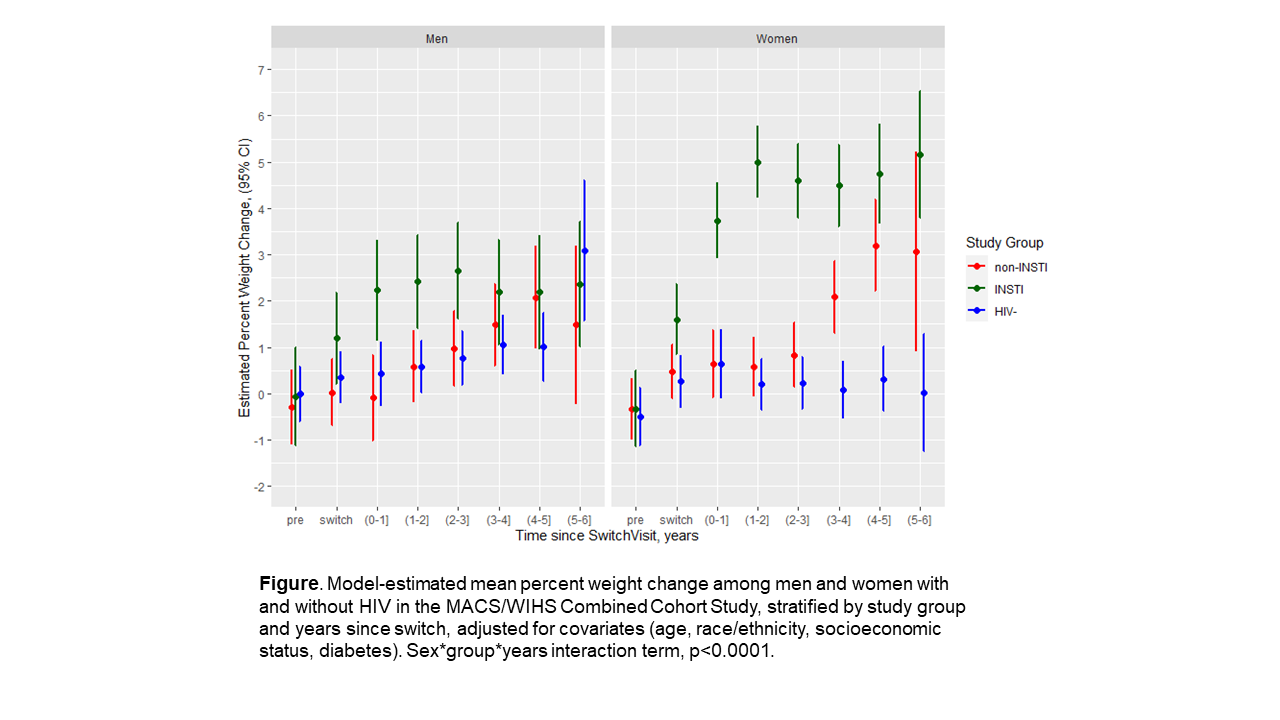
3466 participants contributed a mean 3.2 (±1.5) years of data, including 1940 women (411 INSTI, 711 Non-INSTI, 818 HIV-) and 1526 men (223 INSTI, 412 Non-INSTI, 891 HIV-). Compared to men, women were younger (47.2 vs 54.5 years), more likely to be non-Hispanic Black (65 vs 23%), had higher pre-switch BMI (31.5 vs 26.9 kg/m2), and higher prevalence of diabetes (19 vs 13%), respectively. Absolute weight gain in women versus men was +3.2 (±9.8) vs +1.6 (±6.1) kg in INSTI, +0.8 (±9.4) vs +1.0 (±6.6) kg in non-INSTI, and +0.2 (±11.2) vs +0.2 (±7.2) kg in HIV- groups. In adjusted models, sex and group modified % weight change by time (sex*group*years interaction, p<0.0001). Men switching to INSTIs experienced greater % weight gain compared to non-INSTI and HIV- controls up to 1-2 years post-switch: +2.42% (95% CI 1.41-3.42) vs +0.58% (-0.17-1.34) and +0.58% (0.02-1.14), respectively, with no differences between groups beyond 3 years. In contrast, women on INSTIs experienced greater % weight gain for up to 3-4 years post-switch compared to women on non-INSTIs [+4.49% (95% CI 3.60-5.37) vs +2.08% (1.30-2.87)] and up to 5-6 years post-switch versus HIV- women [+5.16% (3.80-6.52) vs +0.02% (-1.24-1.28)], Figure.
Conclusions:
Short and long-term body weight gain in PWH switching to INSTIs differed by sex, with women experiencing a greater amount and longer duration of weight gain relative to controls. Further research is needed to understand implications of weight gain on cardiometabolic disease and support sex-specific preventative and therapeutic intervention strategies.