Background:
As young people living with perinatally-acquired HIV (YPHIV) become sexually active, they become susceptible to sexually transmitted infections (STI). Because of their HIV status, YPHIV may more frequently receive advice to use condoms consistently to protect their partner(s) from HIV, hence may be at lower risk of STIs than those HIV uninfected. The objective of this study was to compare STI incidence rates between YPHIV and a comparator group of young adults living with perinatal HIV exposure but uninfected (YPHEU).
Methods:
YPHIV and YPHEU participating in the U.S.-based Pediatric HIV/AIDS Cohort Study (PHACS) network had test results for chlamydia (CT), gonorrhea (GC), and trichomonas (TC) abstracted annually from medical charts. Additionally, participants were tested annually by Hologic Aptimatm assay for CT, GC, TC. Women were also tested for human papillomavirus (HPV) via Aptimatm assay. These research samples were sent for testing in batches to a centralized laboratory. Incidence rates of first positive test in AMP Up were calculated for CT, GC, and TC over person-time of follow-up s of January 1, 2020. HPV incidence rates were calculated among those with an initial negative HPV test result. Poisson regression with robust standard errors was used to calculate incidence rate ratios (IRR) and 95% confidence intervals (95% CI) comparing rates by HIV status, age at first STI test, sex at birth, race, and ethnicity.
Results:
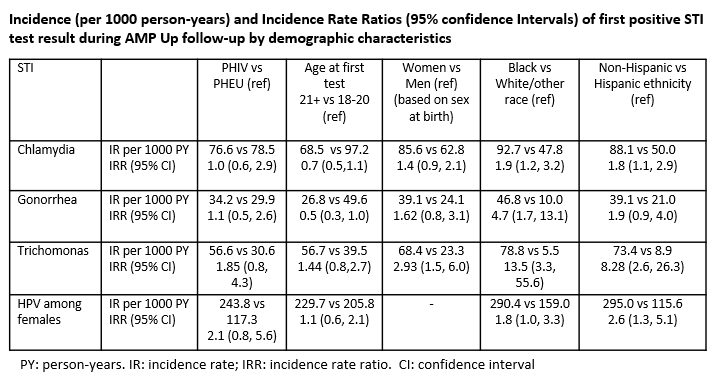
Among 579 AMP Up participants (83% PHIV; 62% female) YPHIV were older than YPHEU at first STI test (mean age 22.9 vs 19.1 years). Incidence rates of CT, GC, and TV were similar by HIV status and age. However, incidence of HPV was higher among women with PHIV compared to those PHEU. Rates of most STIs were higher for women than men, for those of Black (vs White/other) race, and non-Hispanic than Hispanic participants (Table).
Conclusions:
Rates of CT, GC and TV were similar between YPHIV and YPHEU, underscoring the need for better STI prevention strategies among YPHIV, including promotion of condom use. The higher rate of HPV in women with PHIV than PHEU is consistent with the well-documented vulnerability of those with HIV for HPV and underscores the need for HPV-associated cancer surveillance. Confirmation of HPV vaccine status will be a critical next step to understanding HPV vaccine effectiveness in this group.
Incidence (per 1000 person-years) and Incidence Rate Ratios (95% confidence Intervals) of first positive STI test result during AMP Up follow-up by demographic characteristics