Background:
Lacking access to COVID-19-related care could prolong symptoms and accentuate adverse health outcomes among vulnerable populations, including sexual minority populations. We investigated the relationships between sexual orientation and COVID-19 diagnosis, symptoms, and vaccination status.
Methods:
Data for this analysis were from the 2022 National Health Interview Survey. Sexual orientation was self-reported, categorized as sexual minority (self-identified as gay, lesbian, bisexual, or other) and heterosexual. Weighted percentages of self-reported COVID-19 diagnosis, symptoms, and vaccination status were tabulated by sexual orientation, with p-values computed using Rao-Scott Chi-squared tests. Separate weighted logistic regression models were fit to compare these outcomes by sexual orientation and to calculate adjusted odds ratios (aOR) and 95% confidence intervals (95% CI), controlling for age, race/ethnicity, education level, health insurance coverage, and general health status. All analyses accounted for complex sample design.
Results:
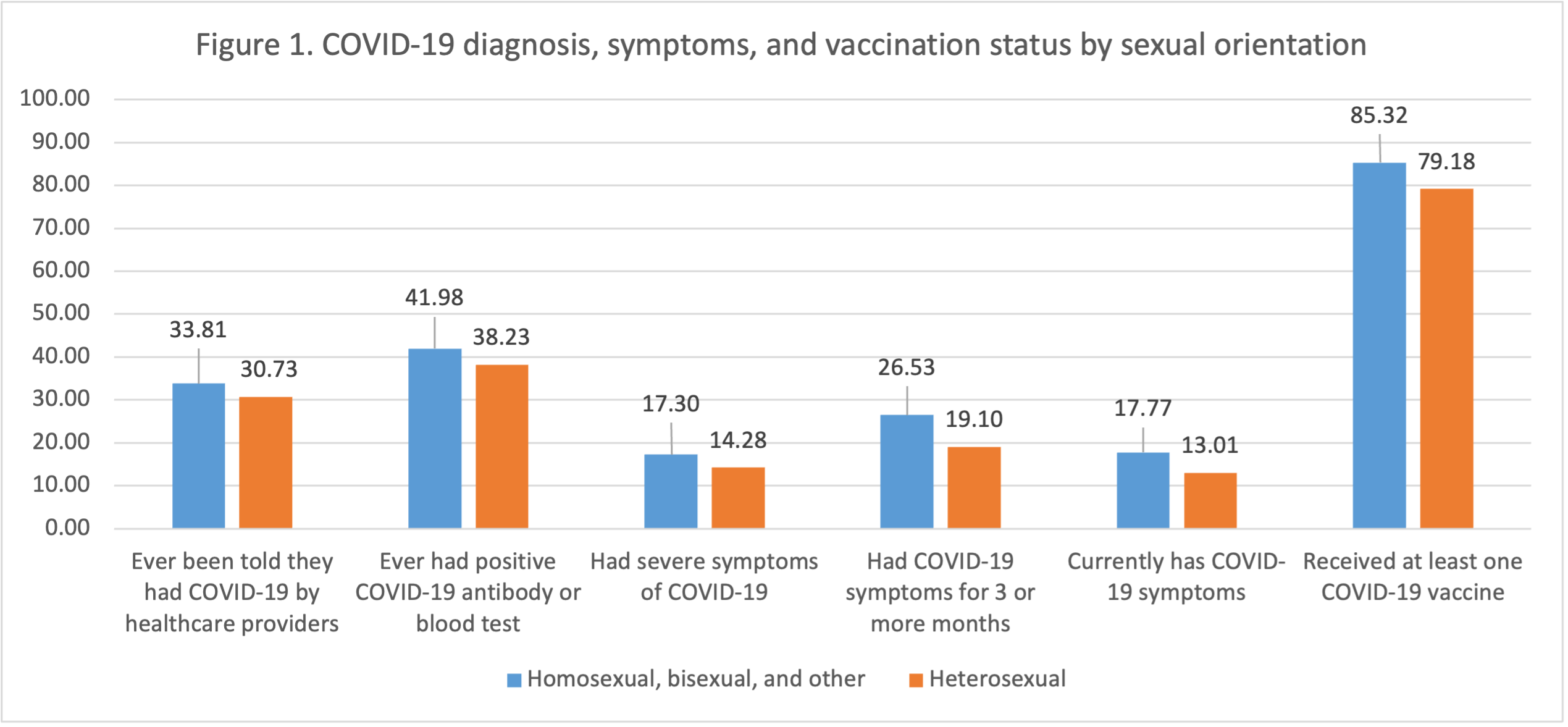
The unweighted sample was 26,057 (weighted n=239,527,538); of whom 94.5% identified as heterosexual and 5.5% as sexual minority. Compared with heterosexual adults, higher proportions of sexual minority adults reported ever been told they had COVID-19 by healthcare providers (33.8% vs. 30.7%, p=0.05), tested positive for COVID-19 by an antibody or blood test (42.0% vs. 38.2%, p=0.02), experienced severe symptoms (17.3%vs. 14.3%, p=0.10), had symptoms for ≥3 months (26.5% vs. 19.2%, p<0.001), received at least one COVID vaccine (85.3% vs. 79.2%, p<0.001), and are currently experiencing symptoms (17.8% vs. 13.0%, p<0.001). After covariate adjustment, sexual minority adults had greater odds of having had severe COVID-19 symptoms (aOR: 1.36, 95% CI: 1.01-1.83), symptoms for ≥3 months (aOR: 1.56, 95% CI: 1.21-2.02), and currently experiencing symptoms (aOR: 1.63, 95% CI: 1.23-2.15) than heterosexual adults. Sexual minority adults also had greater odds of having received the vaccine (aOR: 2.19, 95%CI: 1.77-2.71).
Conclusions:
In this national U.S. sample, sexual minority populations experienced more severe and prolonged COVID-19 symptoms than their heterosexual counterparts, despite being more likely to be vaccinated. Future research is needed to explore factors contributed to severe COVID-19 symptoms or long COVID in sexual minority populations.