Background:
Sex differences in immunological responses to COVID-19 infection and mechanisms that may contribute towards post-acute sequelae of SARS-Co-V2 (PASC) have been reported. However, evidence on the effects of COVID infection on vascular dysfunction and PASC are limited.
Methods:
FDA approved EndoPAT device was used to measure endothelial function [Reactive Hyperemia Index (RHI)] and arterial stiffness [Augmentation Index standardized at 75 beats/min (AI@75; higher AI = worse arterial elasticity)] in an adult cohort (age ≥18 years) with a history of COVID-19 infection (COVID+) or confirmed SARS-CoV2 antibody negative (COVID-). Generalized linear regression was used to compute estimates of RHI and AI@75. Adjusted models included age, sex, race, blood pressure, lipids, body mass index (BMI), smoking status, and pre-existing comorbidities. Two-way interactions were used to determine if the effects of COVID or PASC status on endothelial function depends on age, sex, race, smoking status, or prevalent comorbidities.
Results:
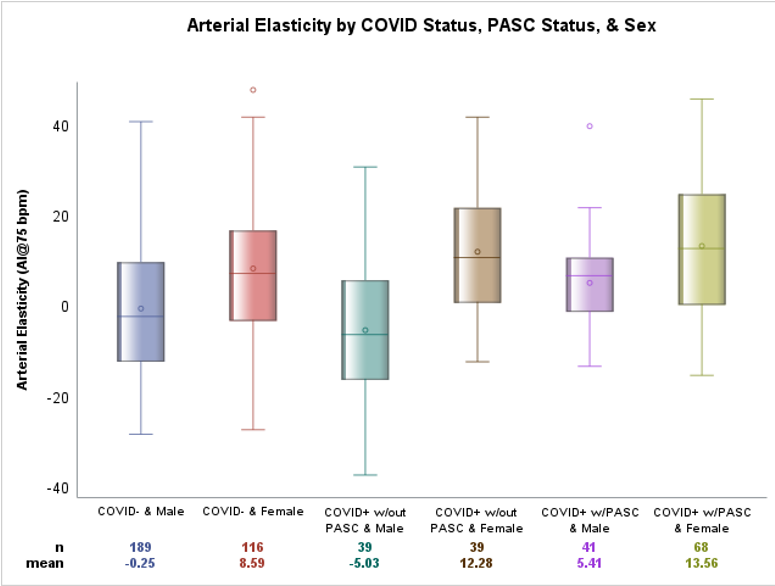
61.99% (n=305) of study participants were COVID- and 187 (38.01%) were COVID+. Among COVID+, 57.22% (n=107) were female, 31.72% (n=59) were non-white race, and the average age was 46.64±13.79 years. COVID- participants had a smaller proportion (38.03%) of female sex (p< .0001), lower BMI [COVID+ (30.79±8.95 kg/m2) vs. COVID- (27.76±5.89 kg/m2); p< .0001], and higher proportion of smokers [COVID+ (17.78%) vs. COVID- (58.22%); p< .0001]. The average follow-up was 349.68±276.76 days and 109 (22.15%) COVID+ experienced PASC. 42.48% (n=80) of COVID+ and 41.64% (n=127) of COVID- had RHI≤ 1.67 (p=0.8). The average AI@75 among COVID+ without PASC was 3.63±16.24, with PASC was 10.5±14.72, and 3.11±15.97 among COVID- (p=0.0001). Male sex had the lowest AI@75 (-0.08±14.9) compared to female sex (10.75±15.3; < .0001). In adjusted models, PASC, female sex had 8.14±2.95 higher AI@75 compared to PASC, male sex (p=0.006), 18.58±2.99 higher AI@75 compared to COVID+ without PASC, male sex (p< .0001), 13.81±2.11 higher AI@75 compared to COVID-, male sex (p< .0001), and 4.97±2.28 higher AI@75 compared to COVID-, female sex (p=0.03). Sex was not associated with RHI or modified the effect of COVID or PASC status on endothelial function
Conclusions:
The effect of COVID and PASC status on arterial stiffness depends on sex. Female sex is associated with increased arterial stiffness (worse arterial elasticity) in the post-acute phase of COVID-19.