Background:
Perinatally-acquired HIV infection is associated with increased risk of postnatal growth deficits which are only partially corrected with antiretroviral therapy (ART). Studies of sex differences in immune recovery and virologic response to ART among infants with perinatally acquired HIV (IHIV) have reported conflicting results. Here we investigate the role of sex in modifying the growth trajectories of IHIV who started ART at an early age.
Methods:
As part of an early ART trial conducted in Johannesburg, South Africa (2015-2018), 116 IVHIV diagnosed within 48 hours of birth initiated ART as early as possible, consisting of nevirapine (switched to lopinavir-ritonavir >= 42 weeks postmenstrual age) lamivudine, and zidovudine (switched to abacavir at 3 months). Eighty infants born to mothers living with HIV but found to be uninfected (IHEU) were enrolled as controls, receiving daily nevirapine for 6 weeks, and twice-daily zidovudine added if high risk. Both groups were followed prospectively through 48 weeks and anthropometric parameters collected. Age and sex adjusted Z-scores for weight (WAZ) and length (LAZ) were compared between IHIV and IHEU, as well as stratified by sex. Generalized linear models were used to describe growth trajectories and main and interactive effects.
Results:
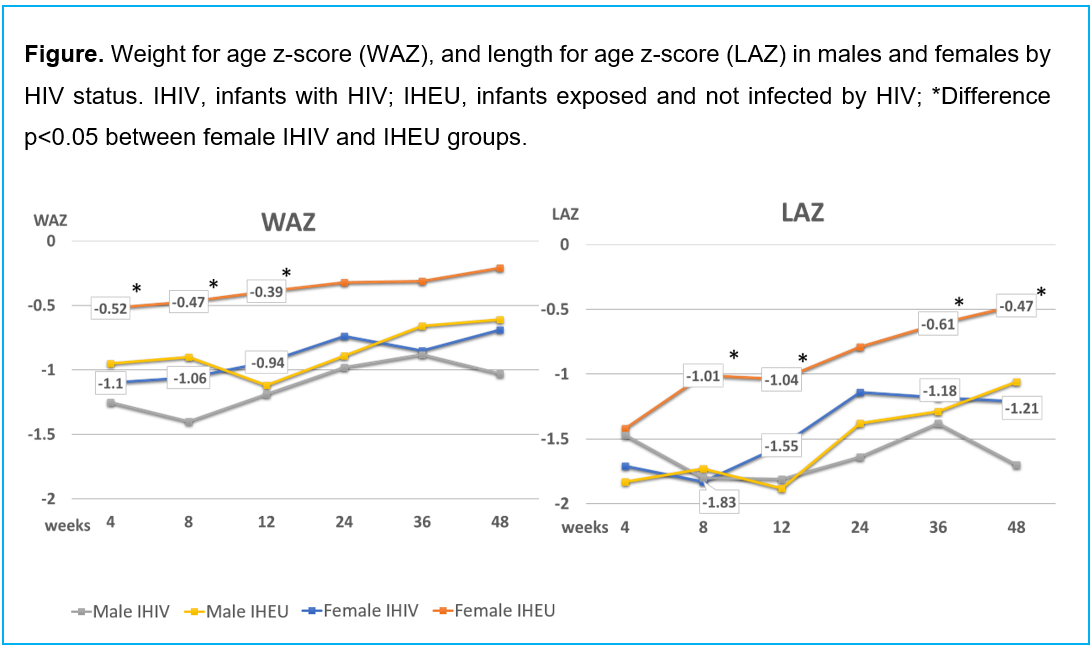
Just under half the infants were male (48.5%), similar proportions in IHIV and IHEU. The deficits in growth through 48 weeks associated with HIV status were most marked in female infants (Figure). Mean WAZ (β= -0.51 [standard error,0.22], p=0.02) and LAZ (β= -0.50 [0.21], p=0.02) were lower in female IHIV than in female IHEU overall (Figure). In contrast, trajectories of WAZ (β= -0.21 [0.30], p=0.48) and LAZ (β= 0.03 [0.32], p=0.92) between male IHIV and male IHEU were similar. Combining the two groups, males had lower WAZ than females over the 48 week period. Males also had lower LAZ than females, with significant differences at 12 and 24 weeks (-1.84 [0.22] vs -1.34[0.12], p=0.04 and -1.53 [0.19] vs -1.01 [0.12], p=0.02). The mean WAZ and LAZ in neither group attained WHO standards by 48 weeks.
Conclusions:
Deficits in WAZ and LAZ in IHIV with early ART compared to IHEU were greater in girls. This pattern was observed despite boys having consistently lower anthropometric parameters than girls in both groups. Factors responsible for this sex difference are not clear, but early ART initiation and/or perinatal infection appears have a differential impact on growth according to sex.