Background:
Jails house vulnerable persons. Crowded conditions, restricted access to medical care, and limited resources facilitate infectious disease outbreaks, particularly for airborne, highly transmissible diseases like COVID-19 (C19). Wastewater-Based Surveillance (WBS) is a low-cost, highly sensitive, non-invasive method that can provide an early warning of C19 surges in communities. We examined the value of SARS-CoV-2 WBS for a mega-jail.
Methods:
28-week study period: 10/20/21- 5/5/22. Wastewater samples were collected x 25 weeks; SARS-CoV-2 RNA was measured using RT-qPCR. We sampled one manhole serving multiple housing units. C19 rapid test data on jail entrants were summarized daily by the jail; 16 mass PCR screenings using self-collected nasal swabs were conducted by the study team. Individual diagnostic tests were collated and analyzed on a weekly basis. Data were summarized by % of the tested jailed individuals found infected. The Spearman correlation coefficient between weekly SARS-CoV-2 RNA in wastewater and % of positive (pos) C19 diagnostic tests were calculated; we also used linear regression to assess the predictability between paired Ct values and weekly % of pos diagnostic tests.
Results:
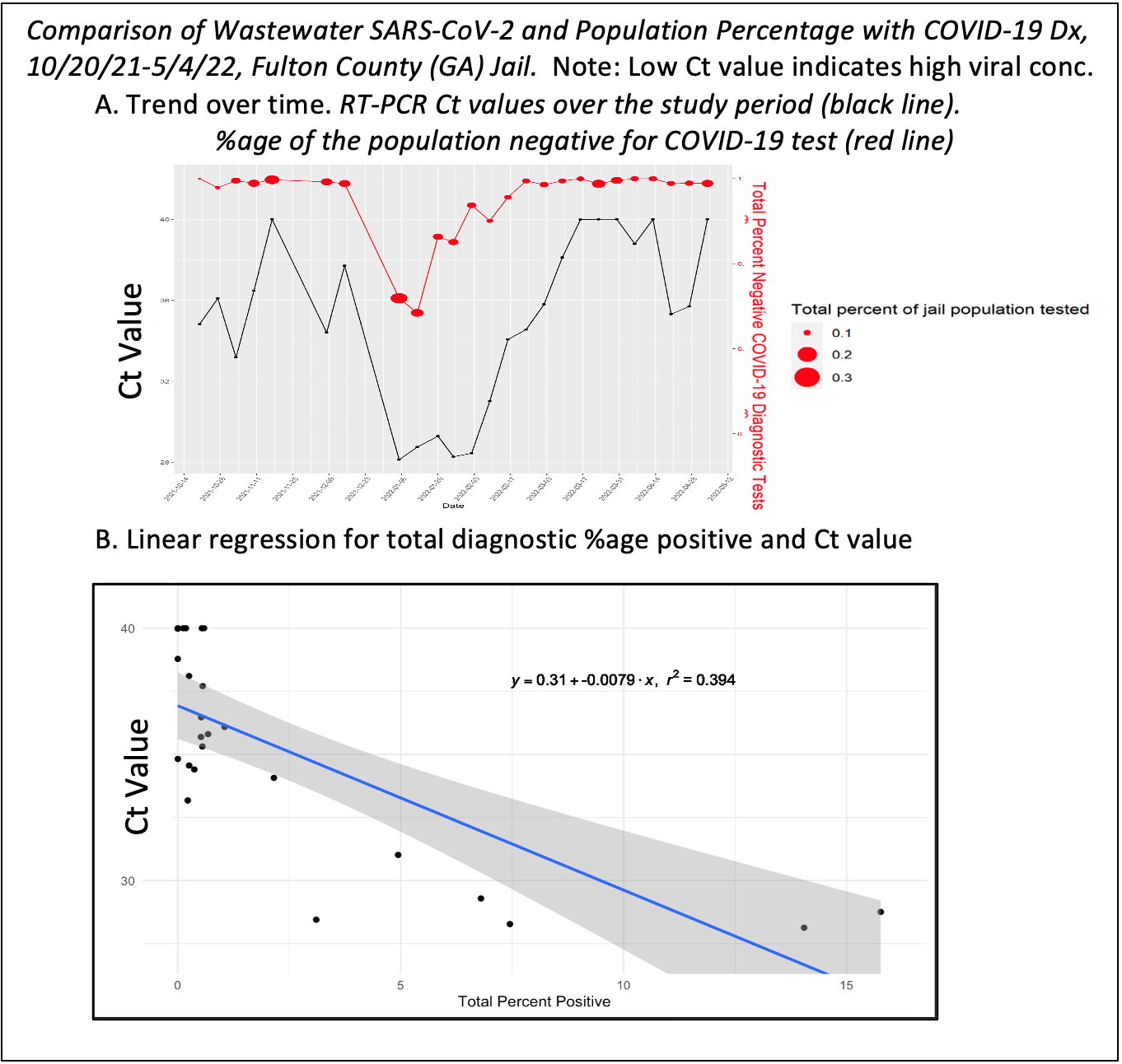
Weekly WBS coupled with periodic mass testing of jailed individuals was feasible. The efficiency of gathering individual nasal swabs increased to 3 tests collected per minute through a CQI process. PCR signal strength for SARS-CoV-2 RNA in jail wastewater correlated with the % of jail residents tested who had C19. The mean RT-qPCR Cycle threshold (Ct) value was 35.2. Overall, 3.4% of nasal swabs were pos. A strong inverse correlation was observed between % nasal swab pos and WBS Ct value (Figure.) The Spearman correlation coefficient was r= 0.628; linear regression likewise showed a similar correlation.
Conclusions:
Weekly WBS results for C19 correlated with the proportion of C19 individual test results. WBS proved to be a practical strategy to surveil for C19 in this jail setting. We are developing means to identify exact source, by housing unit, of wastewater with positive signal. Future studies will explore WBS for Mpox and HIV in correctional facilities. HIV RNA can be found in wastewater specimens; whether WBS for HIV in congregate facilities is feasible remains an open question.
omparison of WWastewater SARS-CoV-2 and Population Percentage with COVID-19 Dx, 10/20/21-5/4/22, Fulton County (GA) Jail