Background:
SARS-CoV-2-specific T cell responses, including those targeting the Nucleocapsid (N) and the conserved Replication-Transcription Complex (RTC), have been associated with protection from infection and airway virus control.
Methods:
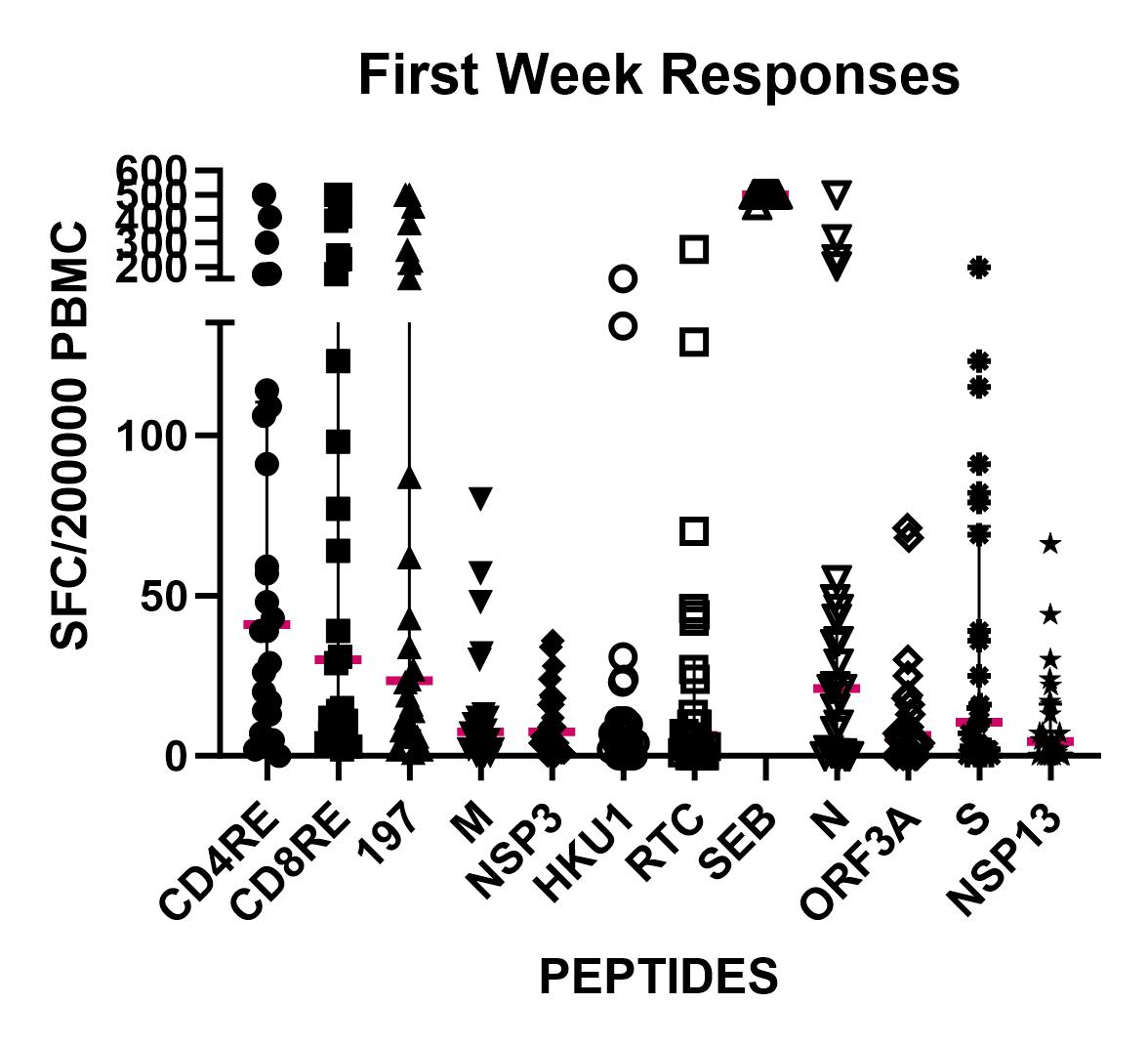
We studied the specificity and magnitude of SARS-CoV-2 T cell responses within the first week of symptom onset in previously unexposed individuals before seroconversion, using an IFN-ƴ ELISPOT assay and peptides pools spanning the SARS-CoV-2 virion structural proteins N, membrane (M) and spike (S), as well as the nonstructural proteins NSP3, ORF3a, and the RTC (consisting of NSP7, NSP8, NSP12 and NSP13). Moreover, pools of MHC Class I- and II-restricted peptides (CD8RE and CD4RE, respectively) spanning the entire SARS-CoV-2 proteome (excluding the S region), as well as a custom pool of 197 non-overlapping 8- to 14mer peptides, selected for their predicted binding affinity to the five most common MHC Class I HLA-A and B alle groups in Europe, were also investigated. To investigate cross-reactivity of the acute SARS-CoV-2 T cell response with the common cold coronavirus HCoV-HKU1, the dominant strain during late 2019/early 2020, an HCoV-HKU1 whole-proteome peptide pool was tested.
Results:
Within the first week of symptom onset, N-specific T cells had the highest median response magnitude (105 Spot Forming Colonies/106 PBMC), followed by S (52.5 SFC/106 PBMC), NSP3, M, ORF3a and RTC (32.5 – 37.5 SFC/106 PBMC) and NSP13 (22.5 SFC/106 PBMC). The megapools CD4RE, CD8RE, and custom MHC Class I pool exhibited a median response of 205, 150 and 117.5 SFC/106 PBMC, respectively, indicating a comparable magnitude of CD4 vs. CD8 T cell responses. Upper airway viral load inversely correlated with N-, S-, RTC-, NSP13-, ORF3a and CD4RE-specific T cell response magnitudes (p<0.05, -0.65≤r≤-0.4). Non-significant inverse associations were detected for CD8RE, the custom MHC Class I pool, NSP3 and the HCoV-HKU1 peptide pool (p>0.05, -0.37≤r≤0.18).
Conclusions:
SARS-CoV-2-specific T cell responses targeting the structural and nonstructural virus proteins, (including the RTC), were associated with airway virus control during early, acute infection before seroconversion. Results show an inverse correlation between the Upper Airway Viral Load (UA-VL) and circulating viral N, ORF3a, RTC, and NSP13-specific T cells, as well as an inverse correlation between UA-VL and MHC Class II-restricted peptides.