Background:
The burden of SARS-CoV-2 infection in immunocompromised children remains unclear due to limited population-based studies. We aimed to assess the incidence of SARS-CoV-2 infection and hospitalization in children with and without immunocompromising conditions.
Methods:
We conducted a population-based cohort study of children aged 0-14 years in the Veneto region, Italy, from February 2020-May 2023. Data were obtained from an Italian pediatric primary-care database (Pedianet) linked to the Veneto region’s hospitalization and COVID-19 nasopharyngeal swab (NPS) registries. Three groups of children were included in this cohort: children with an immunocompromising condition and/or on immunosuppressive treatments (IC), non-immunocompromised children with at least one specific comorbidity other than immunocompromising diseases (non-IC), and healthy children (HC). Adjusted hazard ratios (aHR) and 95% confidence interval (CI) for the risk of SARS-CoV-2 primary infection and COVID-19 vaccine uptake among IC, non-IC, and HC were estimated using Cox proportional hazard models. Models were adjusted for several potential confounders (age, gender, deprivation index, number of visits and antibiotic prescriptions). Hospitalisations’ incidence rate (IR) and 95% CI was condidered within ten days after a positive NPS per 10,000 person days.
Results:
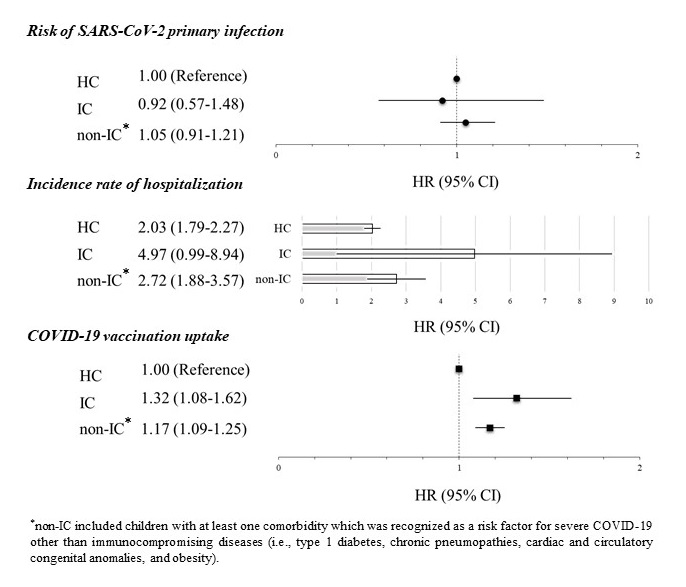
In total, 26,606 children with active follow-up and at least one COVID-19 NPS within the study period were included in the study analysis. Overall, 23,858 were HC, 2,527 non-IC, and 221 IC. Compared to HC, we observed the same risk of SARS-CoV-2 primary infection in IC (aHR = 0.92 [95% CI: 0.57-1.48]) and non-IC (aHR = 1.05 [95% CI: 0.91-1.21]) (Figure). Among 14,968 children with a positive NPS, IC had a higher IR of being hospitalized (IR = 4.97 [95% CI:0.99-8.94]) compared to non-IC (IR = 2.72 [95% CI:1.88-3.57]) and to HC (IR = 2.03 [95% CI:1.79-2.27]) (Figure). IC (aHR = 1.32 [95% CI:1.08-1.62]) and non-IC (aHR = 1.17 [95% CI:1.09-1.25]) were more likely to be vaccinated against COVID-19 than HC (Figure).
Conclusions:
Similar SARS-CoV-2 infection likelihood and higher incidence of hospitalization were observed in IC compared to HC. Greater hospitalization rates in IC may be partly due to lower thresholds for hospital admission for these patients. Hospital-setting surveillance studies evaluating additional outcomes of severity, including intensive care admission and death, are needed to confirm our findings.