Background:
An effective HIV-vaccine should induce broadly neutralizing antibodies (bNAbs) targeting the viral envelope glycoprotein, which is challenged by the low frequencies of bNab precursor B cells. Pre-clinical studies have shown the ability of the BG505 SOSIP.GT1.1 gp140 (GT1.1) vaccine to prime bNAb precursor B cells, including those targeting the CD4-binding site. Here, we report the first safety and immunogenicity data from a first in-human clinical trial using GT1.1.
Methods:
This phase I, double-blinded, placebo-controlled, dose-escalating vaccination trial was conducted at two US sites and one in the Netherlands. Participants received intramuscular injections of either 30µg (low-dose) or 300µg (high-dose) of the GT1.1 vaccine with AS01B adjuvant system, or saline placebo at 0, 8, and 24 weeks. Reactogenicities were reported during the 15 days post-vaccinations, Serious AEs for the entire study period. Serum antibody binding and neutralization responses were quantified using BAMA and TZM-bl pseudovirus neutralization assays, respectively.
Results:
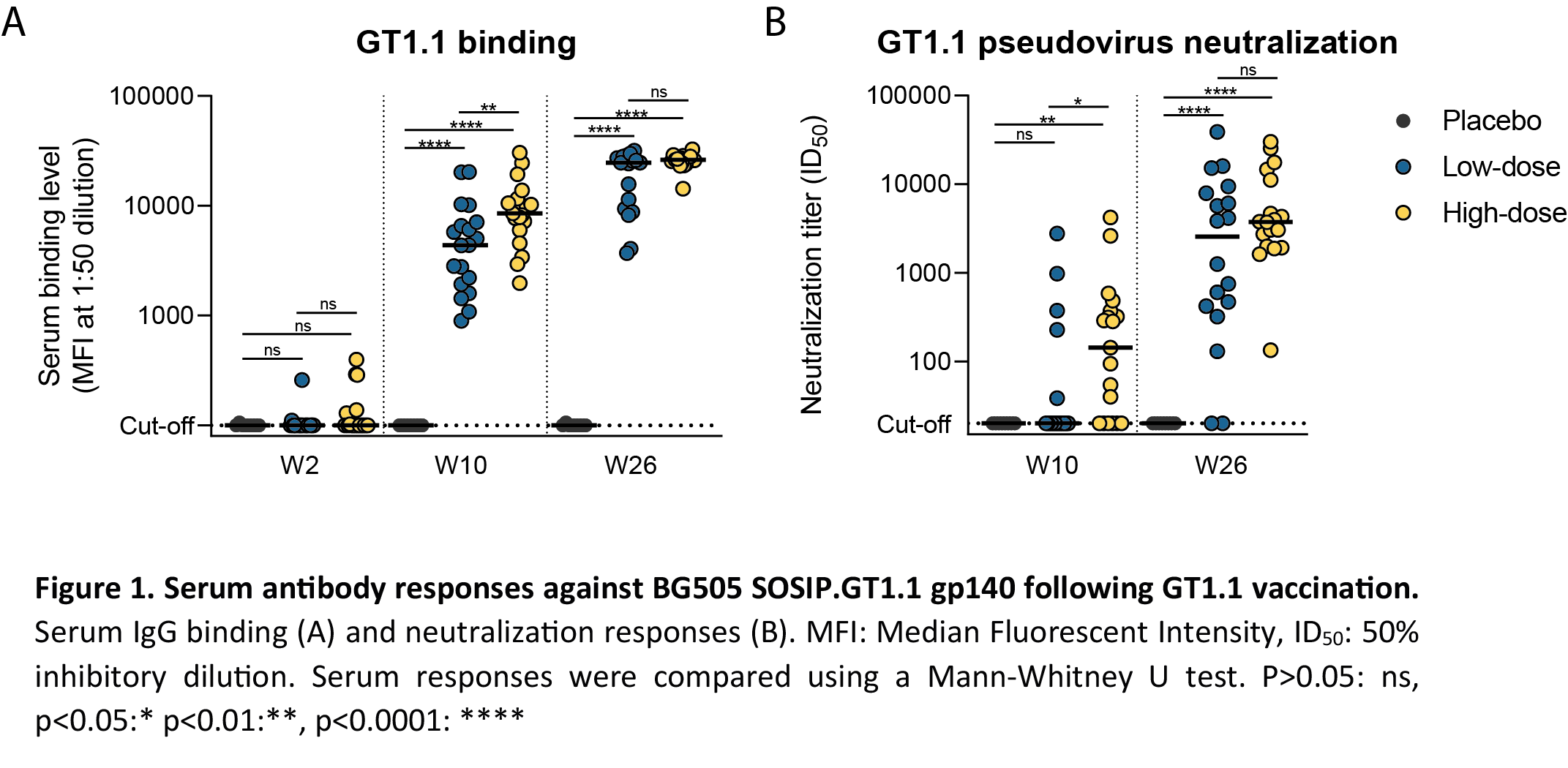
We enrolled 47 adults without HIV (low-dose: n=20, high-dose: n=19, placebo: n=8), with an average age of 30 years and an similar sex distribution between groups. Ninety-four percent of participants reported at least one solicited Adverse Event (AE). Most AEs were graded mild (59.2%) or moderate (37.7%). There were no significant differences in number of AEs between the vaccine administrations (Chi-Squared test, p=0.17), or dose groups (p=0.13). No vaccine-related Serious AEs were reported. All vaccinated participants developed detectable GT1.1-binding serum antibodies at weeks 10 and 26, with the high-dose recipients showing a higher response rate after the first vaccination (10.5% low- vs. 31.5% high-dose) and significantly higher responses at week 10 (p=0.008) (Fig. 1A). GT1.1 neutralizing antibodies (NAb) were more prevalent in the high- compared to the low-dose recipients after the second (68% vs. 28%, respectively) and third vaccination (100% vs. 89%, respectively)(Fig.1B). Serum NAb activity was at least in part directed against the CD4-binding site
Conclusions:
The adjuvanted GT1.1 vaccine has an acceptable safety and reactogenicity profile and induced a potent vaccine-specific serum antibody response. Here, a higher GT1.1 dose induced a more rapid and robust serum antibody binding response without compromising safety. Thus, germline-targeting trimer GT1.1 may represent a promising vaccine candidate for priming bNAb responses in humans.