Background:
The role of remdesivir in hospitalized patients with COVID-19 is not clear. Some studies have demonstrated improved clinical outcomes and reduced mortality, while others have failed to show a benefit.
Methods:
We used the Department of Veterans Affairs’ (VA) national COVID-19 Shared Data Resource database to identify confirmed SARS-CoV-2 infected Veterans between July 1, 2020 and December 31, 2021 who were hospitalized and received remdesivir and propensity-score matched controls who had not received remdesivir. Variables for propensity-score matching included demographics, comorbidities, time and location of diagnosis/admission, severity of illness, and use of other potential COVID-19 therapeutics. Primary outcome of interest was 28-day mortality in the entire matched cohort, and among subgroups stratified by use of supplemental oxygen.
Results:
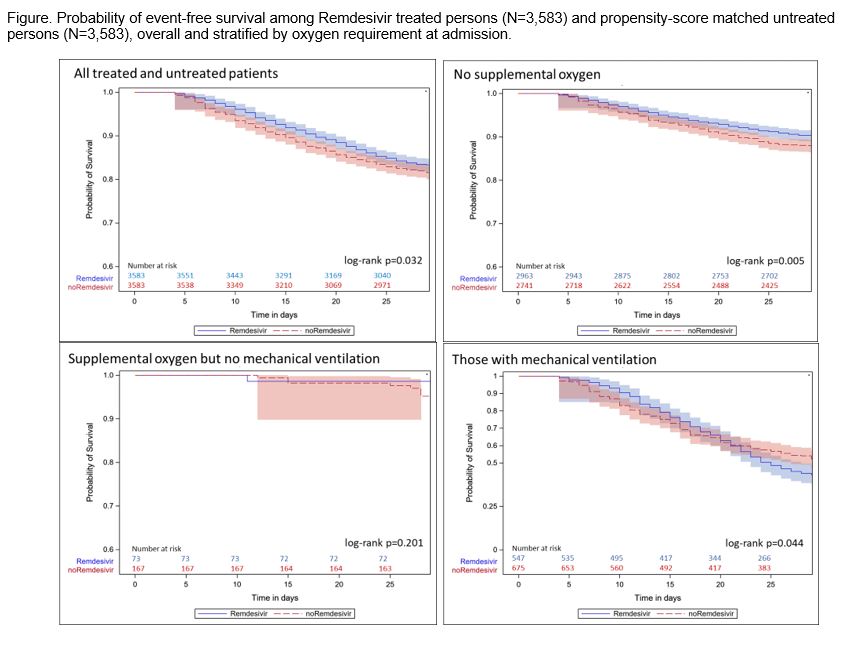
Among 238,298 SARS-CoV-2 infected Veterans, 31,632 were hospitalized, and 13,147 received remdesivir. Our final dataset included 3,583 remdesivir recipients and 3,583 propensity-score matched controls. Probability of survival at 28 days overall was higher in those who had received remdesivir (P=0.032). Remdesivir recipients had better survival among the group who received supplemental oxygen but did not require mechanical ventilation (P=0.005).
Conclusions:
Remdesivir demonstrated a survival benefit among hospitalized patients with COVID-19 which was limited to those who received supplemental oxygen but did not require mechanical ventilation.
PROBABILITY OF EVENT-FREE SURVIVAL AMONG REMDESIVIR TREATED PERSONS (Nf3,583) AND PROPENSITY-SCORE MATCHED UNTREATED PERSONS (Nf3,583), OVERALL AND STRATIFIED BY OXYGEN REQUIREMENT AT ADMISSION.