Background:
The magnitude and causes of sustained neurocognitive impairment in cryptococcal meningitis are not well described. We sought to understand the clinical risk factors associated with sustained neurocognitive impairment among cryptococcal meningitis survivors.
Methods:
At week 12 (+3) from diagnosis, HIV+ participants with first episode cryptococcal meningitis underwent neuropsychological testing consisting of a battery of tests evaluating eight neurophysiological domains. A composite quantitative neurocognitive performance z-score (QNPZ) was calculated as the mean of eight individual z-scores. Impaired neurocognitive function is defined as a QNPZ-8 z-score< -1. We compared demographic variables and clinical characteristics by QNPZ-8 group (QNPZ-8< -1 vs. ³-1).
Results:
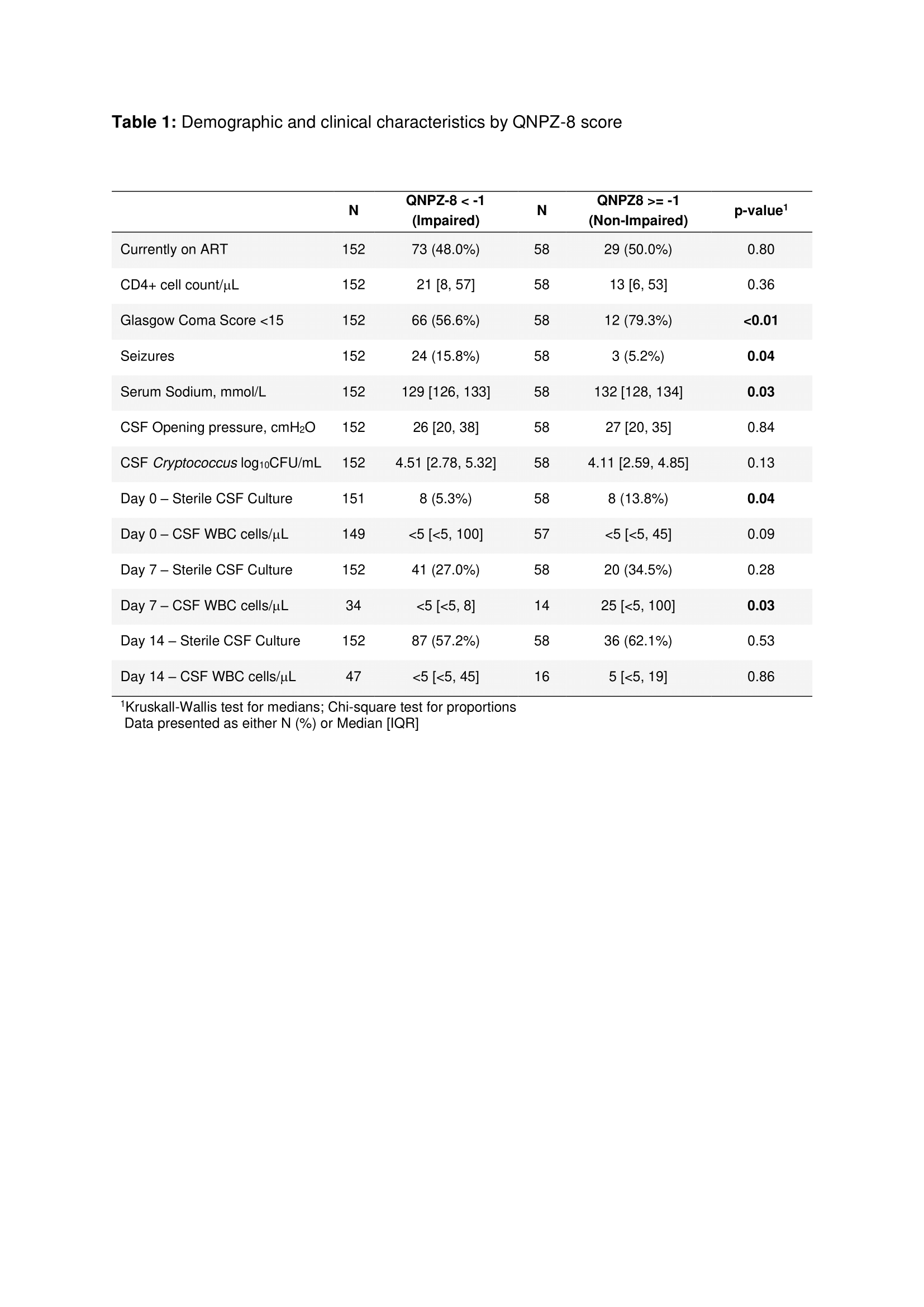
QNPZ scores of 210 participants with cryptococcal meningitis were analyzed. Overall, 72% (152/210) demonstrated sustained neurocognitive impairment at 12 weeks. There were no differences in antiretroviral therapy (ART) use (p=.80) or CD4 count (p=.36) at baseline, between the impaired and non-impaired. Impaired subjects with a QNPZ-8< -1 were more likely to present with a baseline Glasgow Coma Score (GCS)< 15 (p< .01), seizures (p=.04), and lower serum sodium (p=.03) than those non-impaired. We observed no significant difference between CSF opening pressures (p=.84) or quantitative CSF culture burden (p=.13) between impaired and non-impaired groups. We however, found that persons presenting with baseline sterile CSF cultures were more likely to be non-impaired at week 12 (p=.04). While we observed no differences between baseline CSF WBCs (p=0.09) between groups, non-impaired subjects had higher median CSF WBC on day 7 (median 25, IQR < 5 to 100 cells/mcL) as compared to the impaired group (median < 5, IQR < 5 – 8 cells/mcL; p=0.03).
Conclusions:
Neurocognitive impairment at week 12 is common among cryptococcal meningitis survivors. Baseline GCS< 15, seizures, and low serum sodium are risk factors for sustained neurocognitive impairment. Baseline sterile CSF cryptococcal cultures and early rise in CSF WBC is associated with better neurocognitive performance at week 12. Studies looking into the impact and degree of immune recovery during cryptococcal meningitis induction therapy to improve neurocognitive outcomes are warranted.
Table 1: Demographic and clinical characteristics by QNPZ-8 score