PrEP provision in maternal child health (MCH) clinics is important for women at risk for HIV acquisition during pregnancy. In high prevalence settings, the best strategies for PrEP delivery that balance benefits of HIV prevention against unnecessary PrEP exposure are unknown.
The PrEP Implementation for Mothers in Antenatal Care (PrIMA) cluster randomized trial compared two models of PrEP delivery in MCH clinics (NCT03070600). Twenty facilities in Siaya and Homa Bay, Kenya were randomized to either Targeted PrEP (HIV risk assessment via validated HIV risk score, and HIV self-test provision for partners, with PrEP offered to those with high-risk or if requested) versus Universal PrEP (standardized counseling and PrEP offer to all). The Targeted approach was hypothesized to improve risk perception and PrEP decision-making. Participants were enrolled during pregnancy and followed to 9 months postpartum. Primary outcomes were HIV incidence and ‘appropriate PrEP use’ (defined as PrEP used by women with high risk and not used by women with low risk per HIV risk score). PrEP was prescribed per national guidelines. Outcomes were compared between arms, clustered on facility and adjusted for baseline differences using generalized estimating equations.
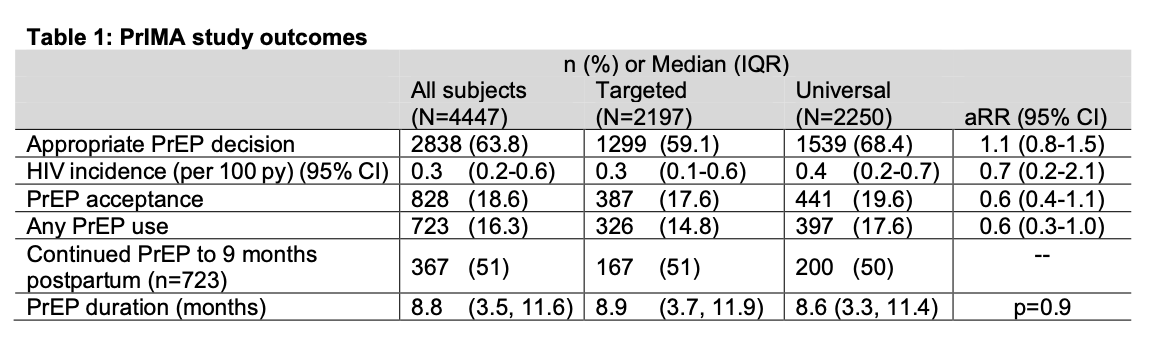
Between January 2018 and July 2019, 4,447 pregnant women were enrolled (2,197 Targeted, 2,250 Universal). Median age was 24 years (IQR 21, 28), most (85%) were married, and median gestational age was 24 weeks (IQR 20, 30). Overall, 1,877 (42%) were at risk for HIV acquisition at baseline, greater in the Targeted group (51% vs 33%, p<0.001). Retention at 9-months postpartum was 94% (92% Targeted, 96% Universal). PrEP was accepted by 18% of women in the Targeted arm versus 20% of women in the Universal arm (adjusted Risk Ratio (aRR) 0.6. 95% Confidence Interval (95% CI 0.4-1.1). Appropriate PrEP use was 59% in the Targeted arm versus 68% in the Universal arm (aRR 1.1; 95% CI 0.8-1.6). Median duration of PrEP use was similar (8.9 vs 8.6 months, p=0.9). HIV incidence was 0.3 and 0.4/100 py (aRR 0.7, 95% CI 0.2-2.1).
At MCH sites in Kenya, a substantial proportion of pregnant women were at risk for HIV, used and continued PrEP, and maternal HIV incidence was low. Targeting by risk-based PrEP offer did not improve PrEP decision-making or decrease HIV incidence. Offering Universal PrEP counselling is an effective and efficient approach to achieve appropriate PrEP use among women at risk.