Background:
Tissue-resident NK cells participate in immune clearance of tumor and infections, yet their response against HIV infection may vary across tissue microenvironments. Here, we characterized NK cells by their memory-like and residency properties, and assessed their functionality in killing HIV-infected cells in relevant tissue models of HIV infection.
Methods:
We obtained tissue resections from tonsils (n=38) and colons (n=32) from routine surgeries. Flow cytometry was used to quantify residency markers (CD49a, CD69, CD103), the memory-related marker NKG2C, and Killer-cell immunoglobulin-like receptors (KIRs) (KIR2DL1, S1, L2, L3, S2). Additionally, we measured natural cytotoxicity (CD107a, IFN-γ) after coculturing tissue cells with HLA-negative K562 cells in suspension, 2D coatings and 3D gels with collagen I and IV. Using tonsil and colon explants, we additionally characterized NK cells following ex vivo HIV(BaL) infection for 5-7 days.
Results:
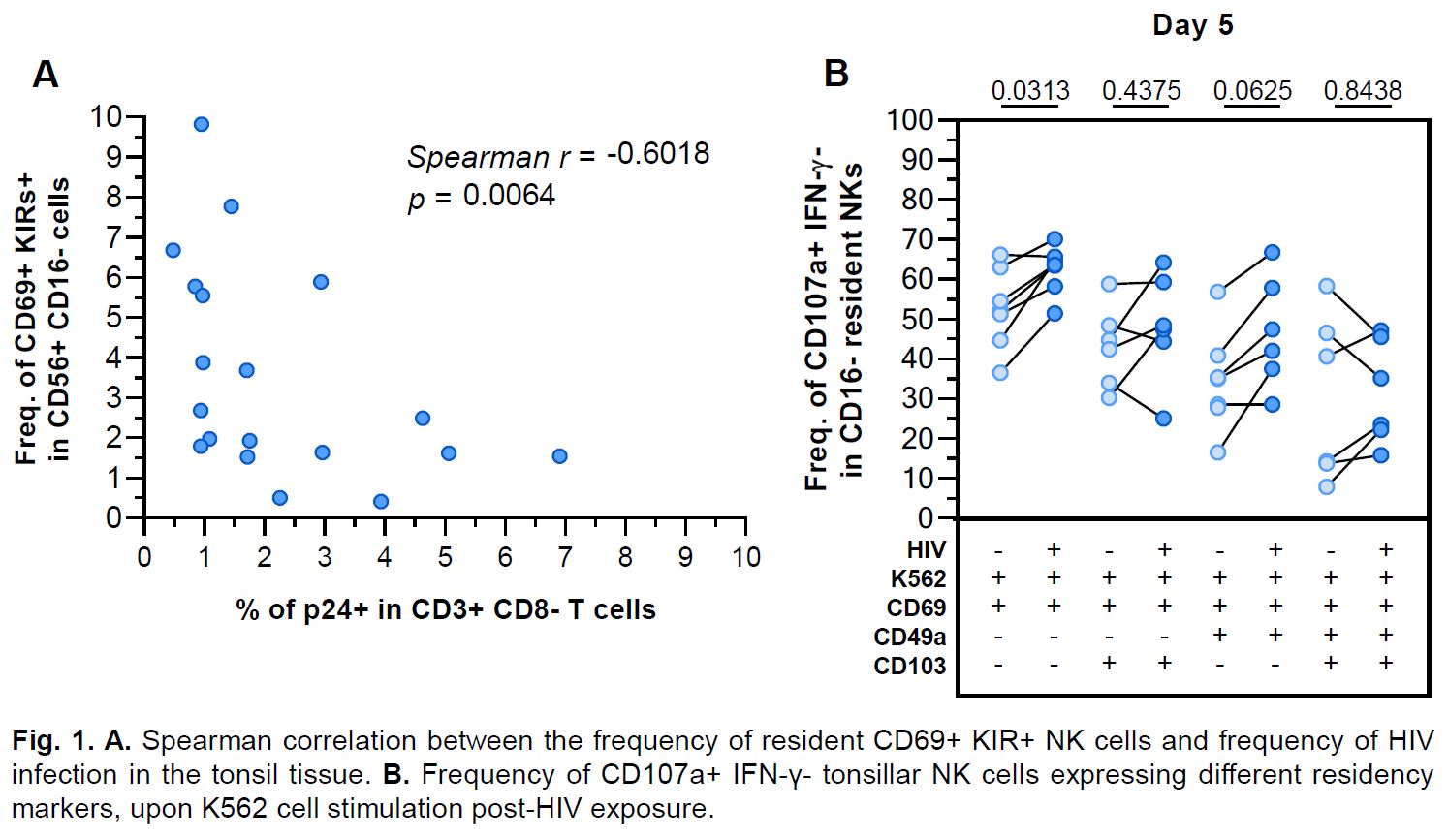
Both tissues shared similar NK cell residency patterns, predominantly CD16-CD69+. Among these, CD49a-CD103- and CD49a+CD103+/- subpopulations exhibited the highest and lowest preactivation levels, respectively (median % of CD107a+IFN-γ- in tonsil: 70.60% vs 9.26%; colon: 77.90% vs 18.35%). However, robust natural cytotoxicity was exclusive to tonsillar NK cells, with CD16-CD49a+ ‘adaptive’ (KIR+NKG2C+) cells showing a median 9.85-fold higher CD107a+IFN-γ+ cells upon stimulation. Of note, we observed that coculture on 2D coatings with collagen I or IV increased the IFN-γ in this subset, and K562 killing in 3D collagen I was enhanced in both tissues (tonsil: 1.75-fold; gut: 1.37). After 5-7 days of HIV infection, tonsils exhibited 10% more KIRs expression on CD16+CD69+CD49a+CD103- NK cells (p=0.032), yet the presence of CD69+KIRs+ NK cells correlated with lower levels of HIV infection (Fig. 1A). Conversely, in the colon, the CD16-CD103+ population significantly expanded (1.27-fold, p=0.001), correlating with reduced HIV infection levels when expressing NKG2C (p=0.017). Moreover, more CD16-CD69+CD49a-CD103+/- tonsillar NK cells were activated (% CD107a+IFN-γ-) after ex vivo HIV infection than in uninfected tissue explants, and CD16-KIRs+ and multiple resident NK cells showed increased CD107a expression upon K562 stimulation post-HIV exposure (Fig. 1B).
Conclusions:
This study underscores tissue-specific NK cell responses to HIV and their potential role in limiting HIV establishment in tissues, offering insights for future research and therapies.