Background:
Previous studies had demonstrated that patients with hematologic malignancies had suboptimal antibody response after receiving COVID-19 vaccines, especially among those having previously treated with anti-CD20 monoclonal antibodies.
Methods:
Adult patients with non-Hodgkin’s lymphoma or chronic lymphocytic leukemia (CLL) were enrolled before receiving the second dose of SARS-CoV-2 vaccine. Determinations of anti-SARS-CoV-2 spike and nucleocapsid IgG titers were performed every 1-3 months, after they received the second and the third dose of SARS-CoV-2 vaccine, respectively. Patients were excluded from analysis if they were diagnosed with COVID-19. All serum samples were tested for anti-nucleocapsid antibody and those tested positive were excluded from subsequent analyses.
Results:
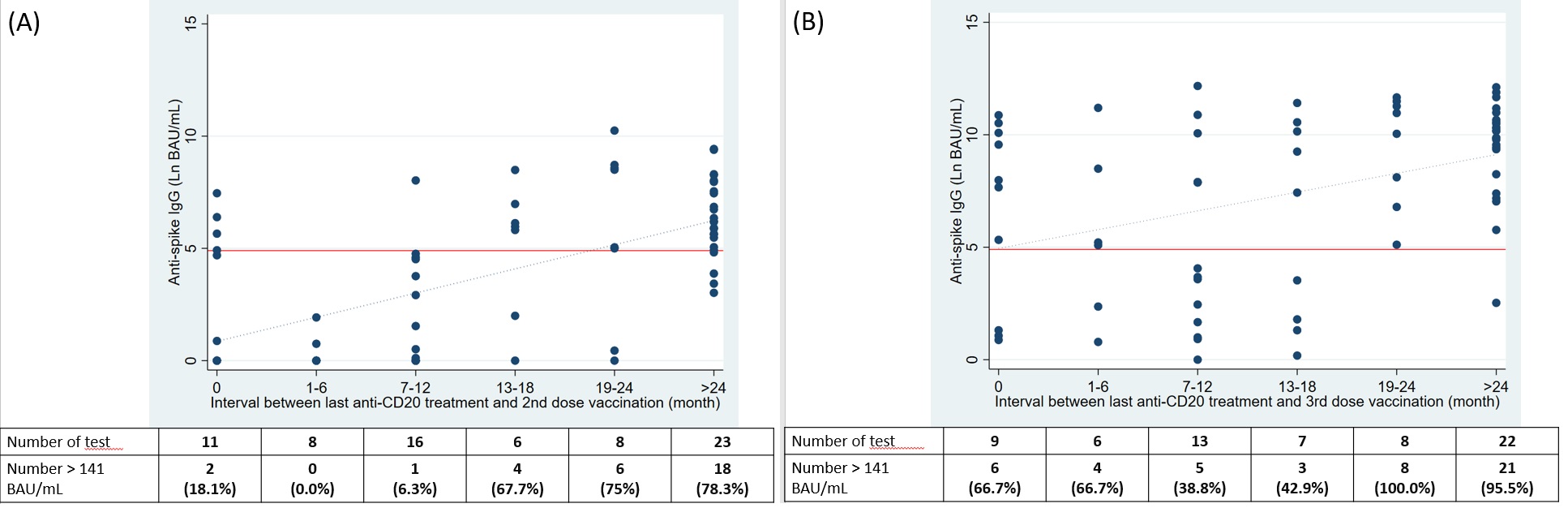
A total of 85 participants were enrolled, including 42 (49.4%) with diffused large B-cell lymphoma, and 13 (15.3) with follicular lymphoma and 9 with CLL. 72 (84.7%) participants had received anti-CD20 monoclonal antibodies, with a median interval of 24 months between last anti-CD20 treatment and the second dose of vaccine, and 21 (24.7%) had HIV infection. Factors associated with failure to achieve an anti-spike IgG titer >141 BAU/mL within 12 weeks after the second dose of vaccine included HIV infection (adjusted odds ratio [aOR], 0.14; 95% CI, 0.04-0.51), active hematologic disease (aOR, 5.50; 95% CI 1.42-21.32), receipt of anti-CD20 monoclonal antibodies (aOR, 6.65; 95% CI 1.52-29.07), and receipt of two doses of homologous mRNA vaccination (aOR, 0.17; 95% CI 0.05-0.56). In the participants having previously treated with anti-CD20 regimen, only 8.6% achieved an antibody response ( >141 BAU/mL) in the first year, while 78.3% achieved anti-spike IgG titer > 141 BAU/mL after two years post B-cell depleting treatment. After the third dose of SARS-CoV-2 vaccine, 53.6% achieved an anti-spike IgG titer > 141 BAU/mL in the first year post anti-CD20 treatment.
Conclusions:
Our study demonstrated that previous treatment with anti-CD20 monoclonal antibodies was associated a lower antibody response among patients with lymphoproliferative disorders receiving two doses of SARS-CoV-2 vaccine. While two doses of SARS-CoV-2 vaccines might not be sufficient even one year apart from the last dose of rituximab, a third dose of vaccine may boost anti-spike IgG particularly in the subset of recent exposure to rituximab.
Anti-spike IgG determined 1-3 months after the second (A) / third (B) dose of COVID-19 vaccine, stratified by the interval between last anti-CD20 regimen and the second / third dose of COVID-19 vaccine.