Background:
Dual therapy with remdesivir (RDV) and dexamethasone (DEX) among patients with COVID-19 has demonstrated improved clinical outcomes compared to DEX monotherapy. We evaluated the effectiveness of RDV+DEX vs. DEX monotherapy by applying and comparing two established methods used to balance two inherently different groups due to confounding by indication in observational research.
Methods:
Adults hospitalised during the Omicron period (Dec’21-Apr’23) with a primary discharge diagnosis of COVID-19 flagged as ‘present-on-admission’ who initiated RDV+DEX or DEX monotherapy in the first 2 days of hospitalisation (baseline period) were identified in the PINC AI Healthcare database. Patients were categorized by baseline supplemental oxygen requirement: no supplemental oxygen charges (NSOc), low-flow oxygen (LFO), high-flow oxygen/non-invasive ventilation (HFO/NIV), or invasive mechanical ventilation (IMV)/ECMO. Balanced distribution of underlying confounders in the treatment groups was achieved through 1) 1:1 propensity score matching (PSM) without replacement, which estimates the effectiveness of RDV+DEX by matching patients in the two groups excluding unmatched patients and 2) Inverse probability of treatment weighting (IPTW), which estimates the effectiveness of RDV+DEX in the full cohort keeping all eligible patients in the analysis. Cox Proportional Hazards Model was used to assess time to 14- and 28-day mortality.
Results:
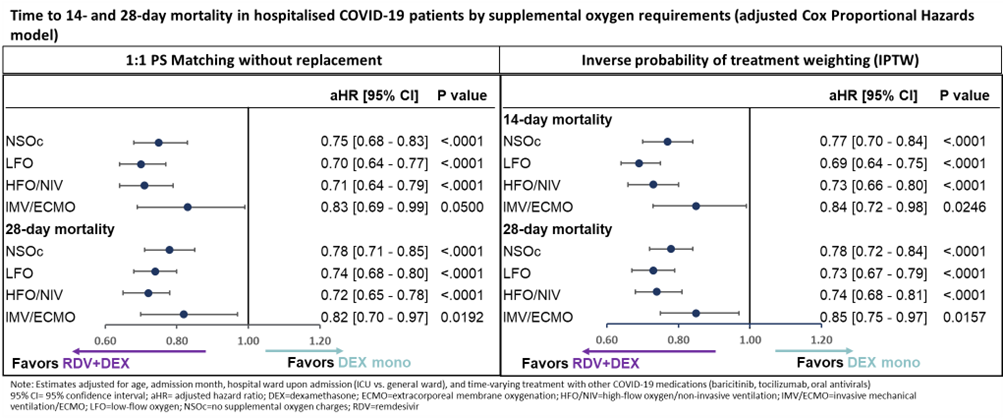
Among 151,215 hospitalised patients for COVID-19, 61,236 (40%) initiated RDV+DEX and 36,489 (24%) DEX monotherapy in the first 2 days. Using PSM, 33,089 RDV+DEX patients were matched to 33,089 DEX monotherapy patients. RDV+DEX had a significantly lower mortality risk compared to DEX monotherapy across all supplemental oxygen requirements at 14 days (NSOc: adjusted hazard ratio[95% C]:0.75[0.68-0.83], LFO:0.70[0.64-0.77], HFO/NIV:0.71[0.64-0.79], IMV/ECMO:0.83[0.69-0.99]); 28 days (NSOc:0.78[0.71-0.85], LFO:0.74[0.68-0.80], HFO/NIV:0.72[0.65-0.78], and IMV/ECMO:0.82[0.70-0.97]) (Fig). Using IPTW, consistent results were obtained across all supplemental oxygen levels (Fig).
Conclusions:
The effectiveness of RDV+DEX in reducing mortality compared to DEX monotherapy was confirmed through two well-established methods of addressing confounding by indication bias, thus providing confidence in the observed effectiveness of RDV+DEX therapy. Appropriate methodologies such as the ones applied in this study enables the use of real-world data to complement findings from RCTs.