Background:
There is limited information on effectiveness of COVID-19 therapies in immunocompromised patients, who are at higher risk of hospitalizations, complications, and mortality due to COVID-19. We examined hospital all-cause mortality for early RDV use vs. no RDV use among immunocompromised COVID-19 patients across several distinct dominant variants of concern (VOC) periods: pre-Delta (Dec’20-Apr’21), Delta (May-Nov’21) and Omicron (Dec’21-Apr’22).
Methods:
Using the Premier Healthcare Database, we identified adults with an immunocompromised condition (cancer, solid organ and hematopoietic stem cell transplant, hematologic malignancies, primary immunodeficiencies, asplenia, bone marrow failure/aplastic anemia, severe combined immunodeficiencies or HIV), hospitalized with a primary diagnosis of COVID-19. Patients treated with RDV in first 2 days of admission vs. those not treated with RDV during the hospitalization were matched using 1:1 preferential within-hospital propensity matching with replacement. Patients were excluded if discharged within 3 days of RDV initiation. Cox Proportional Hazards Model was used to examine time to 14- and 28-day mortality.
Results:
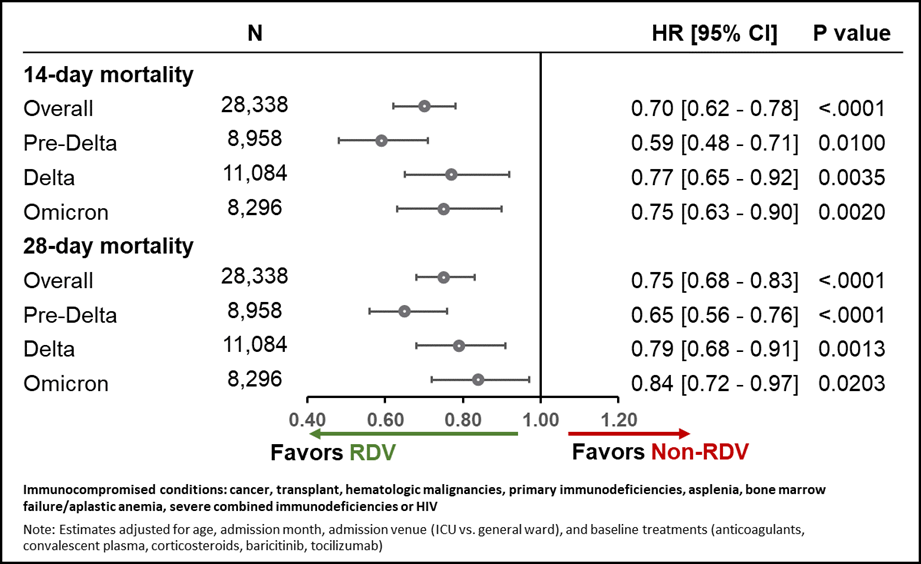
Overall (Dec’20-Apr’22), 14,169 RDV-treated patients were matched to 5,341 unique non-RDV patients. Post-matching balance was achieved with 59% being 65+ years, 40.5% with no supplementary oxygen charges, 39% received low-flow oxygen, 19% on high-flow oxygen/non-invasive ventilation and 1.5% on invasive mechanical ventilation/ECMO at baseline.During the study period, unadjusted mortality rate was significantly lower for RDV patients at 14 days (11% [95% CI: 11%-12%] vs 15% [15%-16%];p< .0001) and 28 days (18% [17%-18%];p< .0001 vs 22% [22%-23%];p< .0001) as compared to patients that did not receive RDV. After adjusting for baseline and clinical covariates, 14-day results showed that RDV had significantly lower mortality risk compared to non-RDV across all VOC periods [overall (30% lower risk), pre-delta (41%), Delta (23%), Omicron (25%)]. Similarly, 28-day results showed that RDV had significantly lower mortality risk compared to non-RDV across all VOC periods [overall (25%), pre-delta (35%), Delta (21%), Omicron (16%)] (Fig).
Conclusions:
Timely initiation of RDV in first two days of hospital admission demonstrated significant mortality reduction in immunocompromised patients hospitalized with primary diagnosis of COVID-19. RDV demonstrated consistent benefit in an immunocompromised cohort across all variant periods of the pandemic.
Figure: Time to 14- and 28- day mortality in immunocompromised patients across the COVID-19 variant periods (adjusted Cox Proportional Hazards model)