Background:
One of the limitations in the control of STIs is that many of them are asymptomatic, making diagnosis, treatment, and contact tracing challenging. The objective of this study is to analyze the significance of asymptomatic STIs in a high-risk population (MSM) that undergoes regular screening for these infections
Methods:
This was a single-center study involving two populations: our cohort of MSM on PrEP (Pre-Exposure Prophylaxis) and People Living with HIV (PLHIV) followed up at our clinic, both at risk of STIs, who undergo STI screening every 3-6 months (including serological tests, cultures, and nucleic acid amplification tests in pharyngeal, rectal, and urethral/urine samples). The following STIs were analyzed: Neisseria gonorrhoeae (NG), Chlamydia trachomatis (CT), Lymphogranuloma venereum (LGV), and syphilis. Study period: November 1, 2022, to June 30, 2023. Proportions were compared using the chi-squared test or Fisher’s exact test. Statistical analysis was performed using SPSS 24.0 software.
Results:
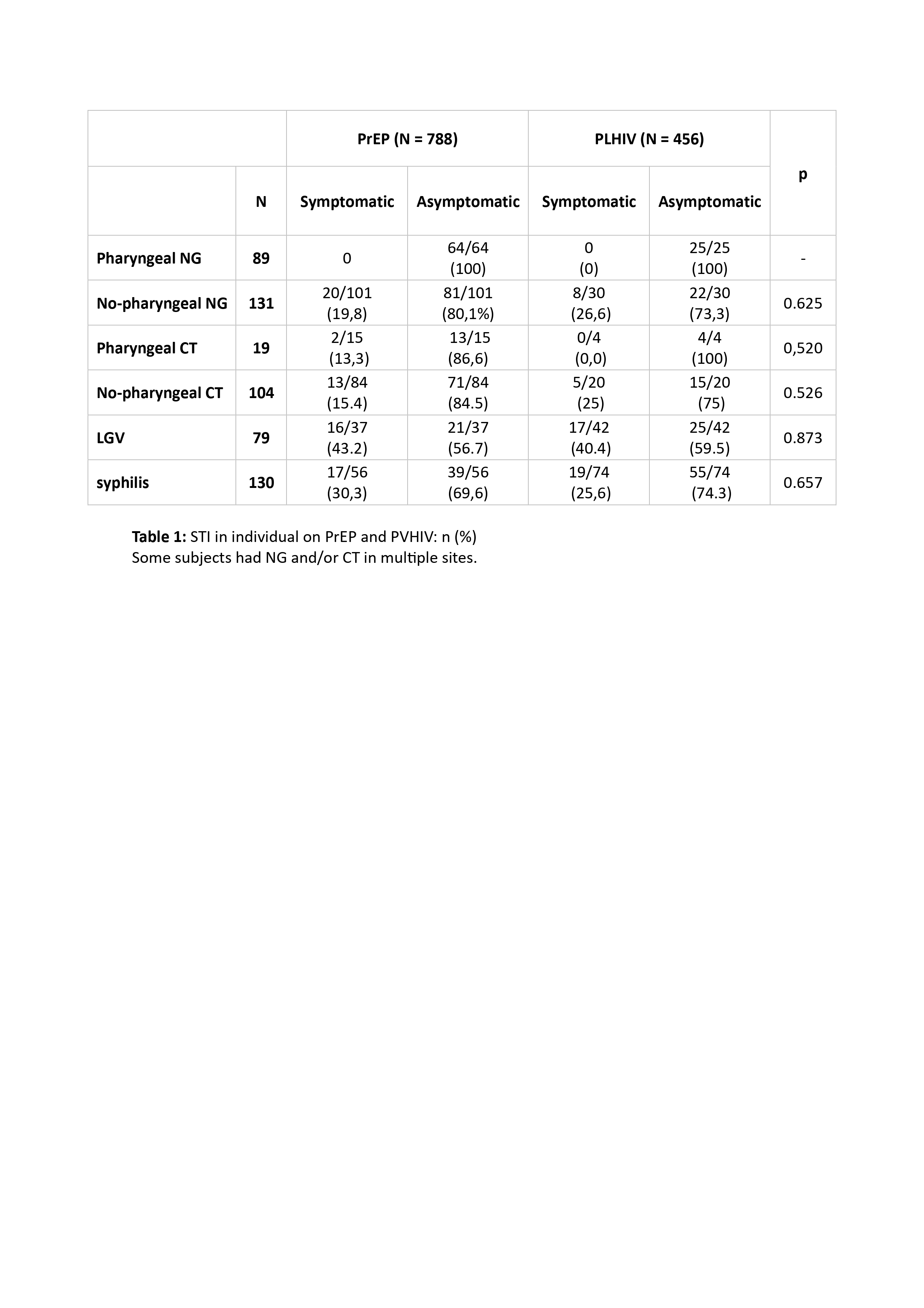
During this period, STI screening was conducted on 788 individuals on PrEP and 456 PLHIV, all MSM. A total of 560 STIs were diagnosed (359 in individuals on PrEP and 201 in PLHIV; p=0.755): NG 194 (34.6%), syphilis 130 (23.2%), CT 121 (21.6%), and LGV 79 (14.1%) and 36 (6,4%) were other STIs; 416 (74.2%) were asymptomatic. Table 1 provides details of symptomatic and asymptomatic STIs in both groups. Some subjects had NG and/or CT in multiple sites. Coincident STIs were detected in 20.3% of the cases. There were no seroconversions among individuals on PrEP.
Conclusions:
Asymptomatic STIs are strikingly prevalent in this high-risk MSM population. No differences in clinical presentation were observed between individuals on PrEP and PLHIV for any of the studied STIs. There is an urgent need to implement new prevention strategies to control STIs in these high-risk populations.