Background:
Accurately describing the epidemiology of HIV requires robust outcome ascertainment. In Latin America, as in many regions, reliable mortality data may not be consistently available to clinical cohorts, particularly among those lost to care (LTC), leading to potential bias in survivorship measured in these populations. We therefore linked cohorts with vital status registries and assessed the impact on estimated survival among people with HIV (PWH) in Latin American countries where comprehensive registries exist.
Methods:
Adult (≥18 years old) PWH in care at Caribbean, Central and South America network for HIV epidemiology (CCASAnet) sites in Brazil, Mexico, and Peru contributed data from antiretroviral therapy initiation date until the first of death date, cohort closure (Dec. 31, 2019), or date of last visit if LTC (i.e., no visit < 12 months before cohort close). Those LTC were matched with national or state mortality registries (Sistema de Informação de Mortalidade in Brazil, Sistema Epidemiológico y Estadístico de las Defunciones in Mexico, and National Registry of Identification and Civil Status in Peru) by probabilistic algorithms, using first and last name (Soundex), birth date, birth sex, as well as governmental identifiers and mother’s maiden name, where available. Kaplan-Meier curves with cluster-corrected log-rank tests were used to compare survivorship in cohorts pre- vs. post-linkage.
Results:
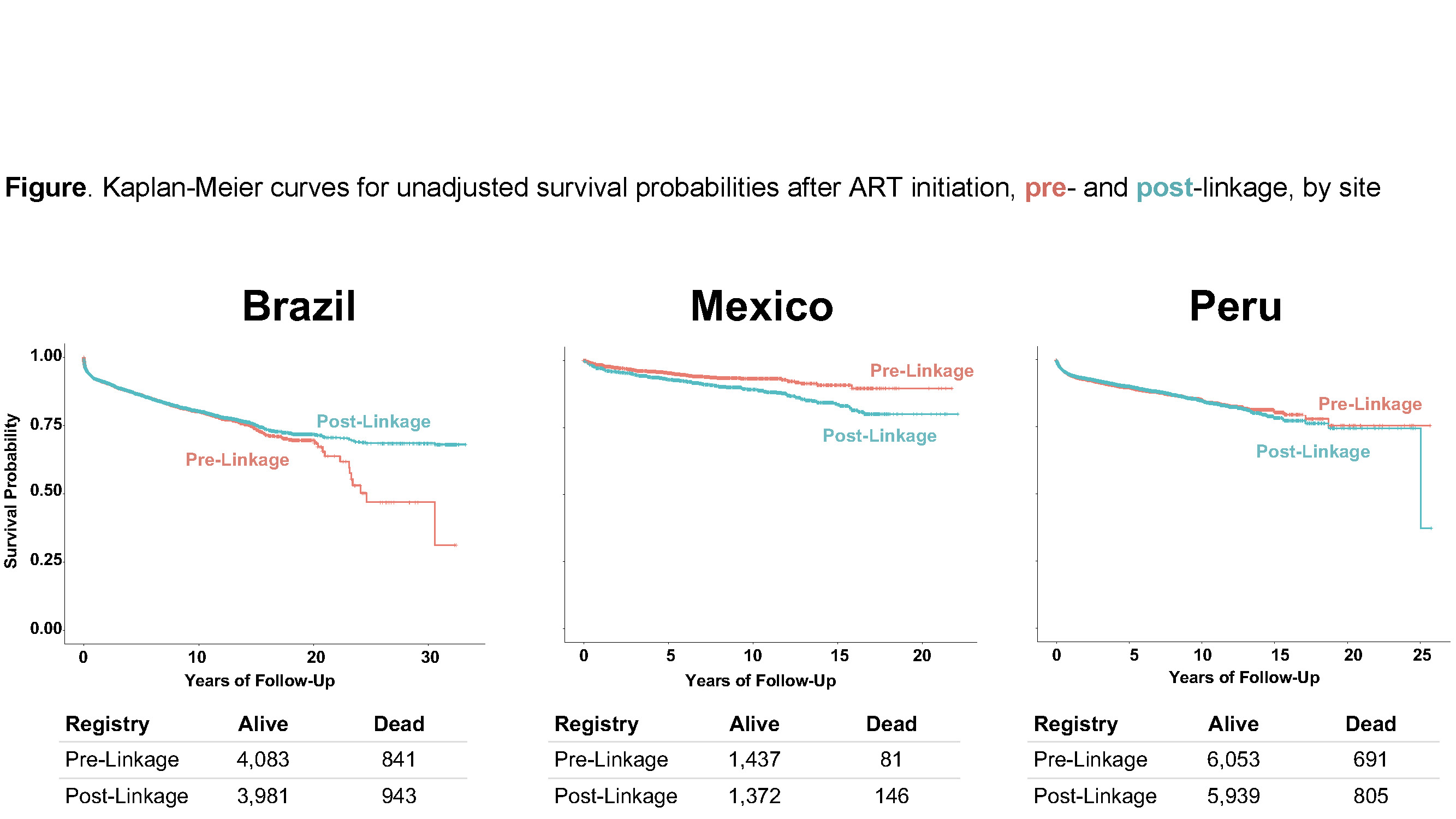
Among 13,186 eligible PWH, 4,924 (37.3%) contributed in Brazil, 1,518 (11.5%) in Mexico, and 6,744 (51.1%) in Peru; overall, 1,345 (10.2%) were LTC, 1,613 (12.2%) deceased, and 10,228 (77.6%) alive in-care, pre-linkage. Post-linkage, proportions LTC (9.4%) and alive (i.e., no death observed; 76.3%) both dropped, while deaths increased (14.3%). Though proportions newly ascertained deceased were small within sites (2.0% in Brazil, 4.3% in Mexico, and 1.7% in Peru), overall numbers and proportions were sizable (n=278 new deaths total; 15% of all deaths). Kaplan-Meier curves showed slight but significant differences in survival post- vs. pre-linkage at each site (cluster-corrected p< 0.01, each), though survival probabilities diverged differently across sites (Figure).
Conclusions:
Though groups like the World Health Organization rely on weights derived from Sub-Saharan African populations to correct for mortality misclassification in Latin America, our results demonstrate that local registry linkage can be successfully used to reduce measurement error in survivorship for these populations.
Figure. Kaplan-Meier curves for unadjusted survival probabilities after ART initiation, pre- and post-linkage, by site