The percentage of HIV cases diagnosed late in infection is a metric for monitoring the adequacy of population-level HIV testing. CDC defines late diagnosis as a CD4 lymphocyte count <200 cells/ml or a clinical diagnosis of AIDS within 1 year of HIV diagnosis. The validity of this approach is uncertain.
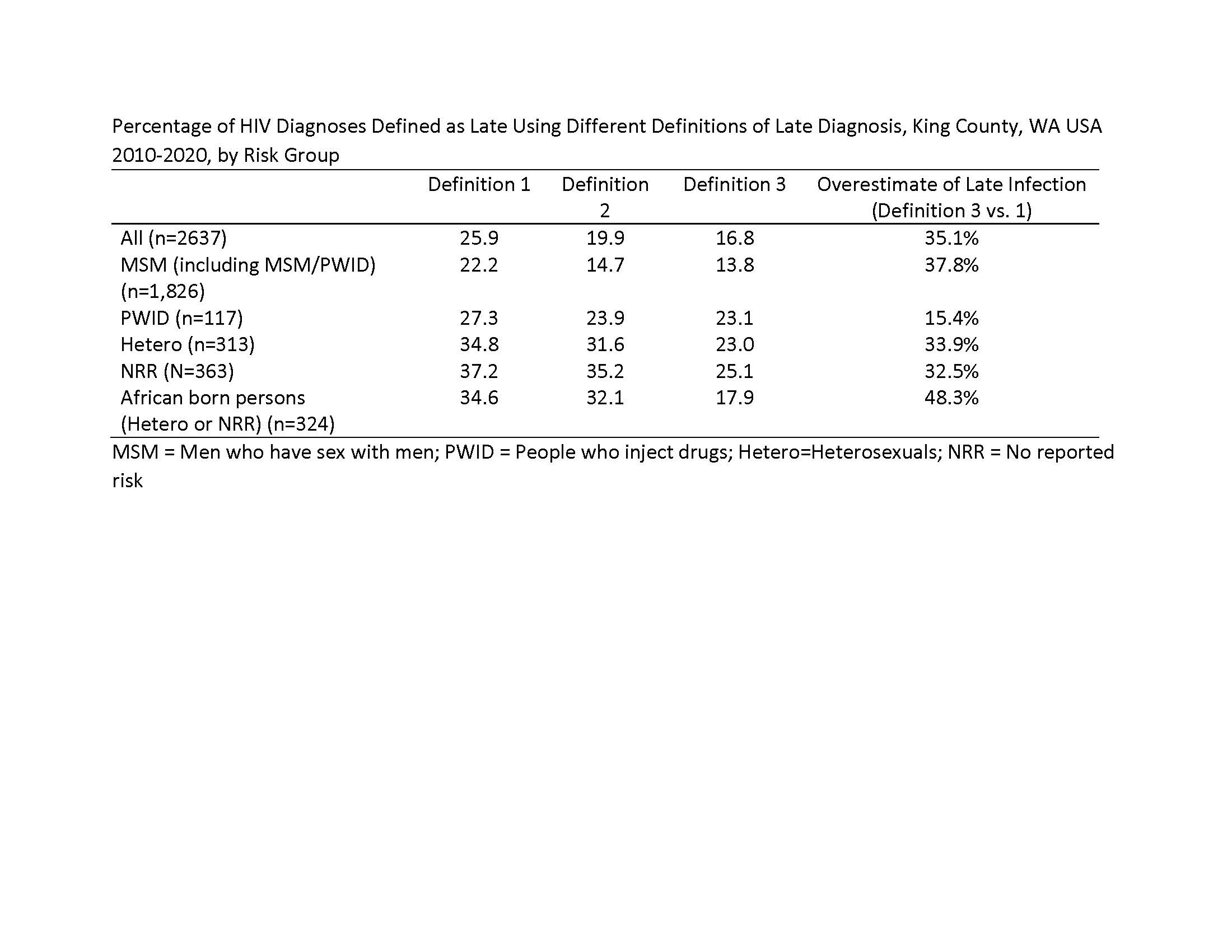
We used surveillance data from persons diagnosed with HIV in King County, WA, USA 2010-2020 to compared 3 definitions of late diagnosis: 1) CD4 lymphocyte count <200 cells/ml or clinical AIDS diagnosis <1 year of HIV diagnosis; 2) definition 1 removing persons with acute HIV and those who report or had a documented HIV negative test in the 2 years prior to HIV diagnosis; and 3) definition 2 removing persons who reported a prior HIV diagnosis (unconfirmed per CDC criteria) or who were diagnosed within 1 year of immigrating to the US. We used published HIV natural history data to estimate the percentage of persons who would meet definition 1 assuming different distributions of time from infection to diagnosis.
Among 2630 adults diagnosed with HIV 1652 had a defined date of last HIV negative test. CD4 count at time of HIV diagnosis was associated with time from last negative test (p<0.001, R2=0.039). However, 153 (13.1%) of 1161 persons with a negative test in the prior two years and 14 (6.2%) of 226 with acute HIV had AIDS within 1 year of HIV diagnosis, representing 23.1% of people identified as late diagnoses based on definition 1. Data on time since immigration were available for 496 (46.5%) of 1066 persons diagnosed with HIV born outside of the US. 375 persons with newly reported HIV infection – including 351 (32.9%) born outside of the US - reported an unconfirmed prior HIV diagnosis. The percentage of diagnoses classified as late for criteria 1, 2 and 3, were 25.9%, 19.9% and 16.8%, respectively. Incorporating additional data into late HIV diagnosis estimates decreased the number of late HIV diagnoses by one-third, with heterogeneous effects in different risk groups (Table). Modeling definition 1 using HIV natural history data, even if all persons with HIV tested within 2 years of infection, 6% would still be defined as late.
Estimates of late HIV diagnosis that depend on CD4 counts and AIDS diagnoses are likely too high in many settings. Integrating HIV testing history and information on nativity and immigration may improve estimates of late diagnosis.