Background:
We previously found that concomitant depot medroxyprogesterone acetate (DMPA-IM) contraceptive use resulted in a doubling of BMD loss in women living with HIV (WLWH) initiating tenofovir disoproxil fumarate (TDF) -containing ART in the BONE: CARE study. We sought to determine whether BMD would recover when these women switched to tenofovir alafenamide fumarate (TAF)-containing ART over a two-year period through a Phase IV open-label hybrid randomized and quasi experimental intervention study, the BONE: STAR study.
Methods:
At the end of their 2-year follow-up in the BONE: CARE study, WLWH on TDF and DMPA-IM were randomized in a 1:1 ratio to either continue on a TDF based ART regimen or switch to B/F/TAF for 2 years. A third group of WLWH on TDF and using non-hormonal contraception were offered B/F/TAF. Dual energy x-ray absorptiometry was used to measure BMD (lumbar spine (LS), total hip (TH) and femoral neck (FN)) at enrollment and at 6-monthly intervals thereafter. Multivariable linear regression was used to assess differences in mean percent (%) change in BMD. We present 12 months data.
Results:
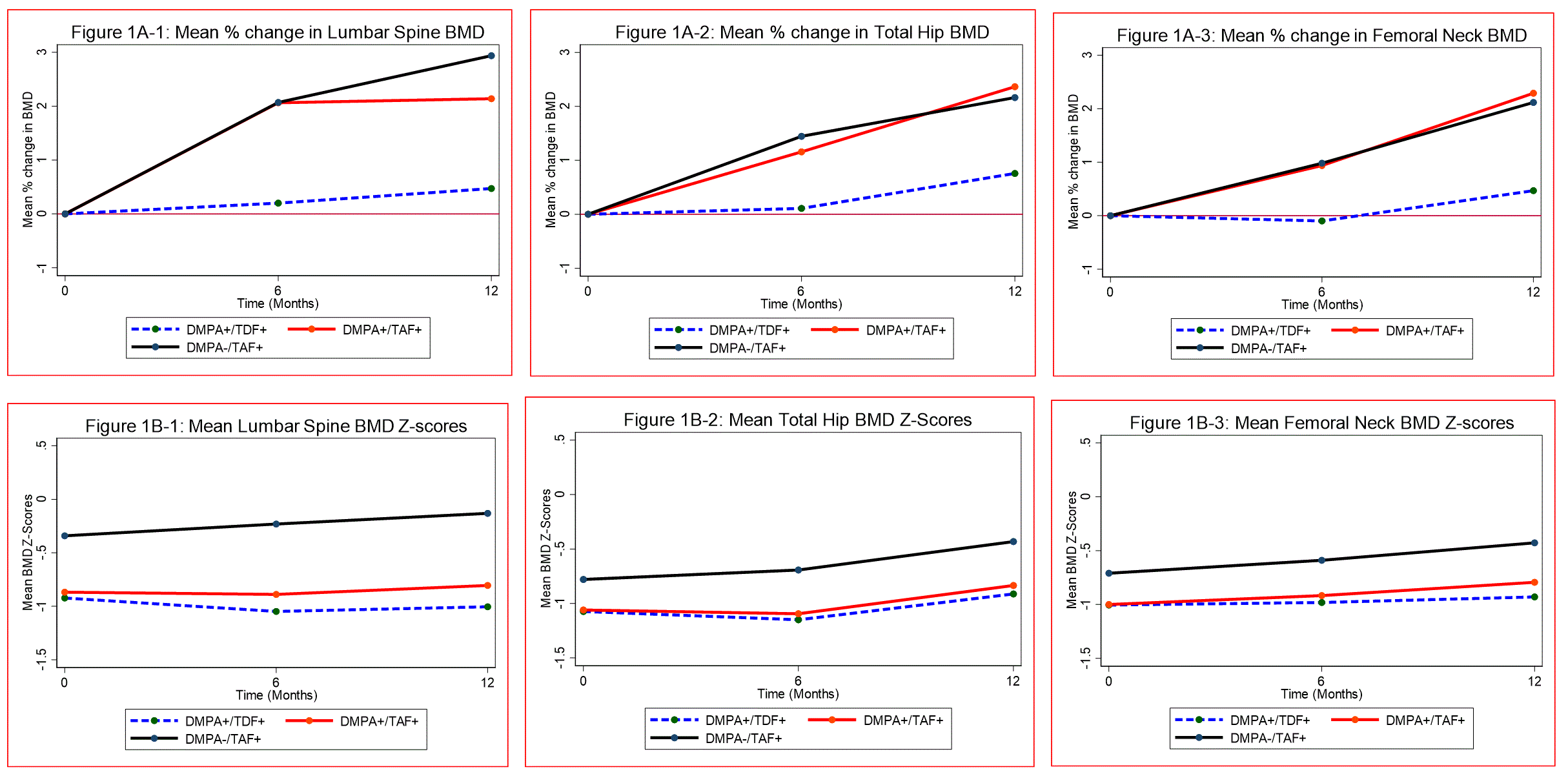
We enrolled 344 virally suppressed women; 125 non-hormonal contraceptive users switching from TDF to B/F/TAF, and 219 DMPA-IM users continuing on TDF (108) or switching to TAF (111). Mean age was 31.3 years (SD 4.2) years. Both non-hormonal and DMPA groups who switched to B/F/TAF had significant improvement in mean % BMD post switch with no significant differences except at the LS; % differences in mean BMD (-0.011% (-0.020, -0.001)) p=0.029 at the LS, (0.254% (1.022, 0.515)), p =0.516 at the TH, and (-0.277(-1.361, 0.806)), P=0.615 at the FN. However, DMPA users had lower mean BMD Z-scores at baseline (Figure) and these remained lower compared to non-hormonal users at the LS -0.805 (-1.017, -0.593) vs -0.131 (-0.321, 0.059), TH -0.835 (-1.050, -0.620) vs -0.432 (-0.639, -0.225), and FN -0.794 (-0.900, -0.590) vs -0.428 (-0.650, -0.206), P ≤ 0.021.
Conclusions:
In WLWH receiving TDF-containing ART, switching to B/F/TAF was associated with significant improvement in mean % BMD underscoring the promising role of newer bone-sparing ART in minimizing comorbid risks among WLWH. However, compared to non-hormonal users, DMPA-IM users had lower BMD Z-scores at all time points. Additional research should focus on the impact of interventions that can preserve BMD for DMPA-IM users on ART, including alternative contraceptive methods.
Mean percent change in BMD and mean BMD Z-scores over a 2-year period among women in the BONE: STAR Study