Background:
People who inject drugs (PWID) are a key population for HIV and HCV transmission in sub-Saharan Africa. Understanding transmission networks is critical to reducing prevalence and incidence among PWID. Yet, network-related factors associated with seropositivity are poorly understood.
Methods:
We are recruiting PWID using respondent driven sampling (RDS) from syringe services programs in Kenya. Upon enrollment, participants complete biobehavioral surveys, receive HIV, HCV, and HBV testing, and are provided with 3 coupons to recruit their peers who are not already in the study. Upon return of 3 coupons, 5 tokens are given to establish crossties among PWID who are already enrolled in the study. We evaluated the relationship between RDS-network size and HIV and HCV infection using t-tests and permutation tests.
Results:
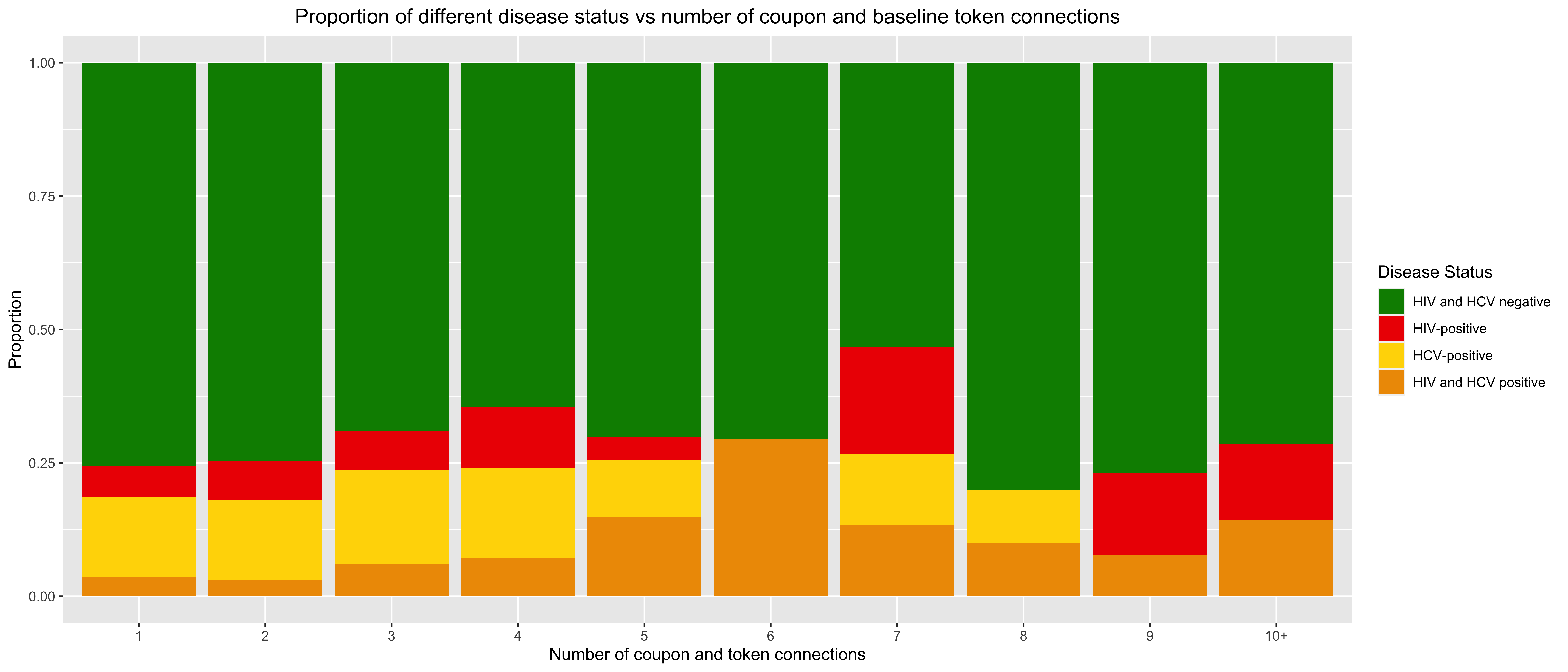
Among 2135 PWID enrolled thus far from May 2022 to August 2023, participants are mainly male (89.8%) and 34.6 years old (SD=±8.7) on average. 236/2135 (11.1%) are HIV positive; with highest regional prevalence in the Coast (130/962, 13.5%), followed by Nairobi (83/770, 10.8%), and Western Region (21/393, 5.3%). HCV follows a similar gradation moving inland – 425/2135 (19.9%) overall; 248/962 (25.8%), 175/770 (22.7%) and 2/393 (0.5%), respectively. On average, participants report they know 11.1 (SD=14.9) PWID who also know them among whom they have seen 8.4 (SD=6.2) in the last 30 days and have injected with 5.4 (SD=5.4). The average network size as determined by coupon and token recruits was 2.2 with 7 (0.3%) having >10 connections. We observed a highly significant positive relationship between the number of RDS connections and likelihood of HIV/HCV co-infected vs uninfected (p<0.001), HIV-monoinfected vs uninfected (p<0.001), and HCV mono-infected vs. uninfected (p<0.05).
Conclusions:
These data, while preliminary, may inform policy makers and programs on HIV and HCV treatment and prevention strategies among PWID. The robust link between network connectivity and elevated HIV and HCV risk highlights the importance of network dynamics in disease transmission. Further study is needed on the potential efficiency of network-based interventions compared with traditional testing and linkage to care to advance efforts toward ending the HIV epidemic and HCV elimination.