Prevention of mother-to-child HIV transmission (PMTCT) requires sustained maternal retention and viral suppression. We hypothesized that integrating HIV messages within a maternal child health (MCH) short messaging system (SMS) platform could improve retention and viral suppression.
The Mobile WAChX 3-arm unblinded randomized trial (RCT) compared 2-way and 1-way SMS messaging to no SMS control. We adapted an existing MCH SMS platform to incorporate antiretroviral therapy (ART) adherence messages based on the Health Belief Model and Social Cognitive Theory. ART and MCH SMS were sent weekly; visit reminders were sent 3 days before appointments. Participants at 6 MCH clinics in Nairobi and Western Kenya were enrolled in pregnancy, randomized, and followed until 24 months postpartum. Clinic attendance, viral load (VL), and infant HIV test results were abstracted from clinic records. Primary outcomes were viral non-suppression (VL ?1000 c/ml), on-time clinic attendance (within 2 weeks), loss to follow-up (?6 months out of care), and infant HIV-free survival. Intent-to-treat analyses compared arms using generalized estimating equations and Cox regression, adjusted for baseline differences.
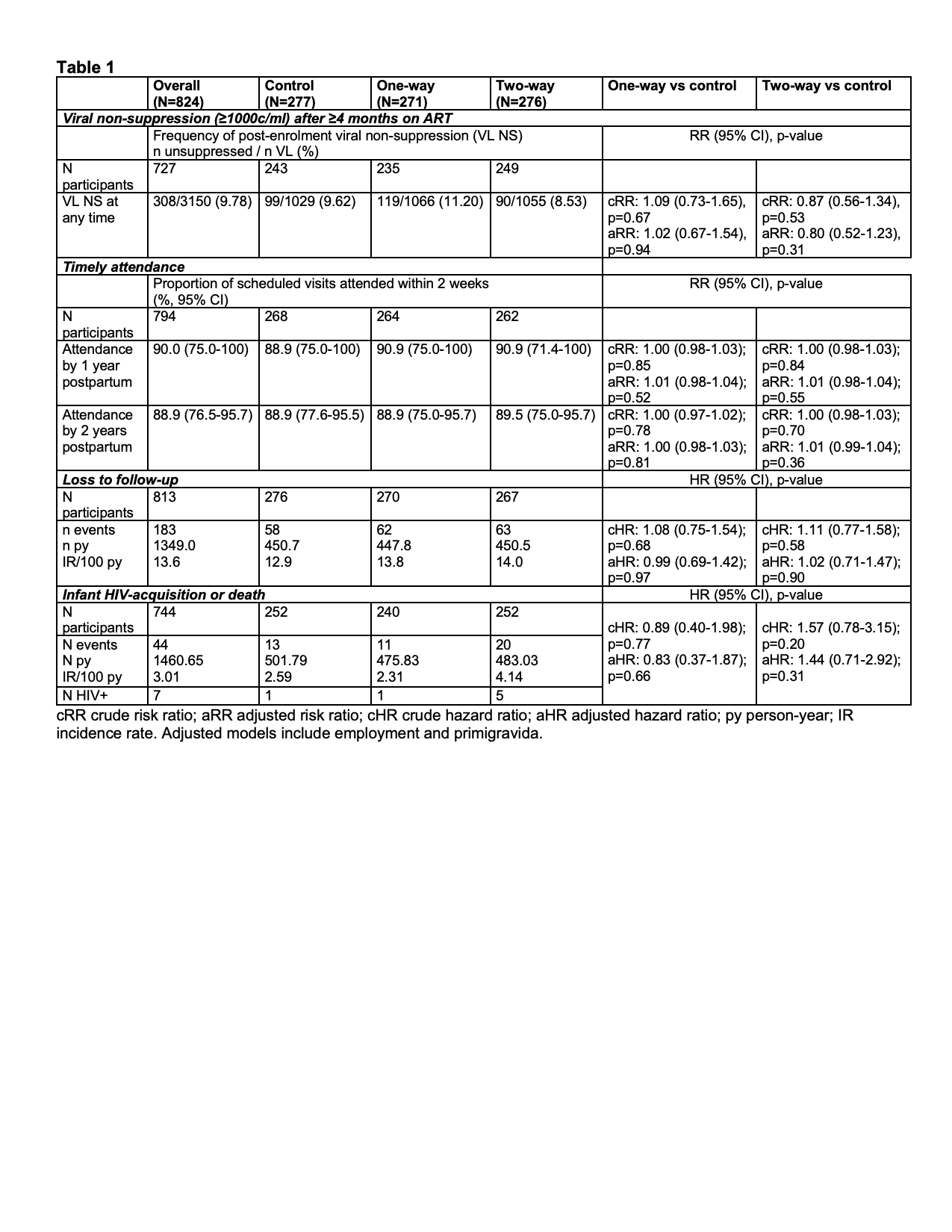
Overall 824 pregnant women were randomized (271 2-way, 276 1-way, 277 control). Median age was 27 years (Interquartile Range (IQR) 23-31), gestational age was 24.3 weeks (IQR 18.3-29.6), and time since ART initiation was 1.00 year (IQR 0.02-3.21). During follow-up to 24 months postpartum, 9.78% of 3150 VL assessments were unsuppressed. There were no differences in frequency of non-suppression in 1-way vs. control (adjusted Risk Ratio (aRR) 1.02 [95% Confidence Interval (CI) 0.67-1.54]) or 2-way vs. control (aRR 0.80 [95% CI 0.52-1.23]) (Table 1). Overall, 88.9% (95% CI 76.5-95.7) of visits were on-time, with no difference in 1-way vs. control (aRR 1.00 [95% CI 0.98-1.03]) or 2-way vs. control (aRR 1.01 [95% CI 0.99-1.04]). Incidence of infant HIV acquisition or death during follow-up was 3.01/100py, with no difference in 1-way vs. control or 2-way vs. control arms; overall HIV transmission risk was 0.94%.
In this multi-site RCT in Kenyan PMTCT programs, MTCT was rare despite appreciable maternal viral non-suppression. Integrated HIV/MCH messaging did not improve clinic attendance or viral suppression. Potential reasons for lack of effect include high baseline clinic attendance or low impact of generic adherence message. Tailoring SMS to real-time VL results may enhance relevance.