Background:
Pre-exposure prophylaxis (PrEP) programs present a platform for integrating curable sexually transmitted infection (STI) testing and treatment. Point-of-care (POC) STI testing has been hypothesized to influence PrEP use, but data are few, especially in pregnancy. We evaluated the impact of POC STI testing compared to standard-of-care (SOC) STI syndromic management on PrEP initiation and persistence among pregnant women in antenatal care in Cape Town, South Africa.
Methods:
We enrolled consenting pregnant (≤34 weeks), HIV-negative women (aged ≥18 years) in Cape Town at their regular antenatal visit. Eligible women were randomised (1:1) to either the SOC (syndromic STI management in antenatal care) or intervention (POC STI testing) arm. Women were offered oral PrEP at baseline and asked to return after 1 month for PrEP counselling and dried blood spot (DBS) collection for tenofovir disphosphate (TDF-DP) analysis. Women in the intervention arm self-collected vaginal swabs that were tested for Chlamydia trachomatis, Neisseria gonorrhoeae and Trichomonas vaginalis using a Cepheid GeneXpert test and offered same-day treatment if diagnosed. We evaluated the proportion of women initiating PrEP and PrEP persistence at 1-month (through self-report and DBS) by study arm.
Results:
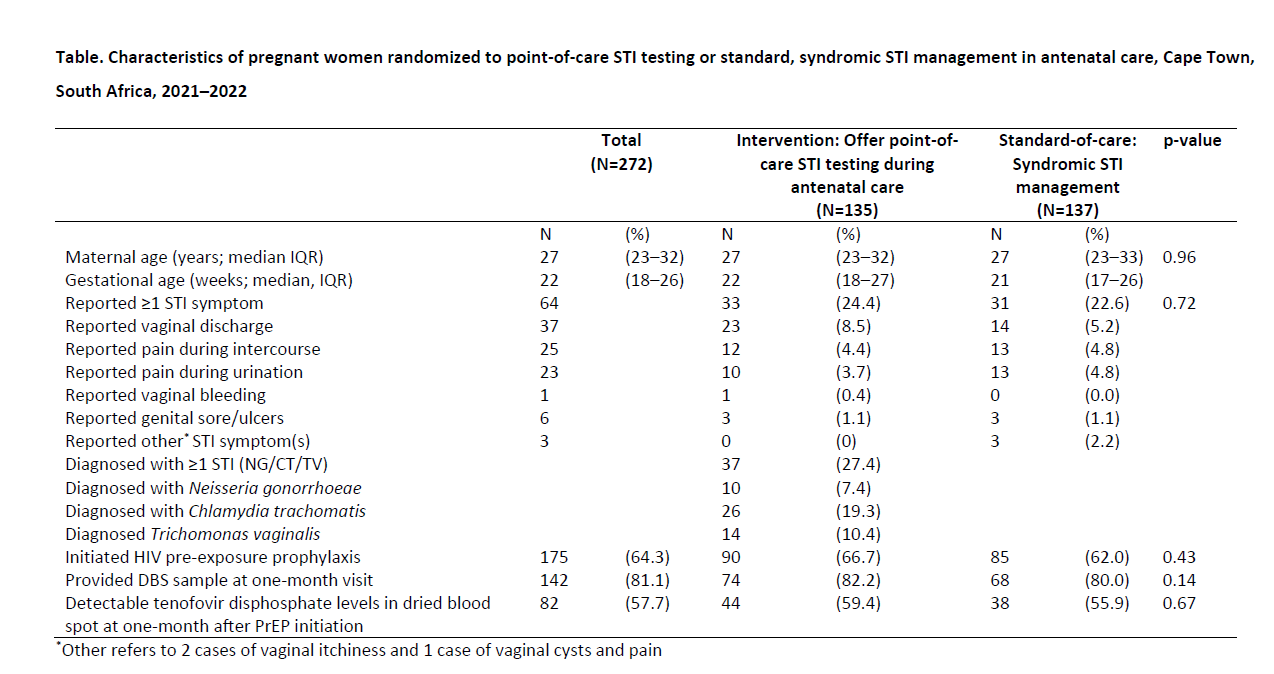
Between November 2021 and July 2022, we enrolled and randomized (1:1) 272 pregnant women (median age 27 years; median gestation 22 weeks). Twenty-seven percent of women in the intervention arm were diagnosed with ≥1 STI vs. 23% of women who were treated for STI symptoms in the SOC arm (p=0.83). Overall, 64% of women initiated PrEP at baseline (62% in SOC; 67% in intervention arm; p=0.43); increasing to 72% among STI diagnosed/symptomatic compared to undiagnosed/asymptomatic women (76% among intervention [p=0.17] and 68% among SOC [p=0.46] arm). Among 152 women that reported PrEP persistence data, 55% reported taking 7 doses/week (51% in SOC, 44% in POC arm; p=0.42) in the last 30 days. Among 142 women with DBS results (93%), 58% had detectable levels of tenofovir at 1-month (60% among intervention and 56% among SOC; p=0.67).
Conclusions:
The proportion of PrEP initiating or persisting (through self-report or DBS) women did not differ by POC vs syndromic STI management. A higher proportion of STI diagnosed and symptomatic women initiated PrEP compared to negative or asymptomatic women, suggesting that STI testing and/or treatment may influence PrEP initiation in pregnant women.
Characteristics of pregnant women randomized to point-of-care STI testing or standard syndromic STI management in antenatal care, Cape Town, South Africa, 2021–2022