Background:
Management of hypertension has emerged as a priority among women living with HIV (WLHIV). Our goal was to evaluate cross-sectional associations of race/ethnicity and HIV status with prevalence, awareness, treatment, and control of hypertension among women participating in the Women’s Interagency HIV Study (WIHS).
Methods:
This study included women who were recruited into WIHS Southern sites between 2013 and 2015. Hypertension was defined as systolic blood pressure ≥140 mmHg, diastolic blood pressure ≥90 mmHg, self-report, or use of anti-hypertensive medication. Awareness was self-reported as ever having hypertension and treatment was reported use of anti-hypertensive medication for hypertension. Blood pressure control was defined as < 140/90 mmHg as aligned with clinical guidelines when baseline data were collected. Prevalence ratios (PRs) for each hypertension outcome were estimated using Poisson regression models with robust variance estimates adjusted for sociodemographic, behavioral, and clinical risk factors.
Results:
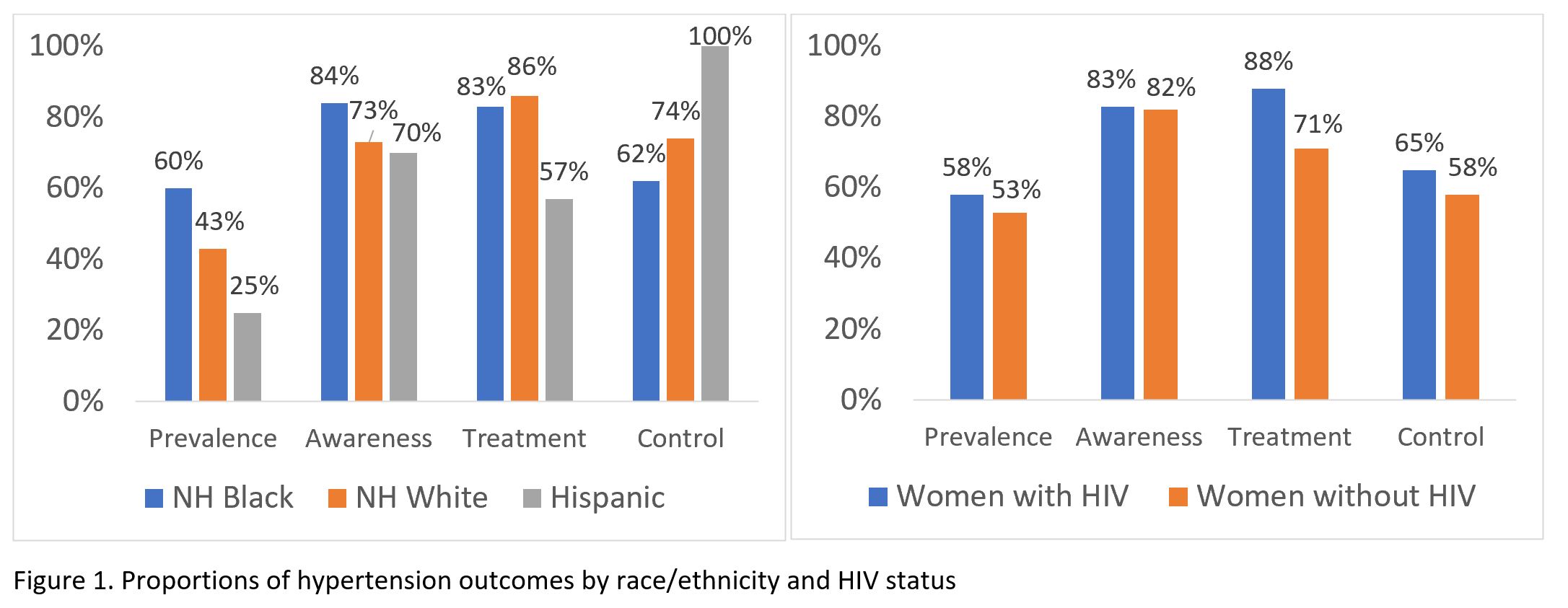
Among 712 women participating in WIHS Southern sites, 602 (84%) were non-Hispanic (NH) Black, 70 (10%) were NH White, and 40 (6%) were Hispanic, including 493 (69%) WLHIV. The average age was 43 years and 401 (56%) had hypertension. Eighty-three percent of women with hypertension were aware of their diagnosis. Of those aware, 83% were currently taking anti-hypertension medication and 63% of women who were treated for hypertension had documentation of controlled hypertension. We found that NH White and Hispanic women had lower prevalence of hypertension compared to NH Black women [PR 0.70 (95% CI 0.54–0.90) and PR 0.52 (95% CI 0.32–0.85), respectively, p< .0001]. Additionally, Hispanic women had better controlled hypertension compared to NH Black women [PR 2.16 (95% CI 1.54–3.01), p< .0001]. WLHIV who had hypertension were more likely to be on anti-hypertension medication compared to women without HIV [PR 1.19 (95% CI 1.01–1.40), p=.0345] (Figure 1).
Conclusions:
In this study population of women living with and without HIV in the U.S. South, prevalence of hypertension was lowest among Hispanic women and highest among NH Black women. Control of hypertension was lowest among NH Black women. Awareness and treatment were similar among race/ethnicity. Women without HIV were less likely to be on anti-hypertensive medication compared to WLHIV although prevalence of hypertension was similar between both groups.
Proportion of hypertension outcomes by race/ethnicity and HIV status