Background:
Initiation of antiretroviral therapy (ART) with tenofovir disoproxil fumarate (TDF)-containing regimens is associated with bone loss and fracture in persons with HIV (PWH). Vitamin D3 (VitD) and calcium supplementation attenuates declines in bone mineral density (BMD); however daily oral regimens increase pill burden and complexity.
Methods:
We conducted a randomized, double-blind, placebo-controlled trial at three HIV care centers in Beijing, China. ART-naïve adults were randomized to receive 180,000 IU VitD oral solution (equivalent of 2000 IU daily) or placebo with initiation of TDF/lamivudine/efavirenz and at the point-of-care every 12 weeks for 48 weeks. All participants received an educational pamphlet regarding dietary calcium. BMD assessments via dual-energy x-ray absorptiometry were assessed at baseline and 48 weeks; 25-hydroxyvitamin D (25OHD) and bone turnover marker levels were measured at baseline, 24, and 48 weeks.
Results:
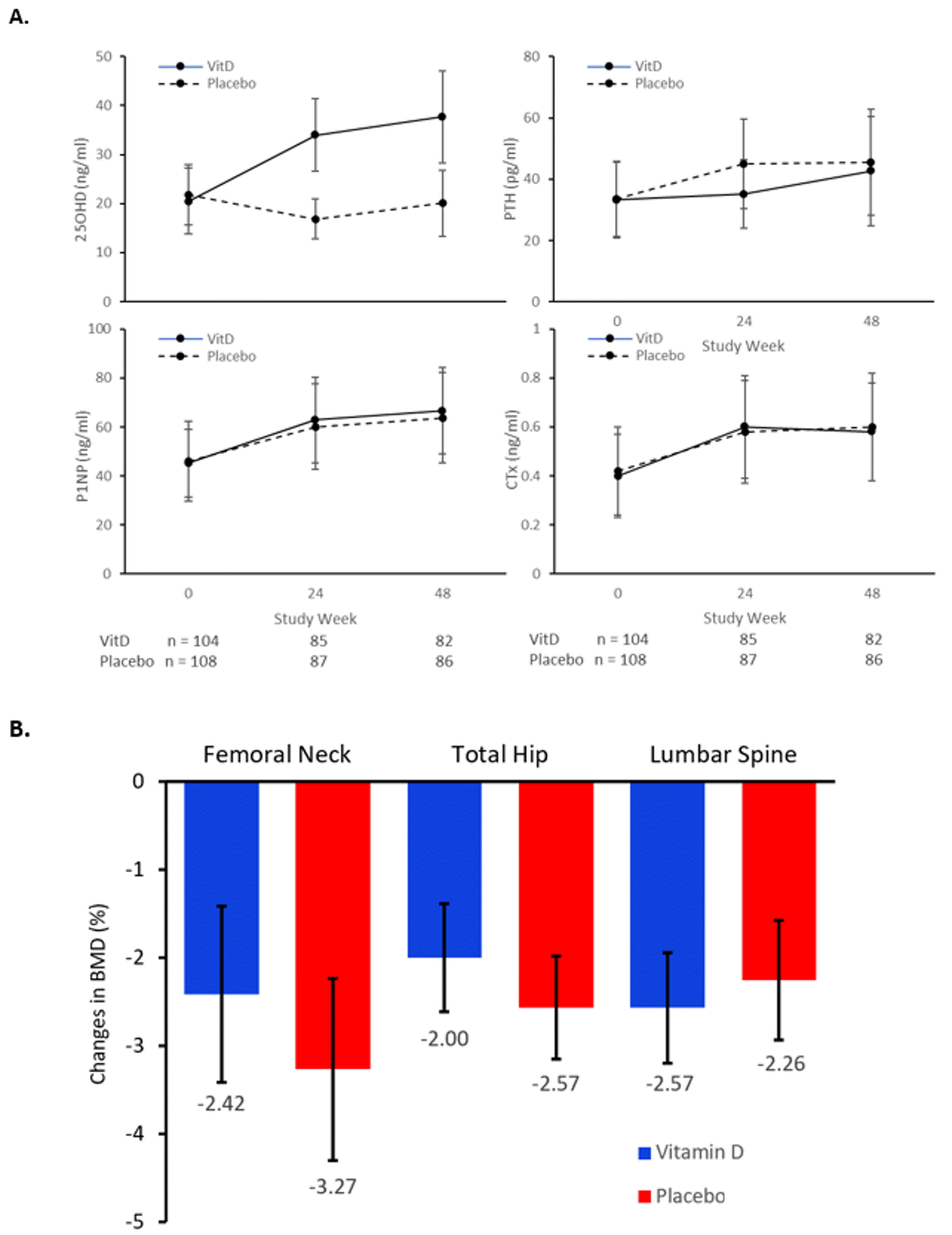
In total, 198/247 (80.1%) of randomized participants completed 48 weeks of follow up (VitD =96, placebo=102). The study groups were similar at baseline with a mean age of 31 years, 99% men, BMI of 22 kg/m2, HIV viral load of 4.41 mean lg copies/mL, and 50% meeting criteria for vitamin D deficiency (25OHD < 20ng/mL). At 48 weeks 96% of patients in both groups had achieved viral suppression ( < 200 copies/mL). Mean 25OHD levels increased in the VitD group from 20.5±6.7 to 37.7±9.4 ng/mL over 48 weeks—with 80.5% of patients achieving vitamin D sufficiency (25OHD >30ng/mL)—but remained unchanged in the placebo group (Figure 1A). Within both groups, BMD declined significantly from baseline to 48 weeks at all sites (p < 0.001), however mean percent decrease in BMD did not differ significantly between treatment groups at the lumbar spine (p=0.5), total hip (p=0.19), and femoral neck (p=0.24) (Figure 1B). A total of 8 patients in the treatment group and 18 patients in the placebo group reported an adverse event, with no cases of hypercalcemia or nephrolithiasis, and similarly low rates of falls and fractures.
Conclusions:
Quarterly administration of an oral vitamin D3 supplement equivalent to 2000 IU daily was well tolerated in our study population but did not attenuate declines in BMD after initiation of TDF/lamivudine/efavirenz or decrease bone turnover markers in comparison to placebo. Potential reasons include insufficient vitamin D dose, lack of calcium co-administration, and limited sample size.
Figure 1. Change in measures from baseline to 48 weeks. A) Mean (95%CI) percent change in BMD from baseline to 48 weeks at the femoral neck, total hip and lumbar spine. B) Changes levels of 25OHD, parathyroid hormone (PTH), and markers of bone formation (Procollagen Type I Intact N-terminal Propeptide, P1NP) and bone resorption (serum cross-linked C-telopeptide of type I collagen, CTx) at baseline, 24 and 48 weeks.