Background:
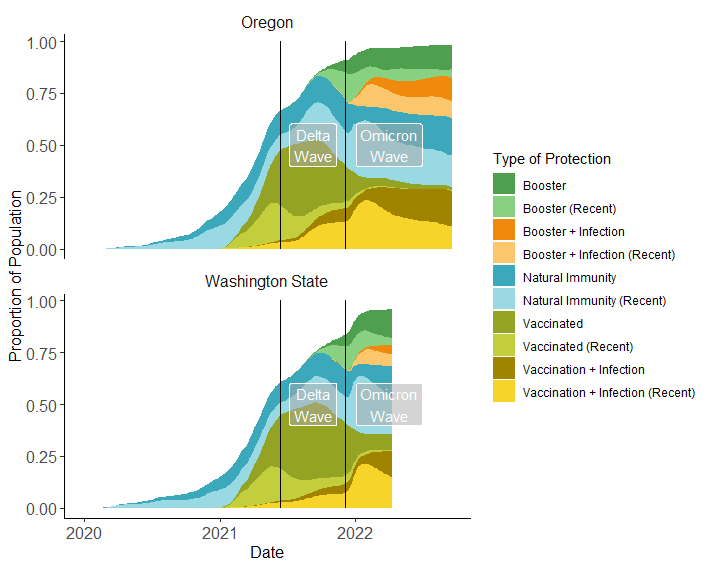
Since early 2020, the novel SARS-CoV-2 virus has spread rapidly throughout the globe. Subsequently many individuals have developed some form of immunity due to either a prior infection, one or more vaccinations, or a combination of the two. Using local epidemic data and mathematical modeling, we enumerate the various immune populations in Washington State and Oregon and quantify the level of protection against infection and hospitalization.
Methods:
We developed a compartmental model of ordinary differential equations, which stratifies the population by age (0-17 years, 18-49 years, 50-64 years, and 65+ years), region, type of immunity (naïve, infection-derived, vaccine-derived, booster-derived, hybrid immunity, etc), and recency of immune conferring event (recent and waned). To track the number of individuals in each category we combine 1) literature-based estimates of susceptibility to infection and severe disease by age, immune status, and variant, 2) calibration to the number of severe infections (hospitalizations and deaths) and number of vaccinations and 3) validation with serological surveys of the population.
Results:
We estimate that by mid-April 2022 more than 95% of the populations of both Washington and Oregon had some immunity against COVID-19 infection and hospitalization. Younger age groups tended to have much higher rates of natural or hybrid immunity with 96% of 0–17-year-olds and 83% of 18–49-year-olds protected due to past infections. Overall, the population-level immunity against the Omicron variant reduced risk of infection by 59% (95% Credible Interval 54% – 62%) and risk of hospitalization by 79% (95% CI 77% – 81%) in Washington and 62% (95% CI 57% -66%) and 83% (95% CI 82% – 85%), respectively, in Oregon. There was similar population-level protection against Delta at the start of the Omicron wave in early December 2021, which reduced risk of infection by 60% (95% CI 56% – 63%) and risk of hospitalization 79% (95% CI 78% – 80%) in Washington and 66% (95%CI 63% – 70%) and 82% (81% – 83%), respectively, in Oregon.
Conclusions:
Very large waves of new infections throughout 2021 and early 2022, in addition to high levels of vaccination and boosting among the older age groups in Washington and Oregon have greatly reduced population susceptibility to currently circulating strains. However even very high population immunity has allowed for emergence of novel variants that escape existing immunity, highlighting the need for continued develop of new variant-specific boosters.