Background:
Although recent modeling suggests needle-syringe programs have reduced parenteral HIV transmission among people who inject drugs (PWID) in Kenya, the prevalence in this population remains high (~14-20%, compared to ~4% in the larger population). Reducing transmission or acquisition requires understanding historic and modern transmission trends, but the relationship between the PWID HIV sub-epidemic and the general epidemic in Kenya is not well understood. Incorporating 6-times more HIV sequences from PWID in Kenya than in prior studies, we quantified rates and direction of HIV-1 transmission involving PWID and other populations from the coast and Nairobi regions.
Methods:
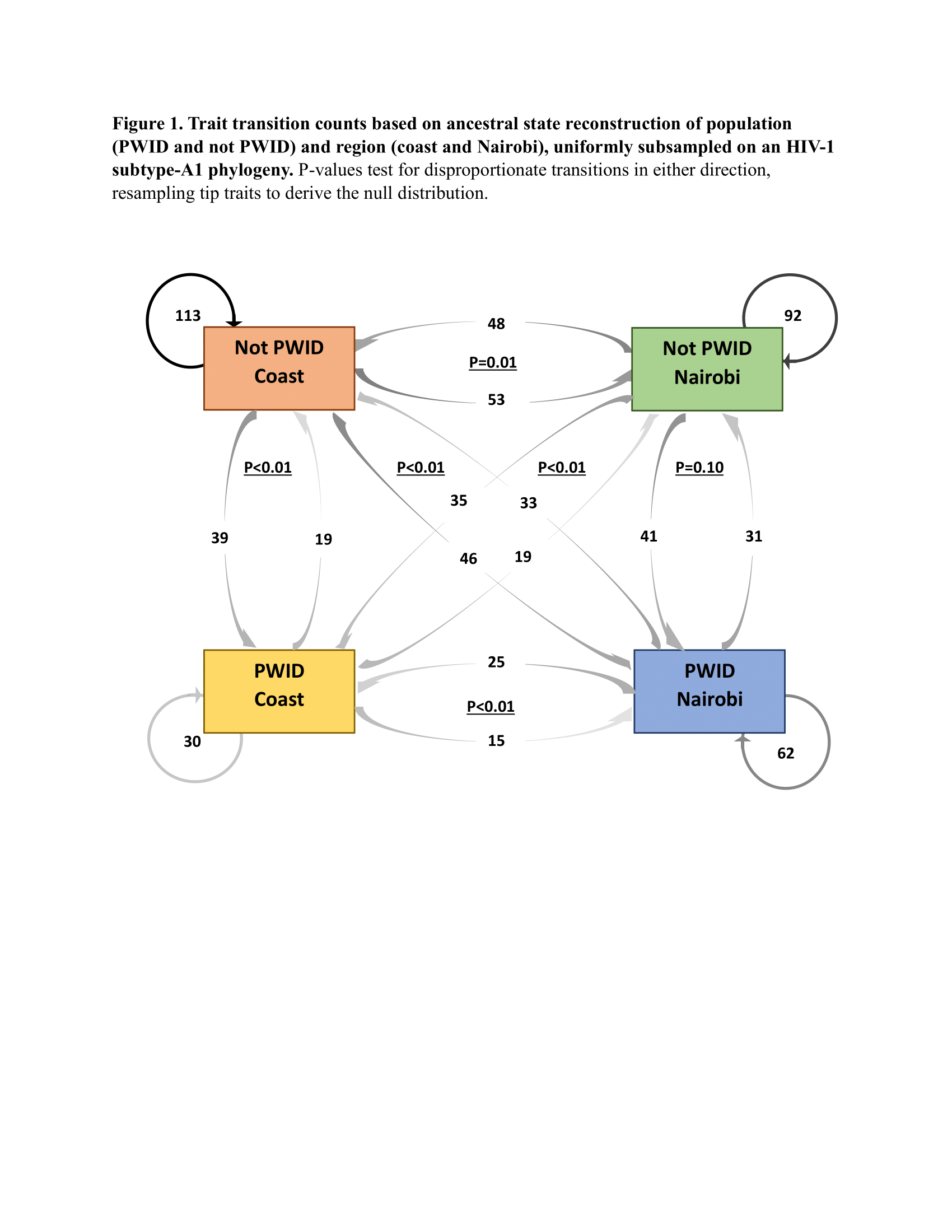
We aligned 303 new (2018-2021) HIV-1 pol sequences from PWID and their sexual and injecting partners with 2,666 previously published Kenyan sequences. We used genetic similarity cluster analysis (thresholds: patristic distance <0.045, aLRT >0.90) and maximum likelihood ancestral state reconstruction to estimate transmission histories at the population (female sex workers, men who have sex with men, PWID, or not key population) and regional (coast or Nairobi) levels. Transition counts estimate how often an ancestor sequence gave rise to a descendant sequence from a different population and/or region.
Results:
In this cohort, 1,081 participants lived with HIV, of whom 274 (25%) were not virally suppressed and 303 (28%) had sequences available. Of new PWID sequences, 55% were in phylogenetic clusters, and the vast majority were interspersed with sequences from other key populations and from those not in key populations. Only 22% of clusters containing PWID sequences included a second PWID sequence. Ancestral state reconstruction (Figure 1) identified substantial transmission between the coast and Nairobi regions and more not-PWID to PWID transmission than PWID to PWID transmission.
Conclusions:
Despite recruiting PWID from local injecting networks, we found minimal linked transmission in this population. This suggests low rates of recent parenteral transmission and supports interventions to reduce sexual transmission while maintaining needle-syringe programs. Because the epidemic among PWID and other populations are inter-related, interventions within the larger population, where we also observed the most transmission between regions, may have carry-over benefits for reducing HIV prevalence in PWID and vice versa. However, greater understanding of how PWID and non-PWID populations interact is needed.