The announcement of the United States’ Ending the HIV Epidemic (EHE) initiative in 2019 articulated a comprehensive strategy to end HIV in high-burden jurisdictions across the country. However, the localized nature of the HIV epidemic in the US suggests that decisions regarding specific priority interventions and key populations must be made at the local level.
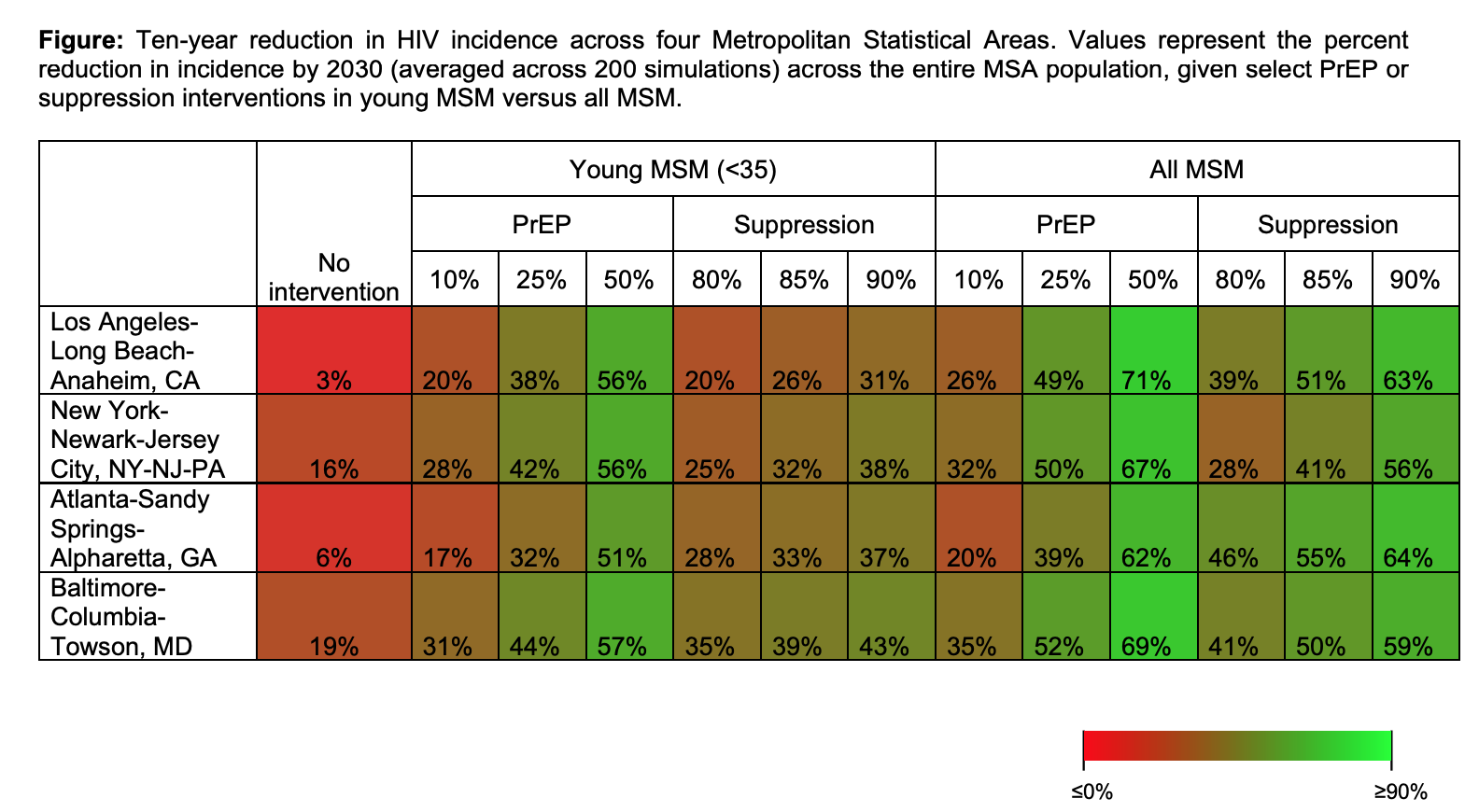
We applied Johns Hopkins Epidemiological and Economic Model (JHEEM), a dynamic, compartmental model of HIV epidemic in US, to evaluate the relative benefits of increased pre-exposure prophylaxis (PrEP) coverage versus improved viral suppression in young (age <35) men who have sex with men (MSM) versus all MSM. We selected four metropolitan statistical areas (MSAs) for comparison: Los Angeles, New York City, Atlanta, and Baltimore. In each MSA, we compared scenarios corresponding to improved PrEP coverage (proportion of individuals at risk for HIV infection who are prescribed and adherent to PrEP and tested for HIV every three months) and improved viral suppression at three levels, assuming scale-up from 2021-2022, with continuation from 2022-2030. Our primary outcome was the MSA-wide reduction in HIV incidence by 2030, evaluated as the mean across 200 independent model simulations.
Across the four MSAs, scaling up PrEP among young MSM yielded large reductions in incidence, while the marginal impact of expanding PrEP interventions to all MSM was modest. The possible benefit of improved suppression, on the other hand, was maximized by scale-up among all MSM more broadly. For example, in Los Angeles, 25% PrEP coverage among young MSM (versus all MSM) reduced ten-year HIV incidence by a projected 38% (versus 49%), whereas increasing suppression to 85% provided a 26% (versus 51%) reduction. Overall, an optimistic strategy of focused PrEP among young MSM (25% coverage) plus broad increases in suppression among all MSM (85% suppression) could lead to a 58-70% reduction in HIV incidence by 2030, while an aspirational strategy of 50% PrEP coverage among young MSM combined with 90% suppression among all MSM was nearly sufficient to meet EHE targets (74-83% reduction in HIV incidence by 2030).
The impact of improved PrEP coverage and viral suppression varies substantially at the local level, but model projections suggest that a strategy targeting PrEP to young MSM while improving suppression levels among MSM in care more broadly could be effective.