With higher risk of cardiovascular disease (CVD) in persons with HIV (PWH), management of hypertension, dyslipidemia, and diabetes mellitus is crucial. Here, we evaluate the extent to which PWH have successfully managed these conditions and their influence on CVD risk.
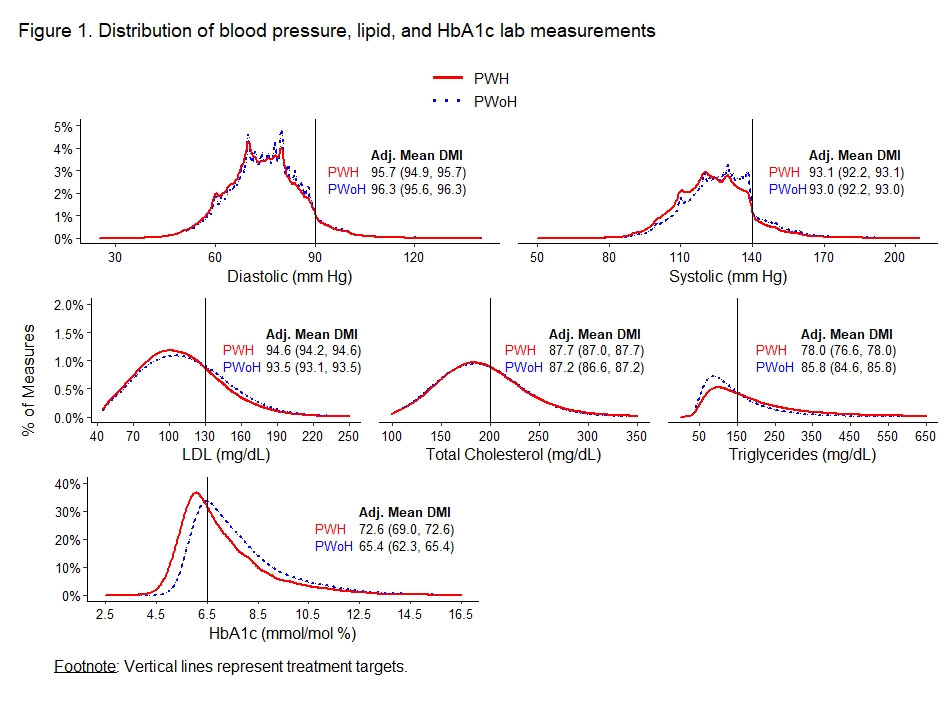
Cohort study of adult (?18 years) PWH and 20:1 age-, sex-, race/ethnicity-matched persons without HIV (PWoH) who were members of an integrated healthcare system in Northern California during 2013-2017. We excluded subjects with prevalent CVD (coronary heart disease or ischemic stroke). In those with hypertension, dyslipidemia, and diabetes, we computed the disease management index (DMI), which accounts for both the amount and duration of person-time above treatment goal (vertical lines in Figure) over 6-month intervals. A DMI of 100% represents perfect control and DMI <100% is the amount in control relative to a reference treated population. Next, using Cox regression, we computed hazard ratios (HR) for incident CVD by HIV status overall, and in subgroups of those with successfully controlled risk factors (i.e., DMI 100%). Models were adjusted for other key modifiable risk factors (smoking and alcohol use), demographics, and clinical factors (Charlson comorbidity index, depression, body mass index, healthcare utilization).
The study included 8,285 PWH and 170,517 PWoH, with similar prevalences of hypertension (19% PWH; 22% PWoH), dyslipidemia (41% for both) and diabetes (8% PWH; 9% PWoH). PWH and PWoH had similar control of most conditions (with DMIs approaching 100%) except for triglycerides (worse control for PWH) and HbA1c (better control for PWH) (Figure). Among PWH, other factors, including smoking and unhealthy alcohol use, had only marginal associations with reduced DMIs. Overall, PWH had 450 CVD events (20.8 per 1,000 person-years) and PWoH had 7,648 events (17.0 per 1,000 person-years), with an adjusted HR of 1.18 (95% CI 1.07-1.30). The elevated risk of CVD for PWH was attenuated and not statistically significant when comparing PWH and PWoH with successfully controlled dyslipidemia (HR 1.10; 95% CI 0.91-1.34), and diabetes (HR 1.02; 0.72-1.42), but remained significant for those with successfully controlled hypertension (HR 1.35; 1.10-1.67).
Successful management of dyslipidemia and diabetes may help mitigate the CVD disparity in PWH. Further research is needed to evaluate whether more stringent hypertension treatment goals than <140/90 mm Hg are needed to prevent CVD in PWH.