Given the inevitable, likely substantial, under-ascertainment of SARS-CoV-2 infection at the population level, using routine laboratory testing, the prevalence of SARS-CoV-2 antibodies (‘seroprevalence’) is an important marker of Covid-19 epidemiology. As nationally representative household surveys are a major undertaking, it will be important to find efficient ways to reliably estimate antibody prevalence from much simpler, less expensive protocols.
Subject to meeting standard blood donor eligibility criteria, and a standing opt-out arrangement for research use of specimens primarily obtained for blood safety screening, unsolicited blood donations, obtained on particular ‘collection days’ at 219 donation sites in South Africa, during January 2021, were tested for SARS-CoV-2 antibodies using the Roche Cobas e411 platform. Donors are currently requested to defer donation if they were diagnosed with Covid-19, or experienced Covid-19-like symptoms, in the preceding 14 days. Estimates were stratified by age, sex and race. The study will have additional testing days. Phone interviews with both antibody positive and negative donors are being conducted to probe PCR diagnosis and symptoms.
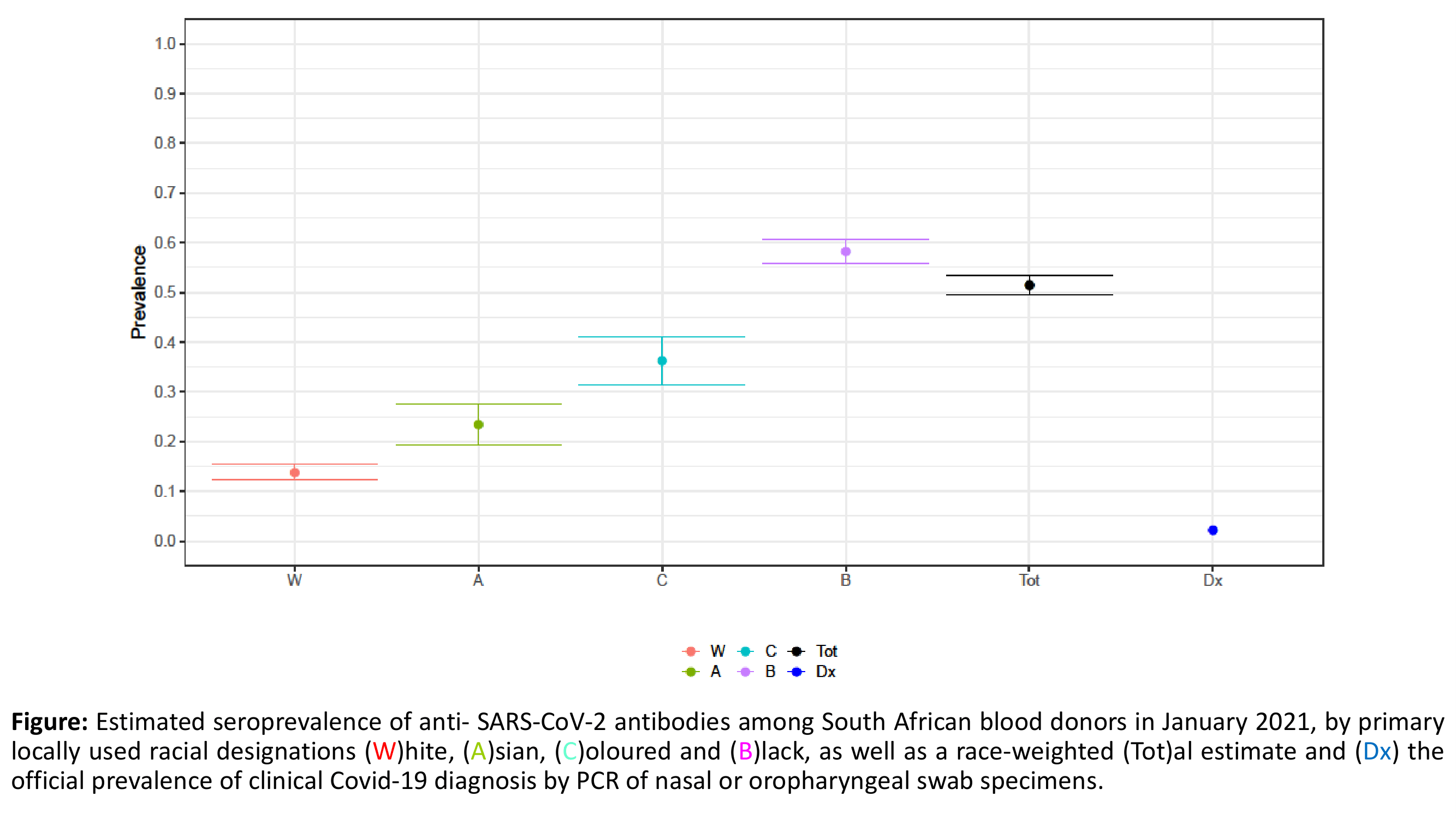
Tested donations numbered 4547, from donors aged 16-81. Seroprevalence did not vary significantly between sexes or age groups. Headline results for the main race groups (in South African nomenclature) are: Black 58.3% (95% CI 55.8 – 60.7% ), White 13.8% (95% CI 12.3 -15.4%), Asian 23.4% (95% CI 19.4 – 27.7%) and Coloured 36.2%(95% CI 31.4 – 41.1%). The population group weighted overall national estimate is then 51.4% (95% CI 49.4 – 53.4%). This is almost 25 times as high as the official prevalence, on 10 January, of having been diagnosed with Covid-19, namely 2.1%. See Figure.
These are the first relatively widely representative SARS-CoV-2 antibody prevalence estimates from South Africa. Population level representativeness of this methodology warrants further exploration – but it is worth noting that 1) as elsewhere, the obtained antibody prevalence estimates imply SARS-CoV-2 attack rates that are easily an order of magnitude higher than the apparently relatively uninformative official case counts; and 2) the marginal cost of performing this study, over the cost of routine blood bank operations, was almost entirely comprised of the cost of reagents. South African case fatality rate estimates will need significant revision.