Background:
Recent data show that ‘unusual’ hepatitis C virus (HCV) subtypes have lower responses to direct-acting antivirals (DAAs) compared to most prevalent subtypes. We aimed to investigate the prevalence and resistance profiles of ‘unusual’ HCV subtypes in Italy.
Methods:
Clinical and virological data of ‘unusual’ HCV genotype (GT)/subtypes (defined as GT1 non-1a/b, GT2 non-2a/b, GT3 non-3a, GT4 non-4a/d) were analyzed within the Italian VIRONET-C database. Subtype assignment was confirmed by phylogenetic analyses on NS3±NS5A±NS5B sequences. The prevalence of resistance associated substitutions (RASs) was evaluated according to Sorbo et al 2018 list.
Results:
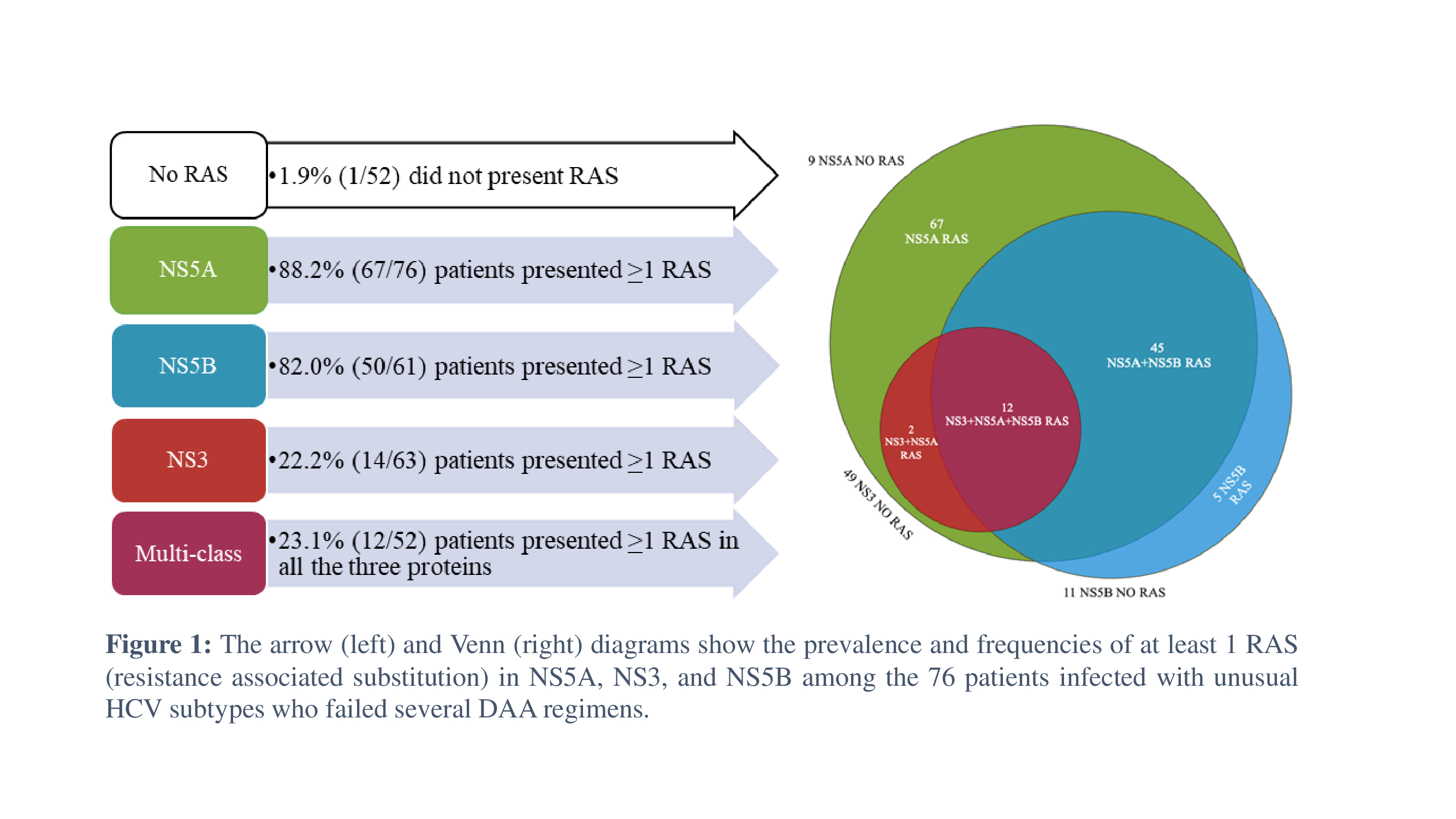
Out of 3554 individuals with an available NS3±NS5A±NS5B sequence, 282 (8%; median age [IQR], 73 [57-81]years; 58% males) were infected with ‘unusual’ subtypes (GT1g/i/l=3/1/2; GT2c/j=247/2; GT3b/g/h/k=1/1/8/1; GT4c/i/l/m/n/o/r/v=1/1/1/1/3/5/3/1). Subtype distribution varied according to ethnicity, with GT2c and GT3h most prevalent in Italians (88-100%), other ‘unusual’ GT3 in Asians (75%), and ‘unusual’ GT1 and GT4 in Africans (78%). 206 individuals (73%) were DAA-naïve, while 76 were DAA-failures (27%), in particular 36 with a recommended regimen (22 glecaprevir/pibrentasvir and 14 sofosbuvir/velapatasvir±ribavirin). The patients infected with GT3 unusual subtypes were more prone to failure (91%, 10/11) followed by GT4 (44%, 7/16), GT2 (23%, 58/249) and finally GT1 (17%, 1/6). All failed patients (except one with GT4n) displayed at least one RAS in at least one protein (Figure 1). The number of RASs in each protein varied by GT, subtype and treatment exposure. Overall, NS5A-RASs were most prevalent, with complex patterns in both DAA-naïve and failures, NS3-RASs were less prevalent but present in all GT3 failures, while NS5B-RAS were rare and present across GT2-GT3-GT4, with variable patterns. NS5A-RASs at position 93 (H/F/S) were detected only at failure in GT3h/k and GT4o/v. Few patients had NS3-RASs, only at failure (3/3 GT3h:80R or 158V; 4/24 GT2c:56Y/H±168V/A).
Conclusions:
In this Italian setting, GT1-GT4 unusual subtypes were frequent, predominated by GT2c in Italians, and with failure rates highest within GT3. Most DAA-failures carried complex NS5A-RAS patterns, some conferring high-level of resistance. These results advise for closer surveillance and further studies to better characterize the impact of ‘unusual’ HCV subtypes on DAA efficacy.