Background:
Pre-exposure prophylaxis (PrEP) taken daily has been shown to be effective prevention against HIV acquisition and has been recommended by WHO for people at substantial risk for HIV since 2015. Zambia has been implementing the PrEP program since 2017 and rolled it out nationwide in 2018.
Methods:
We analyzed data from the 2021 Zambia Population Based HIV Impact Assessment (ZAMPHIA). We used descriptive analysis (with chi-square test) to analyze demographic and behavioral characteristics of PrEP knowledge and PrEP use, and a weighted multivariable logistic regression model to identify key predictors of PrEP use among all participants. All results were weighted to account for complex survey design.
Results:
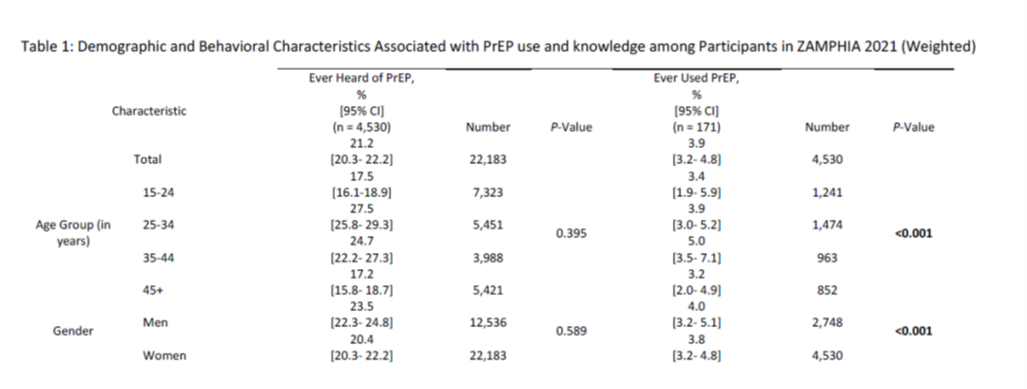
Among 22,183 participants aged 15+ year who answered the PrEP questions, 21.2% (95% CI: 20.3- 22.2) reported ever having heard of PrEP: 18.9% (95% CI: 17.6-20.2) among men and 23.5% (95% CI: 22.3-24.8) among women. Within age groups 17.5% (95% CI 16.1-18.9) of young adults aged 15 to 24 years and 17.2% (95% CI: 15.8-18.7) of those aged 45+ years had ever heard of PrEP. Other characteristics associated with having ever heard of PrEP were being married (22.1% [95% CI: 20.9- 23.3]), living in urban areas (30.3% [95% CI:28.5-32.1]) and having more than a secondary education (56.7% [95% CI:52.8-60.4]). Of those who have ever heard of PrEP, 3.9% (95% CI: 3.2- 4.8) reported ever using PrEP. PrEP use was highest among those who reported having a sexual partner who is HIV positive 16.5% [95% CI: 12.3- 21.7]). Those who reported a HIV positive sexual partner were more likely to report ever having used PrEP compared to those who did not know the HIV status of their partner (aOR 5.84 [95% CI: 3.27-10.41]; P<0.001).
Conclusions:
Although PrEP has been available country wide since 2018, just over one-fifth of adults age 15+ years were aware of PrEP. This is of concern particularly among young adults aged 15-24 who have the highest incidence of HIV as seen in ZAMPHIA. These results can guide the Ministry of Health to target the dissemination of PrEP information to populations with low knowledge of PrEP, including men, those aged 45+ years, living rural areas, and with lower education levels. These results demonstrate that having a sexual partner who is HIV positive is a strong predictor for ever having used PrEP. More efforts, however, are needed to increase uptake in other populations that are at substantial risk for HIV infection, such as persons with multiple sexual partners and low condom use.