Background:
Adherence to oral pre-exposure prophylaxis (PrEP) with tenofovir (TFV)-based PrEP among women in Africa in non-serodiscordant partnerships can be low based on clinical trial and real-world data. A point-of-care (POC) urine assay to objectively assess TFV in urine was recently developed by our group and POC urine monitoring of adherence-informed counseling (PUMA) increases virologic suppression rates among people with HIV on antiretroviral therapy. We performed a pilot trial examining the impact of PUMA on long-term PrEP adherence among HIV-negative women in Kenya.
Methods:
A pilot study randomized 100 women in non-serodiscordant partnerships in Thika, Kenya to standard-of-care (SOC) adherence counseling every 3 months for 12 months versus PUMA with visualization of the POC test by providers and participants. Urine tests were collected for 12-month analysis in the SOC arm, without providing results to participants or staff. Hair samples were collected at month 12 to assess the primary outcome of TFV levels in hair as a long-term metric of adherence in both arms. TFV levels in hair were measured by the UCSF Hair Analytical Laboratory using validated methods; TFV levels below the limit of quantification (BLQ) in hair, specifically <0.002 nanograms/milligrams, defined long-term non-adherence.
Results:
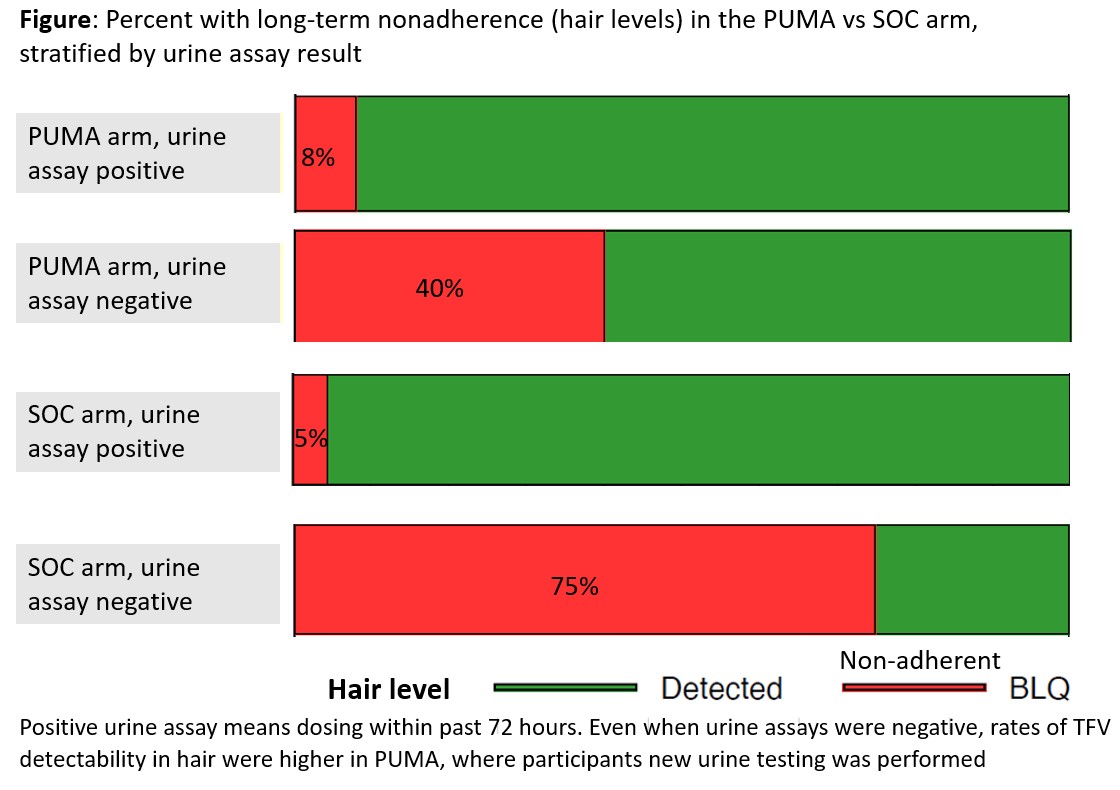
The trial enrolled 49 women in the PUMA arm and 51 women in the SOC arm with counseling performed every 3 months. Retention in the study was 86% in both arms. Hair was collected and tested from 42 participants in the PUMA arm at month 12; hair was collected from 43 participants and testing completed for 41 of those samples in the SOC arm. The percent of hair samples at 12 months with TFV levels BLQ in the SOC arm was 37% versus 21% in the PUMA arm. The relative odds of long-term non-adherence in the SOC arm compared to the PUMA arm was 3.53 (95% confidence interval 1.03, 12.03, p value 0.04). Knowledge that the urine assay was being performed in the PUMA arm seemed to decrease overall non-adherence as compared to the control arm, even when the urine assay showed no TFV (Figure). One seroconversion occurred over the 12-month study in the SOC arm.
Conclusions:
Scalable low-cost adherence interventions to increase pill-taking with oral PrEP are needed. PrEP counseling informed by a POC urine TFV test among at-risk Kenyan women on PrEP decreased overall non-adherence to PrEP at 12 months as determined by hair levels. The real-time urine TFV assay may have a role in improving long-term PrEP adherence.