Background:
Women of color and women of low socioeconomic status (SES) are underrepresented in HIV research, but their participation is crucial to improving HIV outcomes. We assessed baseline factors associated with visit attendance and dropout in women with HIV (WWH) and women without HIV in the Women’s Interagency HIV Study (WIHS).
Methods:
Women enrolled in WIHS from 2011-2015 were followed for up to 10 consecutive semiannual visits through 2019. Dropout was defined as no further attended visits with no passive follow-up and measured from the first missed visit. We assessed the association of baseline factors with full (100%), partial (71-99%) and low (≤70%) visit attendance rates by chi-square and then performed multivariable ordinal logistic regression adjusting for HIV status and factors with p< 0.10 in the bivariate analysis. A separate model in WWH included HIV-related factors. We then identified factors associated with early (visits 2-3), intermediate (visits 4-6) and late (visits 7-10) dropout compared with no dropout by chi-square.
Results:
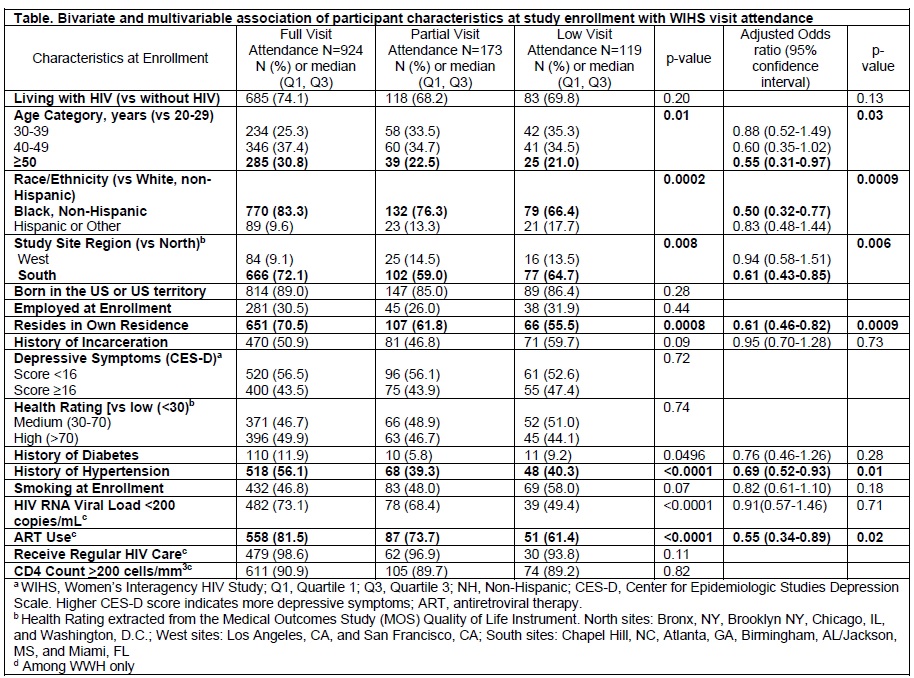
1214 (886 WWH, median age 44 years, 81% Black, 69% from study sites in the U.S. South, 59% income< $12,000/year) participants were included. 76% had full visit attendance, 14% had partial visit attendance, and 10% had low visit attendance. In the adjusted model, greater visit attendance was associated with age >50, Black race, living in one’s own residence, study site in the U.S. South, and history of hypertension (Table). Among WWH, greater visit attendance was associated with age >50, Black race, taking antiretroviral therapy (ART), and study site in the U.S. South. The retention rate was 81%. Early, intermediate, and late dropout occurred in 65(5%), 78(7%), and 82(8%) participants, respectively. Compared with no dropout, early dropout was associated with more depressive symptoms (CES-D score >16), lower health perception, smoking, HIV RNA >200 copies/ml, not on ART, and CD4 count< 200 cells/mm3. Intermediate dropout was associated with non-Black race, no history of diabetes, and being born outside the U.S. Late dropout was associated with employment, smoking, HIV RNA >200 copies/ml, not on ART, ever experiencing physical violence, and not getting regular HIV care.
Conclusions:
Retention in WIHS of predominantly Black, low SES women with and without HIV was excellent. Different baseline factors were associated with different study dropout times suggesting that different retention strategies may be required over time in a longitudinal HIV cohort study.
Table. Bivariate and multivariable association of participant characteristics at study enrollment with WIHS visit attendance