Background:
Long-acting injectable (LAI) cabotegravir/rilpivirine (CAB/RPV) provides a novel treatment option for people with HIV (PWH). However, missed and late injections potentially jeopardize viral suppression, increases risk of resistance development, and requires extensive resources to track adherence and proactively reschedule missed injections.
Methods:
We conducted a retrospective cohort study at the University of California San Diego Owen Clinic. Adult PWH who received LAI CAB/RPV for at least 6 months from May 2021 through August 2023 were included. Data collected included demographics, baseline HIV RNA and CD4 count, distance from the clinic, substance use, CAB/RPV dosing regimen, office visit no-shows one year prior to switching to LAI CAB/RPV, injection visit no-shows, injections outside of the dosing widow, and virologic outcomes. PWH were excluded if they had a late injection due to COVID-19 infection or planned/known travel. Cox-proportional hazards regression was performed to evaluate predictors of no-show to injection visits or late injections.
Results:
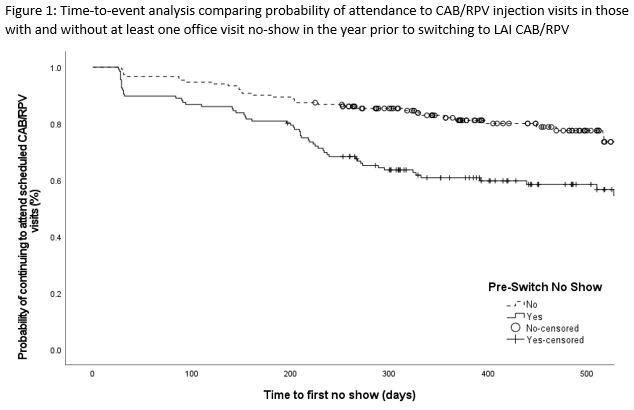
A total of 287 PWH were included with median age of 42 years, 54.4% were non-white, 38% Hispanic ethnicity, and 15% female sex assigned at birth (SAB). Median follow up time (IQR) on LAI CAB/RPV was 450 days (344-548 days), and median distance to the clinic was 4.8 miles (2.5-11.8 miles). A total of 92 (32.1%) had at least one no-show to a scheduled injection visit and 44 (15.3%) had at least one injection outside the recommended dosing window. Younger age (HR 0.97, 95%CI 0.95-0.98) and ≥ 1 office visit no-show in the year prior to switch (HR 2.03, 95%CI 1.32-3.12) were independently associated with having a no-show to an injection visit (Figure 1). The number of pre-switch no-shows was also significantly associated with post-switch no-shows (p<0.001) and those with at least one injection visit no-show had a higher frequency of late injections, 30.4% vs. 8.2%, p<0.0001. Male SAB (HR 9.18, 95%CI 1.26-66.9) after adjustment for age, was independently associated with late injection visits. There was no relationship between no-shows to injection visits or late injections and having a detectable viral load or virologic failure (n=3) after switch to LAI CAB/RPV.
Conclusions:
Conclusion: Evaluating attendance to office visits prior to switching to LAI CAB/RPV may help identify those more likely to miss injection visits, however it was not associated with late injections or having a detectable viral load or virologic failure.