Background:
It is recommended to identify and address adherence barriers to antiretroviral therapy (ART) in routine HIV care. From a conceptual framework, we created a 7-item patient-reported measure (Interference-Score) to evaluate seven barrier domains (i.e. Thoughts/Feelings, Habits/Activities, Social situation, Economic status, Medication, Care, and Health). Both English and French versions were produced with stakeholder engagement and cognitive testing. Here, we assess the measure’s construct validity.
Methods:
Recruited January to August 2022, people with HIV (PHIV) on ART in Canada and France completed the 7-item I-Score with 4 dependent variables at baseline (Time 1) and 4 weeks later (Time 2): dichotomized self-reported measures of adherence (past 7 days, past 30 days), intention to adhere, and HIV viral load. We conducted 3 types of analyses: 1) inter-item correlations (Spearman’s coefficients) to assess item redundancy at Time 1; 2) logistic regressions with all 7 items (covariates), with one model for each dependent variable, to assess each item’s significance; and 3) Receiver operating characteristic (ROC) curve analyses and appropriate reference values, to evaluate the 7-item models’ predictive capacity. Analyses 2) and 3) were performed using I-Score Time 1 items to predict the dependent variables at Time 1 and Time 2, respectively. Areas under the curve are reported with 95% bootstrap confidence intervals.
Results:
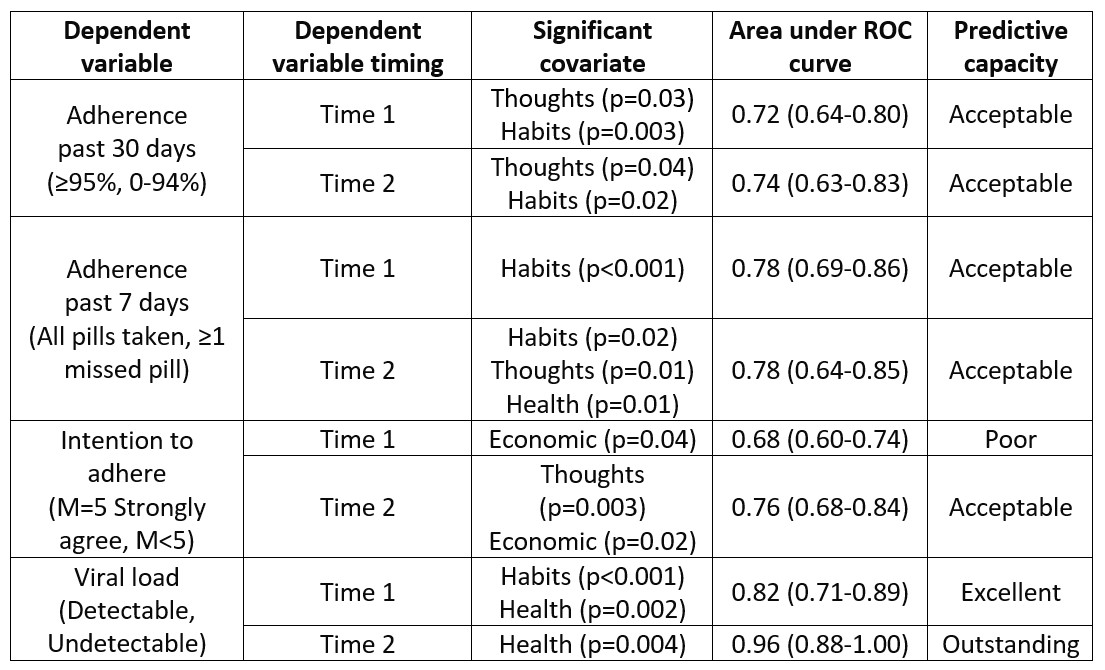
Analyses included 265 PHIV at Time 1 and 154 at Time 2. Correlation coefficients ranged from 0.33 to 0.68; hence, no item was considered for elimination. Table 1 shows all other statistical analyses. The items (covariates) of “Thoughts”, “Habits”, “Health” and “Economic status” were significantly and independently associated with from 1 to 3 dependent variables. The ROC analyses showed the 7-item models’ predictive capacity to be “excellent” to “outstanding” for viral load, correctly classifying over 80% of respondents. The models were also “acceptable” for Adherence in the past 30 days and past 7 days, correctly classifying at least 72% of respondents.
Conclusions:
While there was sample attrition from Time 1 to Time 2, no negative impact on the models’ predictive capacity was observed. The 7-item I-Score is a promising, simple, valid, and comprehensive tool to evaluate ART adherence barriers in care. Its items show limited redundancy, and the analyses provide strong evidence of concurrent and predictive validity for viral load.
Table 1. Results of the eight logistic regressions and ROC curve analyses for the 7-item I-Score.