Background:
Phenotyping to identify susceptibility to broadly neutralizing antibodies (bNAbs) is costly and logistically challenging, and simple clinical markers to predict bNAb treatment success for children are needed. The combination of a negative qualitative HIV DNA and negative enzyme immunosorbent assay (EIA) at study entry was previously reported to correlate with success in the Tatelo Study in Botswana. We now report findings for additional biomarker combinations, at entry to and during the bNAb-only step of the study.
Methods:
Twenty-five children received up to 24 weeks of bNAb-only treatment (VRC01LS+10-1074) following ART interruption. HIV qualitative DNA and HIV RNA were performed every 1-2 weeks and EIA every 4-8 weeks. Using Fisher’s exact test we compared the proportion of infants who remained virally suppressed to < 400 copies/mL (successes) to those with detectable virus by assay type.
Results:
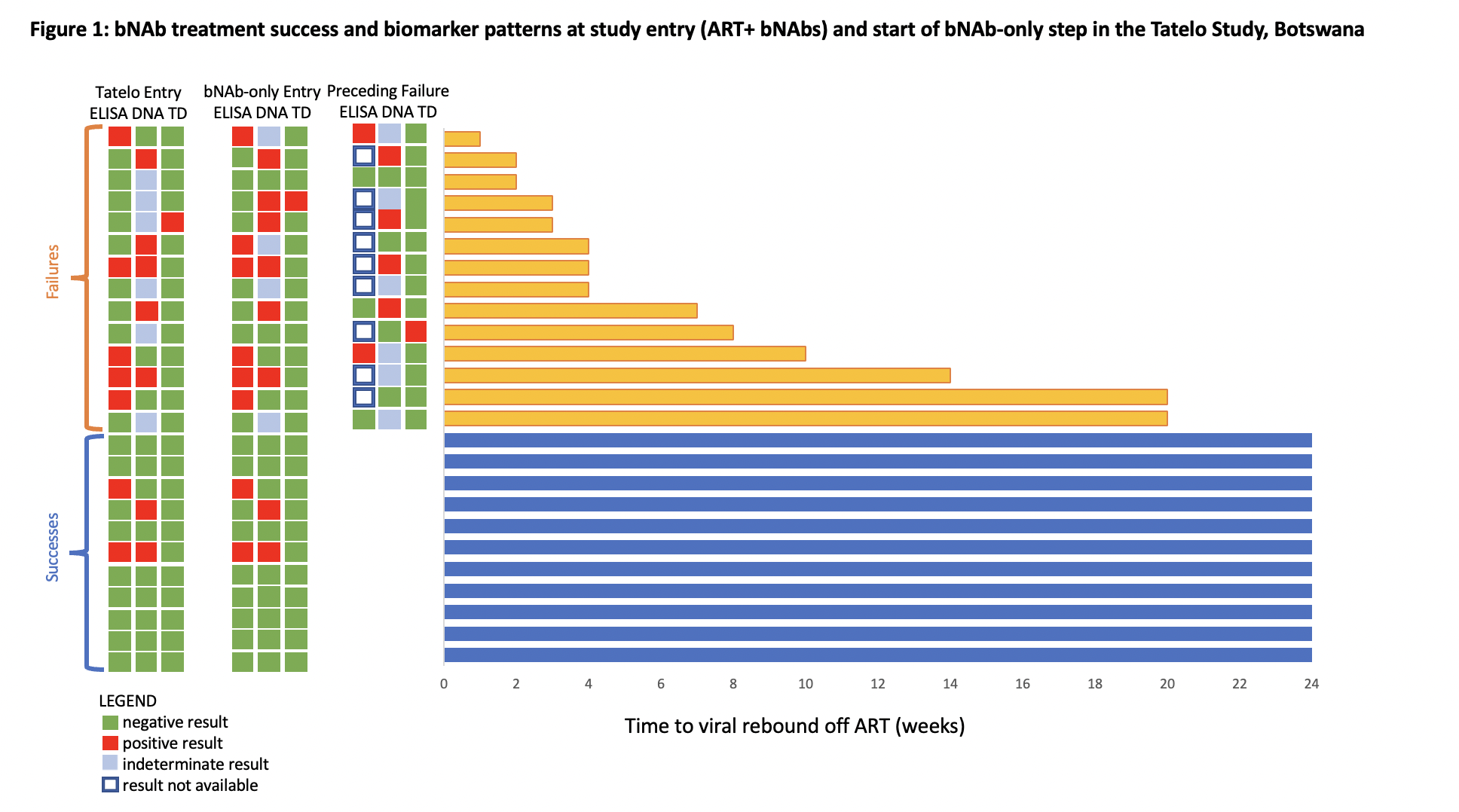
During the bNAb-only step of Tatelo there were a median of 8 qualitative HIV DNA measurements, 12 HIV-1 RNA ‘target detection’ measurements, and 4 EIA measurements per participant available for analysis. At bNAb-only step entry, 13/25 (52%) had negative qualitative DNA and 17/25 (68%) had negative EIA, and 10/25 (40%) were negative for both. Nine of the 13 (69%) with negative qualitative DNA succeeded compared with 2/12 (17%) with positive or indeterminate qualitative DNA (p=0.02). Nine of the 17 (53%) with negative EIA succeeded compared with 2/8 (25%) with positive EIA (p=0.23). Combining biomarkers, 8/10 (80%) who were negative/negative at bNAb-only entry succeeded, compared with 3/15 (20%) with any other pattern (p=0.005); all 8 successes (and no failures) were also negative/negative at study entry (the bNAb+ART overlap step), as previously reported. HIV-1 RNA ‘target detection’ was below the assay limit in all but one participant at the start of the bNAb-only step. In the visit immediately prior to any viral rebound, target detection occurred in only 1/14 (7%) participants (Figure 1). No marker or combination of markers reliably changed in the 3 visits prior to rebound.
Conclusions:
Negative qualitative DNA, and especially negative/negative DNA and EIA, at start of bNAb-only treatment predicted maintenance of viral suppression among children on dual bNAbs. HIV-1 RNA target detection below the assay limit did not prove to be a predictive biomarker, and no biomarker combination was clinically useful in the visits preceding failure.