Background:
Eight weeks of daily, oral glecaprevir (G) and pibrentasvir (P) cures 98% of people with chronic Hepatitis C Virus (HCV) infection. However, major challenges, including medication adherence and loss of patients to follow-up, impede delivery of this combination. As such, 58 million people remain infected worldwide. A long-acting injectable (LAI) providing 8 weeks of pharmacokinetic exposure from a single administration would overcome many of these challenges by providing a one-shot cure. Moreover, G and P possess key physicochemical and pharmacokinetic properties shared by other LAI paradigms.
Methods:
G and P were co-formulated as a fixed dose combination LAI (250 mg/mL G, 250 mg/mL P). Dosing volumes of 0.075, 0.15 and 0.3 mL (representing active doses of 18.75, 37.5 and 75 mg) were administered to male Sprague Dawley rats (n = 4, 250-300 g) via intramuscular injections to the thighs. Plasma samples were collected from the tail vein over 13 weeks and livers were harvested at the end of the study. G/P concentrations were quantified in plasma and liver using validated LC-MS/MS.
Results:
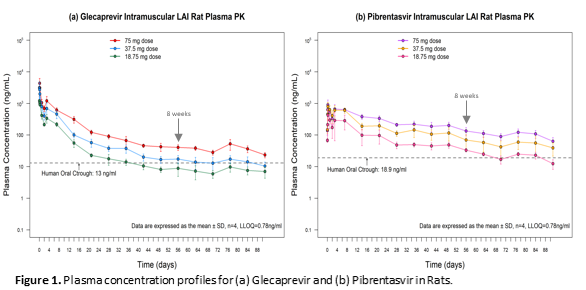
Rat plasma concentration-time profiles for G and P demonstrated a dose-proportional increase in exposure (Fig. 1) with dose-linear increases in AUC for both G and P (AUC0-tlast, 106, 220 and 390 µg·h/ml [G] and 157, 346 and 513 µg·h/ml [P] at 18.75, 37.5 and 75 mg doses, respectively). A less-than-dose-proportional increase in Cmax was observed (1203, 3033 and 4334ng/ml [G] and 428, 799 and 907ng/ml [P] at 18.75, 37.5 and 75 mg doses, respectively). Doses of 37.5 and 75 mg maintained plasma exposures above the reported median human Ctrough for the oral product. For the 18.75 mg dose, G and P concentrations remained above the human Ctrough for 5 and 11 weeks, respectively. Liver:plasma concentration ratios were comparable to those previously reported after oral administration to rats for both drugs. No behavioural issues were encountered, animals gained weight throughout and no overt injection site issues were visible upon inspection.
Conclusions:
Preclinical data for a novel G/P LAI demonstrate sustained therapeutic concentrations in rats over a period of 13 weeks, exceeding the 8-week human target duration. Parenteral administration did not adversely affect hepatic penetration in comparison to the oral route. Further work is required to optimise drug ratios and confirm safety through GLP toxicology assessments to support first-in-human evaluation.