Background:
Long-acting injectable cabotegravir (CAB-LA) demonstrated superiority to daily oral tenofovir disoproxil fumarate/emtricitabine (TDF/FTC) for HIV pre-exposure prophylaxis (PrEP) in two clinical trials. It is recommended by WHO as an additional prevention choice for people at substantial risk of HIV infection. HIV Modeling Consortium and HPTN Modeling Center conducted a comparative modelling analysis of the potential impact of expanding PrEP coverage by offering CAB-LA to men and women in South Africa.
Methods:
Three independent age- and risk-stratified HIV transmission models (Synthesis, EMOD and Thembisa) were parameterised and calibrated to local data from South Africa. Expanding population PrEP coverage to 5 or 10% after 5 years were simulated by recruiting additional users based on model-specific targeting of PrEP use by risk. Models assumed 95% CAB-LA effectiveness based on HPTN 083 and model-specific TDF/FTC effectiveness. Population impact and efficiency of PrEP expansions were evaluated over 20 years compared to base-case scenarios assuming negligible TDF/FTC use.
Results:
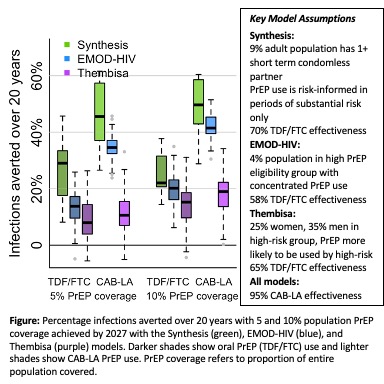
In the base-case scenarios with no PrEP expansion, median overall PrEP coverage in South Africa is currently < 1% and is modelled to remain < 1% by 2042. Achieving 5% PrEP coverage with CAB-LA by 2027 may avert 45% of new infections between 2022-2042 when use is assumed to be available to all but concentrated amongst people in periods of substantial risk (Synthesis), 35% of new infections when targeted to high risk groups (EMOD), and 11% of new infections if CAB-LA is available to all but more likely to be used by high-risk individuals (Thembisa). Increasing CAB-LA coverage to 10% under the same conditions may avert 50% (Synthesis), 42% (EMOD), and 18% (Thembisa) of new infections. A 5% expansion with oral TDF/FTC instead of CAB-LA would be expected to reduce the impact by 18 percentage points (pp) (Synthesis), 21pp (EMOD), and 2pp (Thembisa) due to lower assumed TDF/FTC effectiveness. With better risk targeting, PrEP expansions would require only 18 (Synthesis) and 14 (EMOD) additional person-years (PYs) on CAB-LA to prevent one infection, compared to 67 PYs if CAB-LA is less risk-targeted (Thembisa).
Conclusions:
Our analysis suggests that offering CAB-LA in South Africa may impact the HIV epidemic substantially if it results in higher PrEP coverage and is adequately used by people at high risk of acquiring HIV. Expanding PrEP could be highly efficient if predominately used during periods of substantial risk.
Percentage infections averted over 20 years with 5 and 10% population PrEP coverage achieved by 2027.