People with HIV (PWH) on antiretroviral therapy (ART) still experience an increased risk of morbidity and mortality, which is partly driven by chronic inflammation. We previously demonstrated that soluble galectin-9 (Gal-9), a pleiotropic glycan-binding immunomodulatory protein, is elevated in PWH on ART and associated with markers of HIV persistence, neurological complications and indices of morbidity and mortality in HIV infection. Here, we aimed to identify relationships between Gal-9 and the occurrence of non-AIDS events (NAEs) in PWH on suppressive ART, utilizing a nested case-control study from the AIDS Clinical Trials Group ALLRT cohort.
Study participants were evaluated at baseline (pre-ART; 66 cases, 97 controls), 1 year post-ART (112 cases, 211 controls), and immediately preceding an event (89 cases, 162 controls). NAEs (cases) include myocardial infarction/stroke, malignancy, serious bacterial infection, and non-accidental death. Matched controls had an event-free follow-up equal or greater than that of the relevant case. All participants were virally suppressed by ART by year 1 and matched for age (within 10 years, median 45 years), sex (84% male), pre-ART CD4+ T cell count (within 50 cells/mm3, median 213 cells/mm3), ART regimen at 1 year, and parent study. Gal-9 levels in plasma were assessed by ELISA. Conditional logistic regression analysis assessed associations of Gal-9 with NAEs. Spearman correlations assessed associations between biomarkers among the controls.
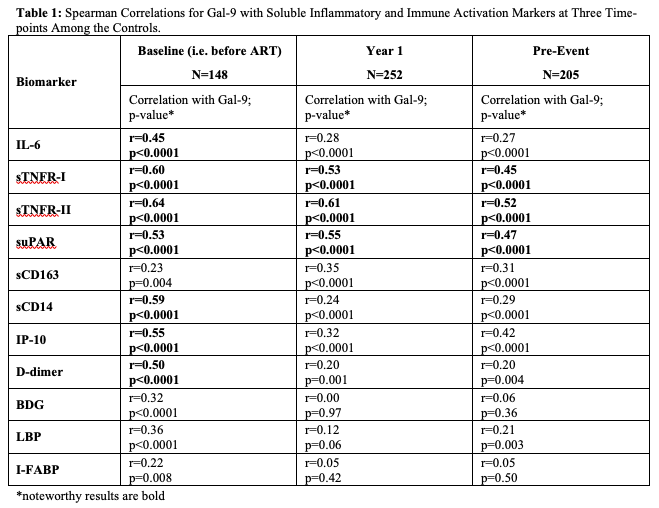
Higher plasma levels of Gal-9 were associated with increased risk of NAEs at year 1 and pre-event (unadjusted OR per 1 IQR (95% CI) = 1.4 (1.0, 1.9), p=0.04 and OR=1.6 (1.0, 2.3), p=0.03). Association at year 1 remained significant with adjustment for CD4 count. Higher levels of Gal-9 were associated with specific NAEs, MI/stroke (OR= 1.9) and death (OR=2.8) at year 1 and malignancy (OR=1.8) pre-event. Gal-9 also correlated with markers previously assessed to be predictive of NAEs, including sTNFR-I, sTNFR-II, and suPAR, at each timepoint (all r?0.45, p<0.0001).
Elevated plasma Gal-9 levels are predictive of NAEs; due to the pleiotropic nature of Gal-9 it may be an ideal target for intervention to help attenuate chronic immune activation and, as a result, lessen the risk of morbidity during suppressive ART.