Background:
In the countries of Eastern Europe (Russia, Belarus, Ukraine), where the HIV-1 epidemics are expanding, the A6 variant remains predominant. After the initiation of the war in Ukraine, Poland has become the principal refuge for Ukrainian citizens; however, migration from this country has been common over the last decade. Evolutionary analyses of viral sequences provide insights into migration events. The aim of this study was to explore the transmission dynamics of the HIV-1 A6 variant between Poland and Ukraine.
Methods:
HIV A6 partial pol sequences from Poland (n=1185) and Ukraine (n=653) were combined with a background dataset of 7665 publicly available sequences from 37 other countries. We used maximum-likelihood phylogenetics and Bayesian inference to identify putative transmission clades. Clades were analyzed in an asymmetric discrete phylogeographic model to characterize HIV migration events (adjusted Bayes factor ≥3) between administrative regions of Poland and Ukraine.
Results:
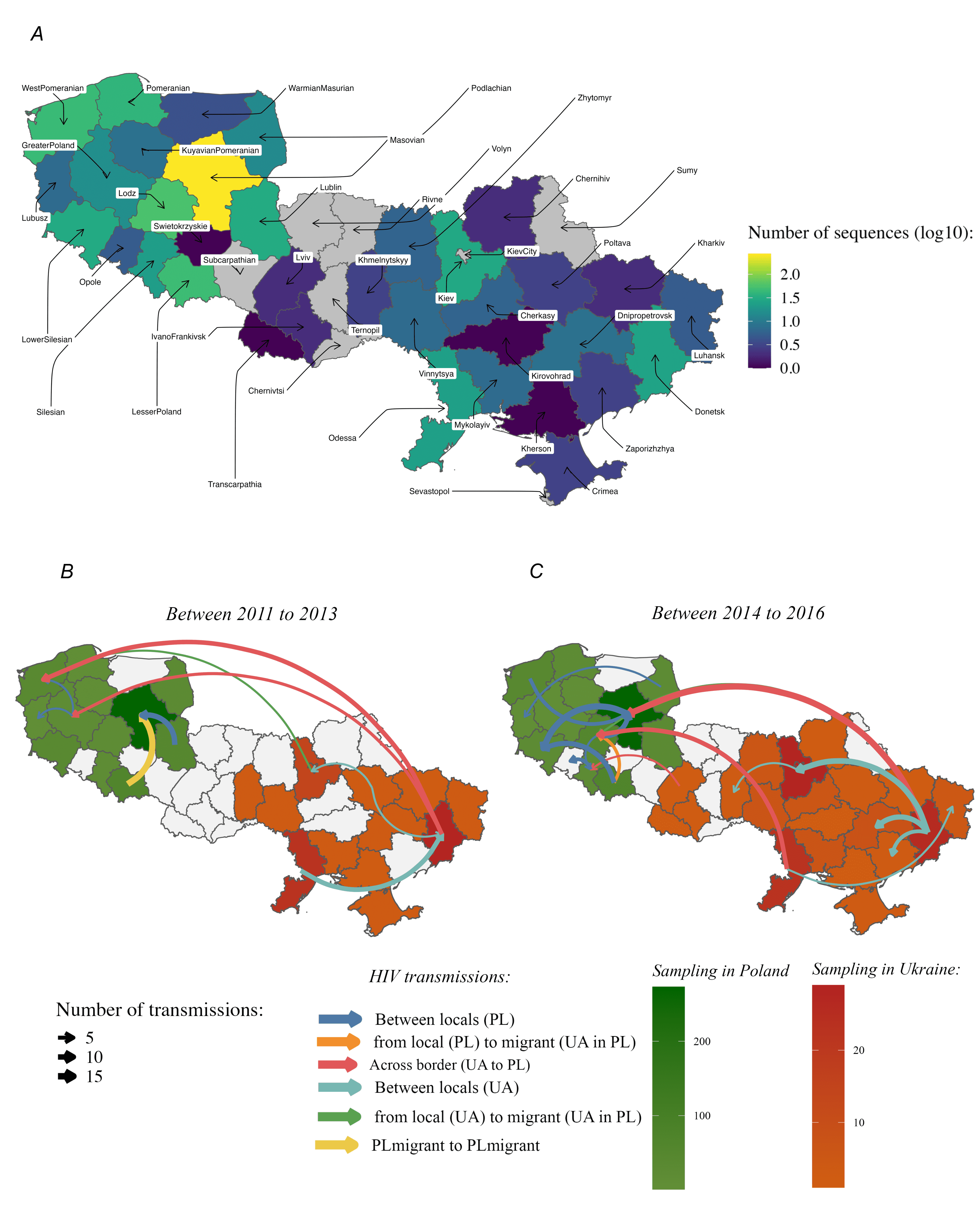
We identified 206 clades (n=1,362 sequences), of these, 63 were binational, containing both Polish and Ukrainian sequences. Migration events were almost exclusively unidirectional from Ukraine to Poland (99.4%). Multiple cross-border migrations were mainly from East and South Ukraine to Central and Western Poland. Donetsk and Odessa regions were the primary source (49.7% and 17.6%, respectively) of the variant dispersal. The most frequent destinations were in Masovian, the highest populated region where Warsaw, the largest city and also the capital of Poland, is located (67.3%); next in Lodz (18.2%); and West Pomerania (10.1%) states. Migration events started to increase in 2011 and remained stable until 2016, at the time of the initial war in the Donetsk region.
Conclusions:
The most common HIV-1 A6 variant migration events to Poland were from Eastern Ukraine long time affected by the Russian-Ukrainian armed conflict. Geospatial A6 transmission networks are expanding in Poland, sustained by local viral dispersal and cross-border migration originating from Ukraine. More introductions are expected since the initiation of war in 2022, which may notably increase the burden of HIV in Central and Western European countries. There is an urgent need for expanded HIV diagnostics and antiretroviral treatment initiations among war-displaced populations to reduce the transmission networks.
Sampling density and phylodynamics of HIV A6 variant between Poland and Ukraine A. Sampling density of HIV-1 A6 variant. Regions with a lack of sequences were depicted in grey; Migration events between regions in Poland and Ukraine through time B. between 2011 and 2013; C. between 2014 and 2016. The thickness of the arrows corresponds to the average number of inferred migration events. Inward movements between a particular group and location are depicted in the same color. Regions are colored according to the number of sequences included in the clade. Phylogeographic inference was performed using the asymmetric discrete phylogeographic model implemented in the BEAST 1.10.5 software package