Background:
IMPAACT P1078 evaluated the safety of isoniazid (INH) preventative therapy initiated antepartum (AP) or postpartum (PP) in women with HIV (WWH). Hepatotoxicity occurred at high rates (~6-7%) across both arms during the PP period and a higher risk of adverse pregnancy outcomes was also identified among N-acetyltransferase type 2 (NAT2) slow acetylators. These adverse outcomes may be due in part to toxic INH metabolites, such as hydrazine (Hz), which have not been previously evaluated in pregnancy. INH can either be converted to acetylisoniazid (AcINH) via NAT2 and then acetylhydrazine (AcHz), or to isonicotinic acid (INA) via amidases, with both pathways contributing to Hz formation. Here we describe the PK of INH, INA, AcINH, AcHz, and Hz in AP and PP WWH receiving IPT.
Methods:
Samples and data from intensive PK assessments among WWH enrolled in P1078 were included in the analysis. WWH received INH 300 mg once daily for at least 2 weeks prior to the intensive PK assessment. Samples were collected at 0, 1, 2, 4, 6, 8 and 12 h post-dose. Intensive PK during AP occurred ≥28 weeks of gestation and 16 (±2) weeks PP. INH, INA, AcINH, AcHz, and Hz were quantified using a validated LC-MS/MS method (lower limit of quantification 10 ng/mL for all analytes). PK data were analyzed using noncompartmental methods. Data were summarized descriptively by pregnancy stage and NAT2 acetylation status (fast, intermediate, slow). Linear mixed models were used to compare percent differences (95% confidence intervals [CI]) between AP vs. PP for each analyte.
Results:
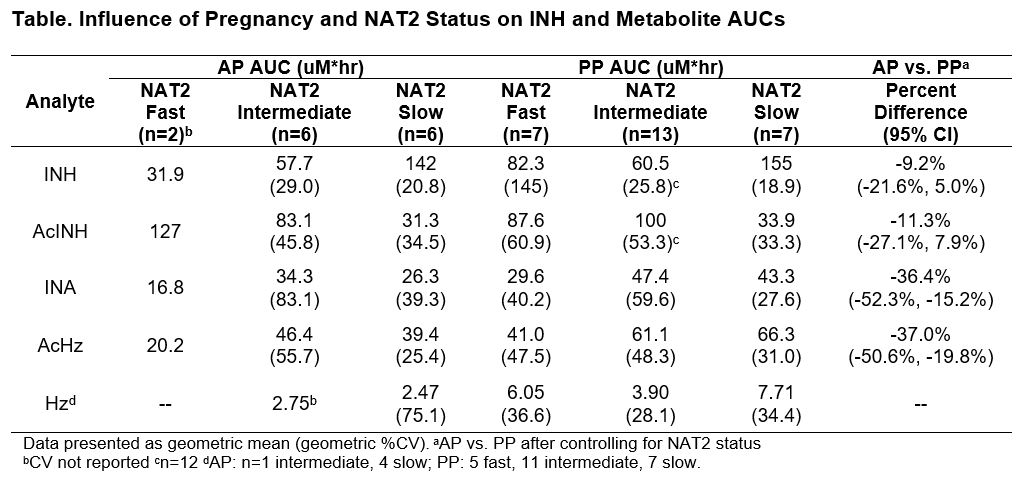
Data from 31 WWH were analyzed (10 AP and PP, 4 AP only, 17 PP only). The median (range) gestational age at entry was 26 (14-34) weeks. Maternal median (range) age was 29 (18-41) years with 81% Black and 19% Asian. Observed AcINH exposures were higher among intermediate and fast acetylators, whereas INH, INA, and AcHz exposures were higher in intermediate and/or slow acetylators (Table). INA and AcHz were lower AP versus PP after controlling for NAT2 status. Hz was quantifiable in 5/14 AP and 23/27 PP WWH, with numerically higher AUCs observed PP.
Conclusions:
These data demonstrate relationships between NAT2 and the formation of INH metabolites in pregnant and postpartum WWH. INA and AcHz AUCs were higher and Hz was detectable in more women during PP. Analyses to examine the influence of pregnancy and other factors affecting INH metabolite PK in the overall study population and potential associations with hepatotoxicity in P1078 are ongoing.