Background:
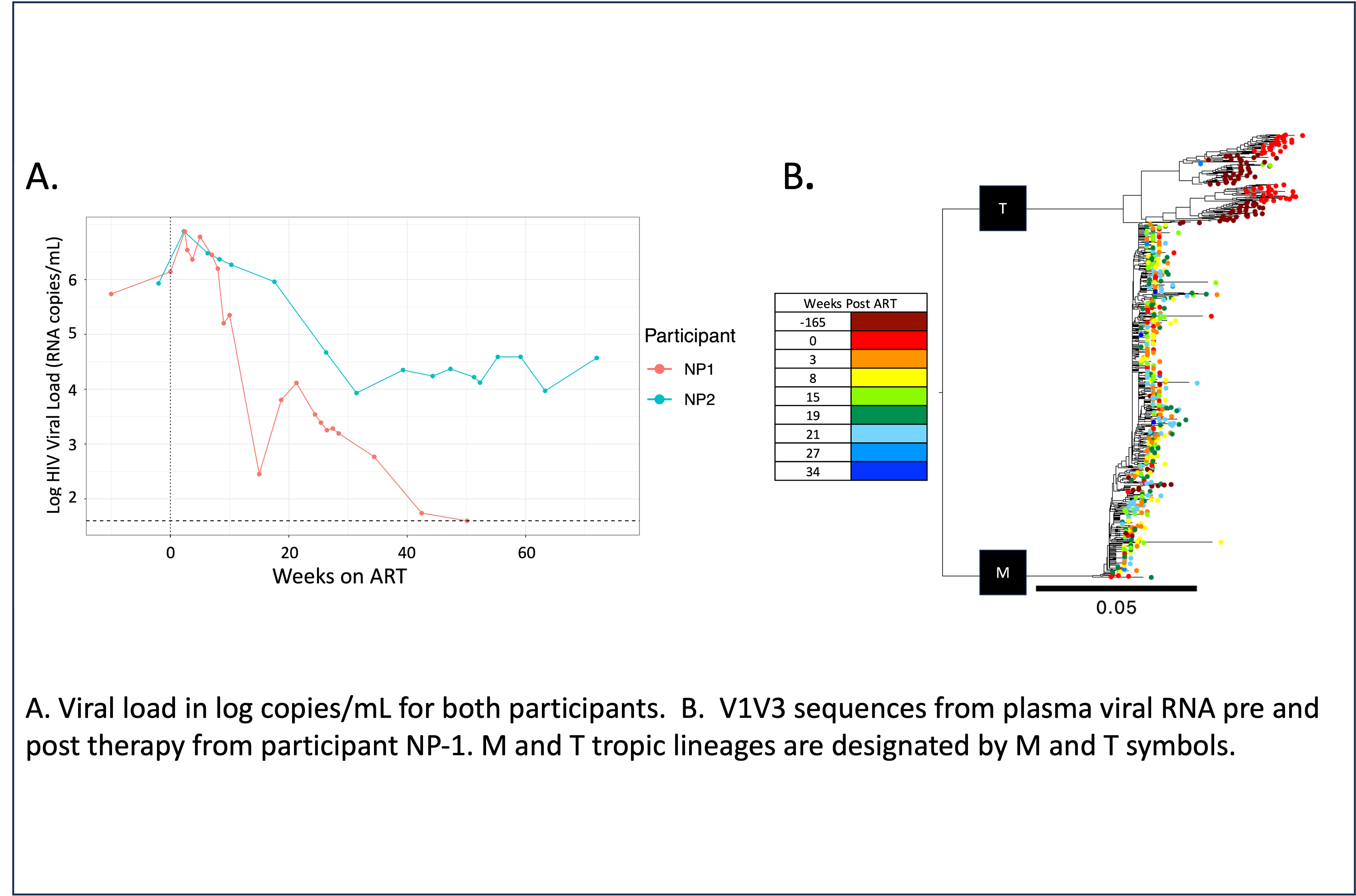
Antiretroviral therapy (ART) usually suppresses plasma HIV-1 RNA to limits of detection within months of initiation. Rarely, persistent low-level viremia occurs despite good ART adherence due to viral release from a large, clonally-expanded reservoir of HIV-infected CD4 cells. We describe two PWH on ART with persistent, high-level viremia that failed to fully suppress for >10 months, and was associated with persistent macrophage-tropic virus.
Methods:
Two PWH (NP1, NP2) initiated ART with high HIV-1 viral load and low CD4 counts. Both were adherent to ART regimen, by observation and drug levels and no evidence of resistance emergence by Sanger and deep sequencing. Plasma samples were collected from both participants, and total PBMCs from one. Viral RNA was sequenced using MiSeq with Primer ID on portions of pol and the env V1/V3 region. Near-full length sequencing was conducted on proviral DNA from PBMCs and viral RNA from the plasma. Full length env were cloned from plasma RNA and proviral DNA for pseudoviral assays to assess infection efficiency at low CD4 density as a predictor of macrophage tropism.
Results:
No DRMs were detected in either participant and a diverse plasma RNA population was seen in the V1V3 region. In NP1, a viral lineage representing ~50% of the total sequences rapidly declined, leaving a single, diverse persistent lineage, with no evidence of ongoing replication. In both participants, pseudoviruses generated from HIV envelopes of the persistent viremia were able to infect Low CD4 density cells to a similar degree as other described macrophage tropic viruses. In NP1, the plasma viral lineage that disappeared with ART initiation and that was present in total PBMC DNA did not infect at low CD4 density, consistent with T cell tropic viruses. Sequencing of PBMC DNA in NP1 found 2% of proviruses recovered were of the macrophage tropic lineage. Viral integration site analysis suggested intact proviral DNA from PBMCs was not clonal. Curiously, in this participant all M-tropic viruses were also found to have mutations in Vpr that abolished its open reading frame.
Conclusions:
We describe two PWH with persistent high-level plasma viremia derived likely from infected macrophages with a long half-life, with additional studies being explored to confirm this. This has both clinical significance as the treatment regimens are still effective at preventing further infection, and has implications to the persistence of the reservoir in long-lived macrophages.