Background:
Young women have high HIV incidence and risk for unintended births in sub-Saharan Africa. Women congregate regularly in hair salons; these may be useful community settings for providing HIV prevention and family planning. Our objective was to assess PrEP and contraceptive persistence following dispensing in hair salons in South Africa.
Methods:
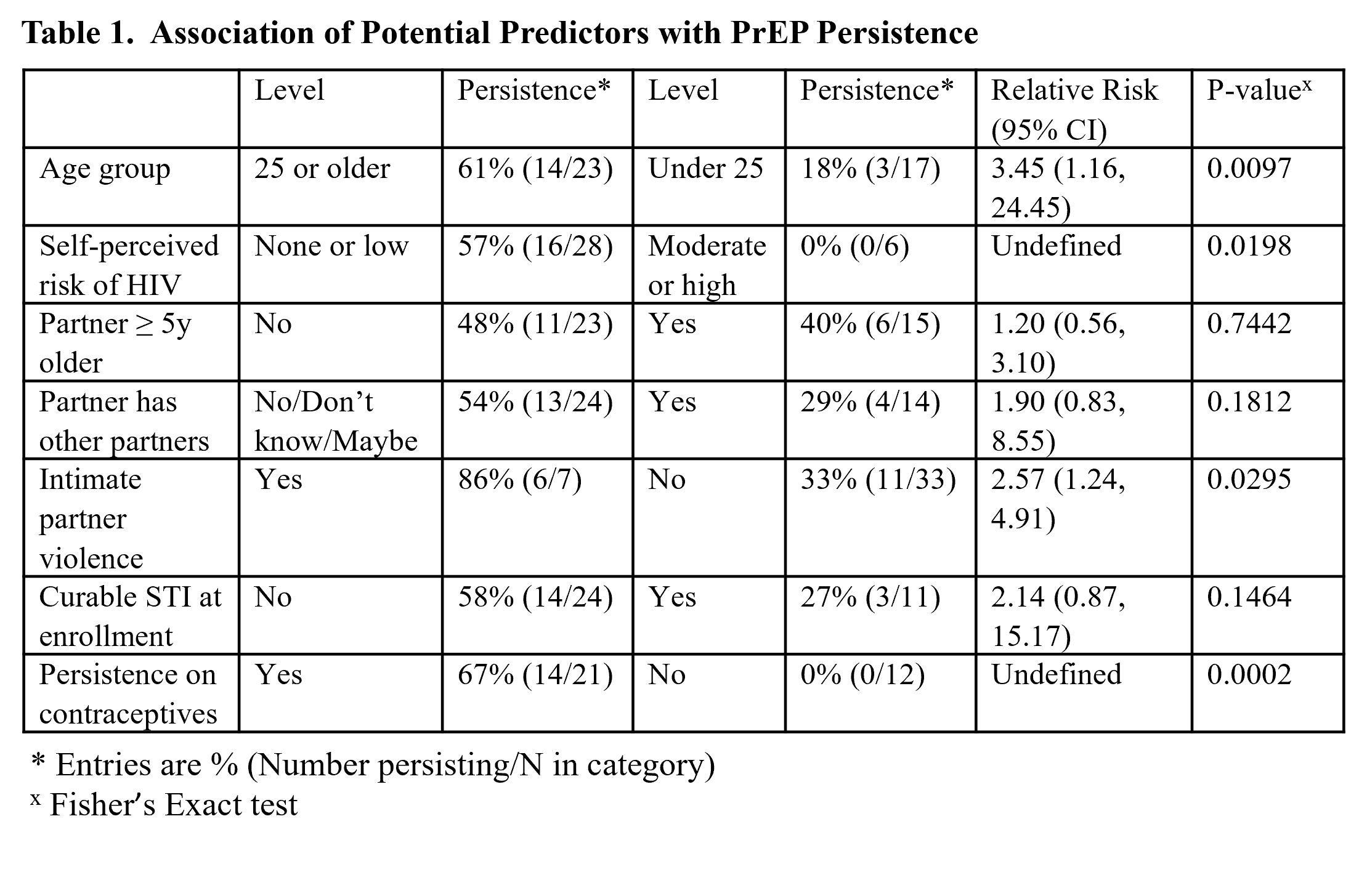
We conducted a pilot randomized trial to evaluate uptake and persistence of a nurse-supported intervention offering PrEP (TDF-FTC) and contraception (oral/injectable) in 5 salons in urban KwaZulu-Natal. Women could start PrEP and/or contraception at the initial visit or opt in at a later visit. We defined persistence as one additional visit within 6 months with continued treatment (PrEP, contraception, or both). We assessed the association of PrEP persistence among intervention participants using contingency tables. Factors assessed included age, self-perceived risk of HIV, partner ≥5y older, primary sex partner having other partners, intimate partner violence, curable STI at enrollment, and persistence on contraception.
Results:
Among 125 participants in the intervention salons, median age was 26y (IQR 22-29). 93 (75%) reported visiting the salon at least every 2 months; 34 (27%) were taking hormonal contraception at enrollment. 25 (28%) described themselves as having moderate or greater chance of getting HIV in the next year and 35 (32%) think their primary sex partner has other partners. 46 (37%) initiated PrEP during the study; among the 40 returning for at least 6 months of follow-up, 17 (43%) persisted. 39 (31%) opted for oral contraception and 77 (62%) for injectable contraception; among the 94 with at least 6 months follow-up, 66 (70%) persisted on contraception. Persistence on salon-based PrEP was associated with age ≥25y (RR: 3.45 [95% CI: 1.16,24.5]) and intimate partner violence (2.57 [1.24,4.91]). PrEP persistence was also related to no/low perceived risk of HIV and contraceptive persistence (RR undefined).
Conclusions:
Young women in South Africa found receipt of HIV prevention services and family planning in a hair salon acceptable over time, with persistence for contraception (70%) greater than for PrEP (43%). Factors related to PrEP persistence include age ≥ 25y, intimate partner violence, a low or no perceived risk of HIV, and persistence on contraceptives. Hair salons are a novel venue for delivering long-term sexual reproductive health services, however, a menu of PrEP delivery methods may be required to support persistence.