Background:
Individuals who recovered from tuberculosis disease (post-TB) remain at increased risk of cardiovascular events and mortality. However, the underlying mechanisms of cardiovascular disease in post-TB remain unknown. Here, we aimed to characterize the immune profile of Mtb-specific CD4+ T cells in post-TB and explore their relationship with coronary artery disease (CAD).
Methods:
We conducted a cross-sectional study of individuals 40 to 70 years of age with latent TB infection (LTBI), TB patients on isoniazid/rifampin consolidation treatment (TB-on-treatment); and clinically-cured individuals within one year of TB treatment completion (post-TB) between March 2018 and October 2019. Participants completed a coronary tomography angiography to assess CAD and provided blood for immune profiling of Mtb-specific CD4+ T cells using flow cytometry. Mtb-specific T cells were defined based on IFN-γ, IL-2, or TNF-α intracellular cytokine production upon in vitro PBMC stimulation with CFP-10/ESAT-6 or Mtb-whole-cell-lysate.
Results:
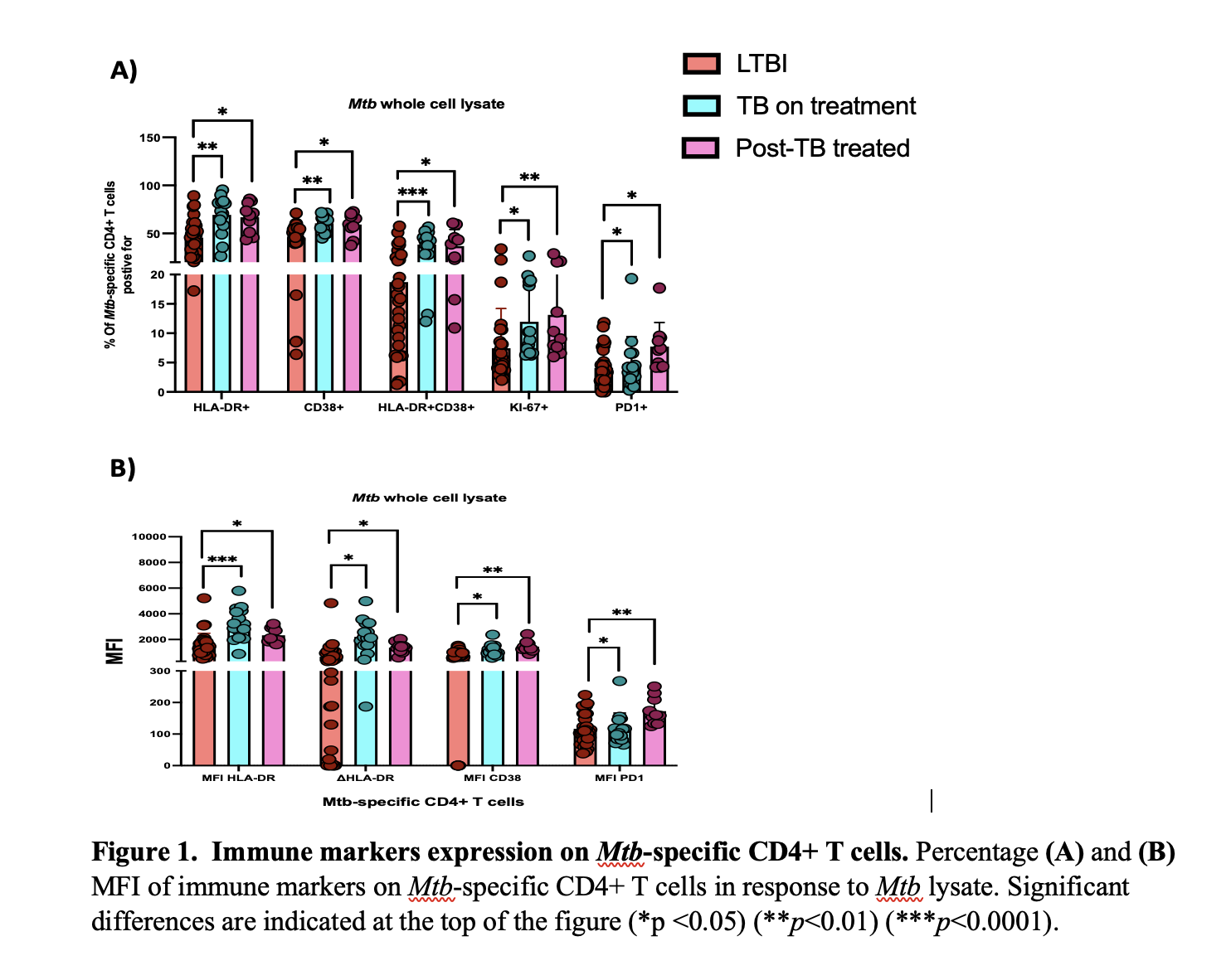
41 LTBI, 24 TB-on-treatment, and 11 post-TB participants without HIV were included in this analysis. After PBMC stimulation with Mtb-lysate, TB-on-treatment and post-TB patients exhibited higher percentage of Mtb-specific CD4+ T cells compared to LTBI (1.35 vs. 1.55 vs. 0.69; p=0.006). The percentage and MFI of activation markers HLA-DR, CD38, and delta HLA-DR (CD4minusMtb) were higher on Mtb-specific CD4+ T cells from TB-on-treatment and post-TB patients upon CFP-10/ESAT-6 and Mtb-lysate stimulation. Compared to LTBI, percentage of KI-67 and PD1 expression on Mtb-specific CD4+ T cells were increased in TB-on-treatment and post-TB upon Mtb-lysate stimulation (Figure 1). Polyfunctionality analyses revealed that TB-on-treatment participants exhibited a higher percentage of Mtb-specific CD4+ T cells positive to ≥2 cytokines upon Mtb-lysate stimulation, compared LTBI and post-TB participants. TB-on-treatment and post-TB individuals with CAD had higher MFI of PD1 on Mtb-specific CD4+ T cells, compared to those without CAD (181.5 vs. 123; p=0.022). Similarly, MFI of PD1 on Mtb-specific CD4+ T cells from TB-on-treatment and post-TB individuals positively correlated with CAD-RADS score (Spearman rho=+0.502; p=0.017).
Conclusions:
Despite clinical TB cure, individuals post-TB exhibited signs of persistent immune activation and exhaustion of their Mtb-specific CD4+ T cell population. PD1 expression on Mtb-specific CD4+ T cells was associated with CAD during TB treatment and post-TB.