Background:
Simple serological scores, such as the hepatic steatosis index (HSI) and fatty liver index (FLI), have been proposed for the detection of liver steatosis, but their prognostic value in people living with HIV (PLWH) remains ill-defined. We assessed their diagnostic performance in patients on antiretroviral therapy (ART) in the Swiss HIV Cohort Study (SHCS).
Methods:
We included consecutive participants at Bern University Hospital with available transient elastography (TE) and parameters for the calculation of both scores between November 2019 and August 2021. Individuals with active or past viral hepatitis co-infection and pregnant women were excluded. We defined severe hepatic steatosis (S3) as controlled attenuation parameter (CAP) ≥280dB/m using TE. HSI (gender, BMI, AST, ALT and diabetes) and FLI (waist circumference, BMI, triglycerides and GGT) were calculated and validated diagnostic thresholds for steatosis were considered (HSI ≥36 and FLI ≥60). We calculated sensitivity, specificity and the area under the receiver operating curve (AUROC) of both biomarkers for diagnosing severe liver steatosis.
Results:
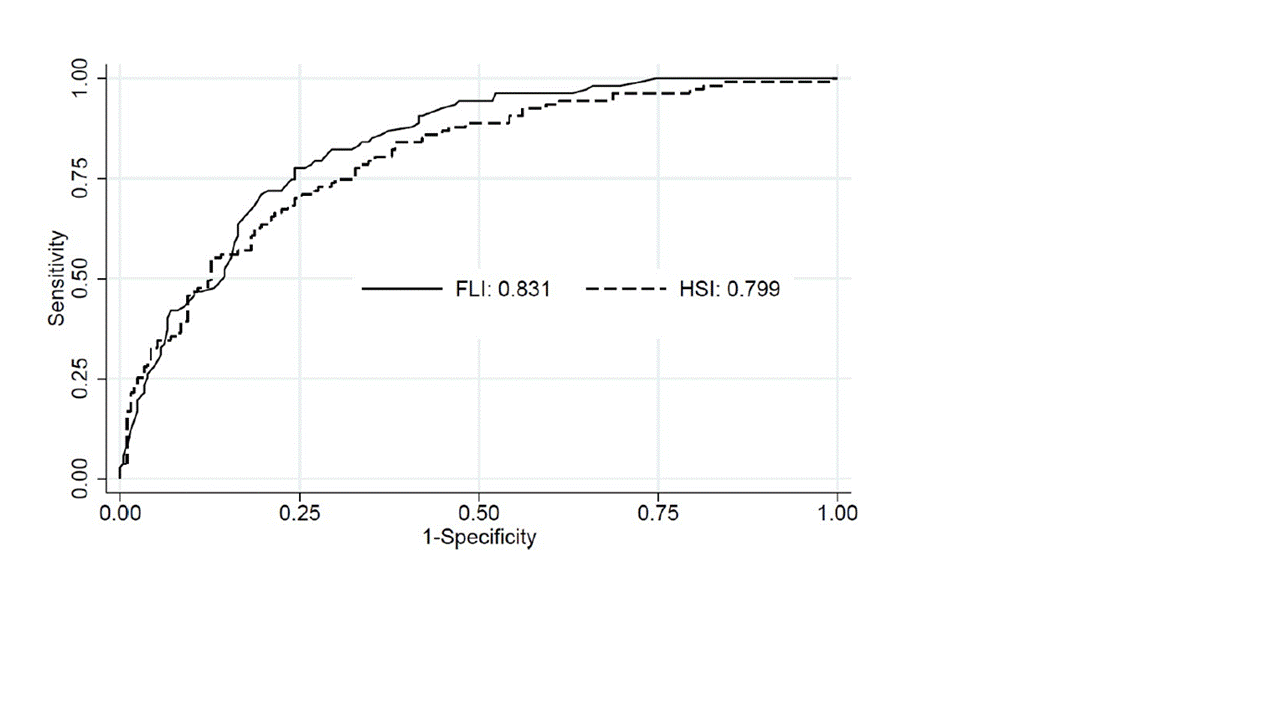
Of 418 eligible individuals, 321 (76.8%) had measured biomarkers and a reliable TE measurement. Their median age was 51.4 years (interquartile range [IQR] 42-59), their median CD4+ count 757 cells/μl (IQR 546-933), 91 (28.4%) were female, 230 (71.7%) Caucasian, and 164 (51.1%) overweight (BMI ≥25kg/m2). At time of TE, participants had been on ART for a median of 12.3 (IQR 6-19) years, 225 (70.1%) had been exposed to integrase strand inhibitors (InSTI) and 184 (57.3%) to tenofovir alafenamide (TAF). Overall, 107 (33.3%) participants had severe steatosis based on TE, 128 (39.9%) had a HSI ≥36 and 125 (38.9%) FLI ≥60. The AUROC for severe steatosis was 0.80 (95% confidence interval [CI] 0.75-0.85) using HSI, and 0.83 (95% CI 0.79-0.88) with FLI. HSI and FLI showed similar sensitivity (HSI: 70.1 vs. FLI: 72.0%) and specificity (HSI: 75.2 vs. FLI: 77.6) to detect severe steatosis in the whole study population. AUROC was highest for the diagnosis of severe steatosis among patients < 50 years (HSI: 0.86, 95% CI 0.79-0.93; FLI: 0.88, 95% CI 0.82-0.94), and lower for those ≥50 years (HSI: 0.79, 95% CI 0.72-0.85; FLI: 0.79, 95%CI 0.73-0.86).
Conclusions:
HSI and FLI can be used as simple diagnostic tools to detect liver steatosis in PLWH, with a higher accuracy in patients aged < 50 years.
Figure. 1 Receiver operator characteristic (ROC) curve for Fatty Liver Index (FLI, solid line) and Hepatic Steatosis Index (HSI, dashed line) for the detection of severe liver steatosis (S3) in the whole study population. Numbers represent the area under the curve (AUC) measures for steatosis classification.