Background:
The pharmacokinetics (PK) of cabotegravir (CAB) long-acting and rilpivarine (RPV) long-acting has not been prospectively studied in pregnancy. Physiologically-based pharmacokinetic models (PBPK) offer the ability to incorporate physiologic pregnancy-associated changes and drug specific characteristics to predict the concentration exposure during pregnancy.
Methods:
We used a published maternal-fetal PBPK model by Dallmann et. al. in Open Systems Pharmacology to predict concentrations of Cabotegravir (CAB) and Rilpivirine (RPV) after long-acting injection (LAI) in nonpregnant cisgender women during their 2nd and 3rd trimesters of pregnancy. This model was previously used to predict the maternal PK of Dolutegravir and Raltegravir and to verify the induction of UGT1A1 and CYP3A4 during the 2nd and 3rd trimesters. We obtained drug specific parameters for CAB and RPV from the published literature and used published clinical PK data for CAB and RPV (oral and IM) in nonpregnant, cisgender women to validate the nonpregnant PBPK model. We then extended the validated model to pregnancy and the PBPK model was utilized to simulate dose sequences in nonpregnant and pregnant individuals, including a loading dose paradigm, with monthly dosing up to 6 months.
Results:
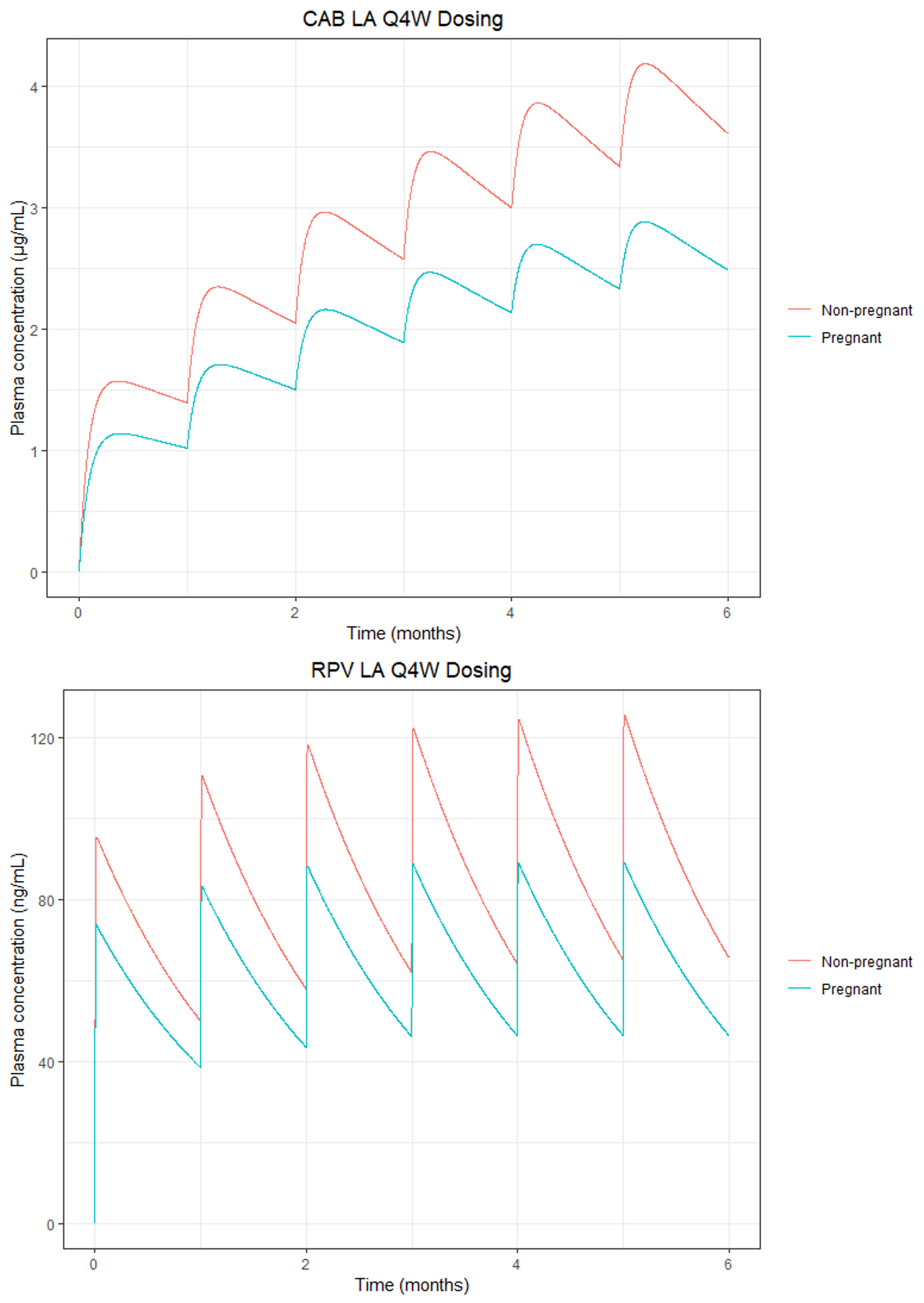
The simulation result using the maternal-fetal PBPK model is shown in figure 1. According to the simulation results, the trough concentrations after the 1st injection were 29.5% and 23.0% lower during pregnancy compared to outside of pregnancy for CAB and RPV, respectively. The trough concentrations after the 6th injection were 31.1% and 29.2% decreased for CAB and RPV, respectively.
Conclusions:
This maternal-fetal PBPK model predicts a reduction in plasma concentrations in the 2nd and 3rd trimesters for both CAB LA and RPV LA, attributed to the predicted induction of UGT1A1 and CYP3A4 during the 2nd and 3rd trimesters. Clinical trials of CAB LA and RPV LA in pregnancy populations are necessary to further evaluate the pharmacokinetics in the 2nd and 3rd trimesters.
Predicted PK of CAB LA and RPV LA in non-pregnant and pregnant patients