Background:
Transgender women (TW) bear a disproportionate burden of HIV and other STIs. There are limited data comparing the epidemiology of STIs between TW with HIV and TW without HIV. We describe the prevalence and patterns of STIs among TW in 6 eastern and southern US cities by HIV status.
Methods:
We analyzed baseline data collected between March 2018 and August 2020 among adult TW across 6 US cities screened for the LITE study (Nf1,018). Participants completed a sociobehavioral survey, oral HIV screening, and self-collected urine, anal, and neovaginal specimens for Chlamydia trachomatis (CT) and Neisseria gonorrhoeae (GC) testing, and provided sera for treponemal syphilis testing and rapid plasma reagin (RPR) testing with quantitative RPR titers. Sera were assayed for herpes simplex virus type 2 (HSV-2). The primary outcome was ≥1 bacterial STI (BSTI). We examined the association of HIV status with BSTI and conducted HIV-stratified analyses to identify correlates of BSTI. For each covariate of interest, we estimated adjusted prevalence ratios (aPR) via separate modified Poisson regression models adjusted for age, race, and geographic region.
Results:
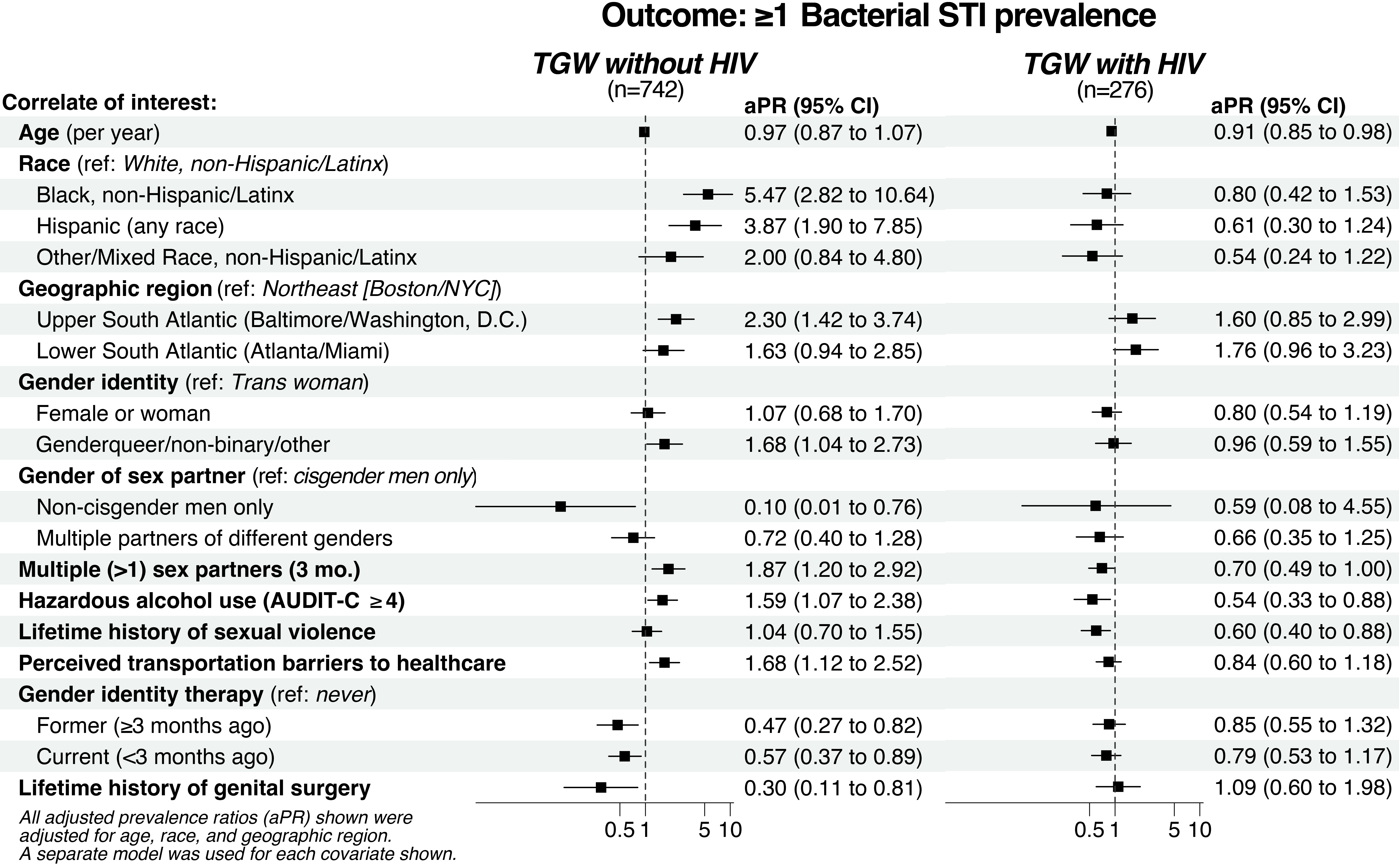
Compared to TW without HIV (n=742), TW with HIV (n=276) had a higher prevalence of ≥1 BSTI (11% vs. 33%; aPR=1.96 [95%CI=1.43-2.70]). BSTI prevalence included 4% CT, 2% GC, and 6% syphilis among TW without HIV, and 8% CT, 4% GC, and 28% syphilis among TW with HIV. Compared to TW without HIV, TW with HIV also had a higher prevalence of HSV-2 antibodies (30% vs. 82%; aPR=1.53 [95%CI=1.33-1.75]). Among TW without HIV, a higher prevalence of ≥1 BSTI was associated with living in the Upper South Atlantic region (vs. Northeast), identifying as Black and/or Latinx (vs. White), identifying as gender nonbinary/genderqueer (vs. trans woman), reporting >1 sex partner, hazardous alcohol use, and having safety concerns regarding transit to healthcare (Figure). Receipt of gender-affirming medical services (e.g., psychotherapy, surgery) was associated with lower BSTI prevalence. Among TW with HIV, older age, hazardous alcohol use, and a lifetime history of sexual violence was associated with lower BSTI prevalence.
Conclusions:
TW had a high prevalence of bacterial and viral STIs. STI prevalence was significantly higher in TW with HIV, and the correlates of BSTI prevalence differed by HIV status. Elucidating the drivers of STIs unique to TW with and without HIV will be key to informing tailored interventions and reducing sexual health-related inequities among TW.
Figure. Correlates of Bacterial STI prevalence stratified by HIV status.