Background:
Real world data on safety of antiretroviral drugs (ARVs) in pregnancy informs decision-making, but accumulating sufficiently large samples with specific periconception ARV exposure to rule out increased risk of rare birth defects, such as neural tube defects (NTDs), can take many years.
Methods:
We assessed risk of birth defects and other adverse outcomes following prenatal exposure to raltegravir (RAL) using pooled prospectively collected individual patient data from studies in the European Pregnancy and Paediatric Infections Cohort Collaboration (EPPICC). Pregnancies with any documented prenatal exposure to RAL and with outcomes in 2008-2020 were included. Earliest prenatal RAL exposure timing was classified as periconception (PC) (exposure at ≤6 completed gestational weeks [GWs]), later first trimester (later T1) (exposure in T1 at >6 completed GWs), and second/third trimester (T2/T3) (exposure at >12 completed GWs).
Results:
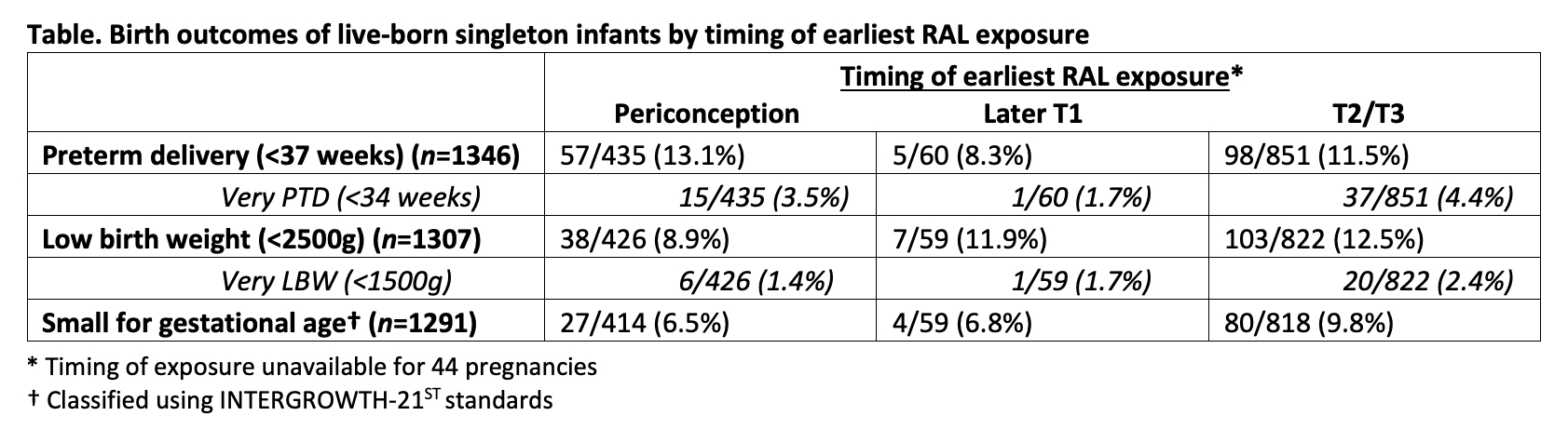
A total of 1499 pregnancies across 9 cohorts were included (1194, 79.7% from the UK). Most pregnancies were in women of Black (898/1480, 60.7%) or white (466/1480, 31.5%) ethnicity. Median age at conception was 32 years (IQR: 27-36). Half (763/1487, 51.3%) of RAL-exposed pregnancies were conceived on ARVs. There were 1429 live births (1466 live-born infants), 10 stillbirths, 41 spontaneous abortions, and 19 terminations. Among stillbirths, earliest RAL exposure was PC in 3, later T1 in 1, and T2/T3 in 6, with no defects reported. Birth outcomes of live-born singleton infants (1393) by timing of earliest RAL exposure are in the Table. Among all live-born infants (1466), earliest RAL exposure was PC in 466 (31.8%), later T1 in 62 (4.2%), T2/T3 in 892 (60.9%), and unknown in 46 (3.1%). Where data were available (1443/1466), 56 (3.9%, 95% CI 2.9, 5.0) live-born infants had a reported birth defect (9 had 2 defects), including 23/461 (5.0%, 95% CI 3.2, 7.4) of those with PC exposure; 38 (2.6%, 95% CI 1.9, 3.6) infants had defects per EUROCAT classification. Defects were in the following systems: heart (20), limb (16), CNS (5), genitourinary (4), gastrointestinal (2), oral facial cleft (2), ear, face and neck (1), respiratory (1), musculoskeletal (1), and other (13). One NTD was observed (spina bifida with PC exposure). Of the 5 neonatal deaths (2 with PC, 3 with T2/T3 exposure), 2 had defects.
Conclusions:
The birth defect rate in EPPICC is consistent with and contributes to the current evidence-base on safety of periconception RAL use.